Comparative Study
. 2011 Jan 18;108(3):1028-33.
doi: 10.1073/pnas.1008856108. Epub 2010 Dec 28.

Complex genetic, photothermal, and photoacoustic analysis of nanoparticle-plant interactions

Affiliations
Comparative Study

Complex genetic, photothermal, and photoacoustic analysis of nanoparticle-plant interactions

Mariya V Khodakovskaya et al. Proc Natl Acad Sci U S A. .

Abstract

Understanding the nature of interactions between engineered nanomaterials and plants is crucial in comprehending the impact of nanotechnology on the environment and agriculture with a focus on toxicity concerns, plant disease treatment, and genetic engineering. To date, little progress has been made in studying nanoparticle-plant interactions at single nanoparticle and genetic levels. Here, we introduce an advanced platform integrating genetic, Raman, photothermal, and photoacoustic methods. Using this approach, we discovered that multiwall carbon nanotubes induce previously unknown changes in gene expression in tomato leaves and roots, particularly, up-regulation of the stress-related genes, including those induced by pathogens and the water-channel LeAqp2 gene. A nano-bubble amplified photothermal/photoacoustic imaging, spectroscopy, and burning technique demonstrated the detection of multiwall carbon nanotubes in roots, leaves, and fruits down to the single nanoparticle and cell level. Thus, our integrated platform allows the study of nanoparticles' impact on plants with higher sensitivity and specificity, compared to existing assays.


Conflict of interest statement

The authors declare no conflict of interest.

Figures
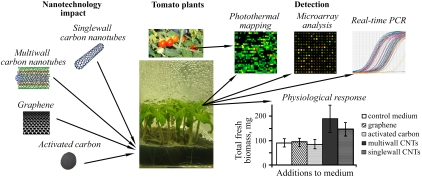
Fig. 1.
Fig. 1.
Schematics of integrated genomic and photothermal-based analysis of nanoparticle-plant interaction. The right bottom shows the effect of carbon materials (activated carbon, few-layer graphene structures, and single- and multiwall CNTs) on biomass accumulation of tomato plants. Pseudocolor in example of photothermal leaf map on right top indicates signals from small CNT clusters (red- maximum signal, green low signals).
Fig. 2.
Fig. 2.
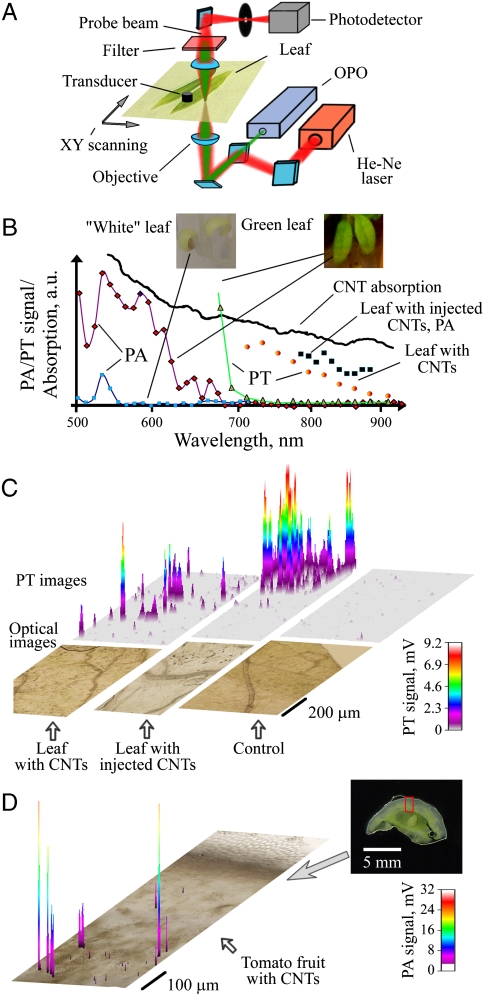
Photothermal and photoacoustic detection of multiwall CNTs in tomato leaves. Schematic of integrated PA/PT scanning cytometer (A). Spectral PA and PT identification of CNTs (B); given are images of tomato leaves grown in darkness (white) and under light (green). Two-dimensional PT maps (with three-dimensional simulation) of CNT distribution in tomato leaves compared to conventional optical images (C). Calibration model was constructed by injection of CNTs into leaf. PA detection of CNTs in 1 mm thick section of tomato fruit (D).
Fig. 3.
Fig. 3.
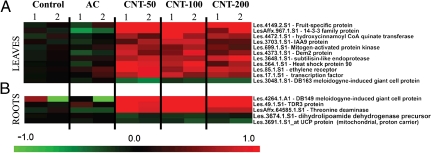
Microarray data of transcripts showing significant quantitative differences between the tomato seedlings exposed to CNTs in concentrations of 50; 100; and 200 μg/mL and two groups of control seedlings (exposed to activated carbon and unexposed to any carbon material) in two tissues of 10-day-old plants [roots (A) and first two leaves (B)]. Statistical analysis was performed by T-test (P < 10-3) based on log (2) fold changes of mRNA abundance over the average abundance of the specific transcript in the seedlings not exposed to carbon material. Only genes with known functions are presented here.
Fig. 4.
Fig. 4.
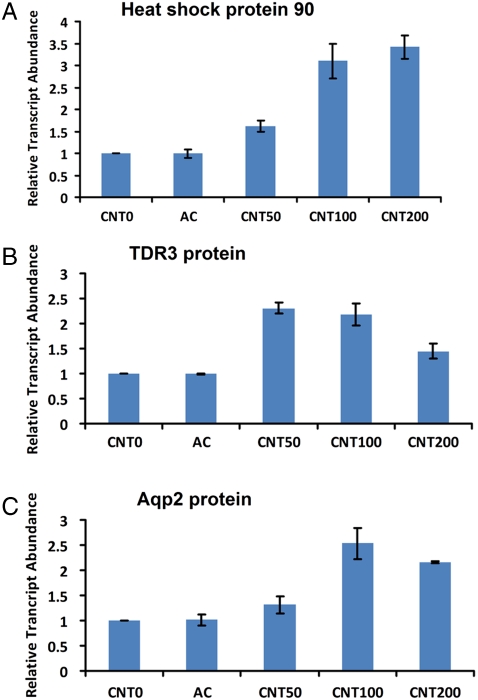
Relative transcript abundances of Les.564.1.S1- heat shock protein 90 in leaves (A), Les.49.1.S1- TDR3 protein in roots (B), and LeAqp2 protein in roots (C) of tomato seedlings exposed to AC, CNTs in concentrations 50, 100, and 200 μg/mL), and seedlings not exposed to carbon materials (CNT 0). Expression of genes was analyzed by real-time RT-qPCR. Results are shown as the average of three independent biological replicates. Relative expression levels were normalized to an internal standard (actin transcript) for each treatment. Bars represent standard error (SE) of means.

References

    1. Zhang L, et al. Nanoparticles in medicine: therapeutic applications and developments. Clin Pharmacol Ther. 2008;83:761–769. - PubMed
    1. Joseph T, Morrison M. Nanotechnology in agriculture and food. 2006. www.nanoforum.org.
    1. Kam NWS, O’Connell M, Wisdom JA, Dai H. Carbon nanotubes as multifunctional biological transporters and near-infraredagents for selective cancer cell destruction. Proc Nat Acad Sci USA. 2005;102:11600–11605. - PMC - PubMed
    1. Liu SB, et al. Sharper and faster “Nano Darts” kill more bacteria: a study of antibacterial activity of individually dispersed pristine single-walled carbon nanotubes. ACS Nano. 2009;3:3891–3902. - PubMed
    1. Liu Q, et al. Carbon nanotubes as molecular transporters for walled plant cells. Nano Lett. 2009;9:1007–1010. - PubMed

Publication types

MeSH terms

Associated data