


Control of nematode parasites with agents acting on neuro-musculature systems: lessons for neuropeptide ligand discovery
- PMID: 21189677
- PMCID: PMC3732103
- DOI: 10.1007/978-1-4419-6902-6_7
Control of nematode parasites with agents acting on neuro-musculature systems: lessons for neuropeptide ligand discovery
Abstract
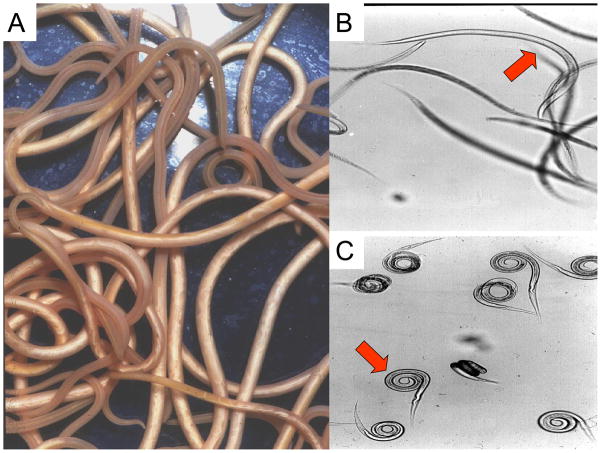
There are a number of reasons why the development of novel anthelmintics is very necessary. In domestic animals, parasites cause serious loss of production and are a welfare concern. The control of these parasites requires changes in management practices to reduce the spread of infection and the use of therapeutic agents to treat affected animals. The development of vaccines against parasites is desirable but their development so far has been very limited. One notable exception is the vaccination of calves against infection by Dictyocaulus viviparous (lungworm) which has proved to be very effective. In domestic animals, the total market for anti-parasitic agents (both ecto- and endo-parasites) is in excess of a billion U.S. dollars. In humans there are serious problems ofmorbidity and mortality associated with parasite infections. 1.6 billion People throughout the world are infected with ascariasis (Fig. 1A) and/or hookworm. Approximately one-third of the world's population is suffering from the effects of intestinal nematode parasites, causing low growth-rates in infants, ill-thrift, diarrhea and in 2% of cases, loss of life. Despite the huge number of affected individuals, the market for anti-parasitic drugs for humans is not big enough to foster the development of anthelmintics because most infestations that occur are in undeveloped countries that lack the ability to pay for the development of these drugs. The major economic motivator then, is for the development of animal anthelmintics. In both domestic animals and now in humans, there is now a level of resistance to the available anthelmintic compounds. The resistance is either: constitutive, where a given species of parasite has never been sensitive to the compound; or acquired, where the resistance has developed through Darwinian selection fostered by the continued exposure to the anti-parasitic drugs. The continued use of all anthelmintics has and will, continue to increase the level of resistance. Cure rates are now often less than 100% and resistance of parasites to agents acting on the neuromuscular systems is present in a wide range of parasites of animals and humans hosts. In the face of this resistance the development of novel and effective agents is an urgent and imperative need. New drugs which act on the neuromuscular system have an advantage for medication for animals and humans because they have a rapid therapeutic effect within 3 hours of administration. The effects on the neuromuscular system include: spastic paralysis with drugs like levamisole and pyrantel; flaccid paralysis as with piperazine; or disruption of other vital muscular activity as with ivermectin. Figure 1 B and C, illustrates an example ofa spastic effect oflevamisole on infectious L3 larvae of Ostertagia ostertagiae, a parasite of pigs. The effect was produced within minutes of the in vitro application oflevamisole. In this chapter we comment on the properties of existing agents that have been used to control nematode parasites and that have an action on neuromuscular systems. We then draw attention to resistance that has developed to these compounds and comment on their toxicity and spectra of actions. We hope that some of the lessons that the use of these compounds has taught us may to be applied to any novel neuropeptide ligand that may be introduced. Our aim is then is to provide some warning signs for recognized but dangerous obstacles.
Figures
References
-
- ARENA JP, LIU KK, PARESS PS, FRAZIER EG, CULLY DF, MROZIK H, SCHAEFFER JM. The mechanism of action of avermectins in Caenorhabditis elegans: correlation between activation of glutamate-sensitive chloride current, membrane binding, and biological activity. J Parasitol. 1995;81:286–294. - PubMed
-
- BAGGOT JD, MCKELLAR QA. The absorption, distribution and elimination of anthelmintic drugs: the role of pharmacokinetics. J Vet Pharmacol Ther. 1994;17:409–419. - PubMed
-
- BAIN RK. Irradiated vaccines for helminth control in livestock. Int J Parasitol. 1999;29:185–191. - PubMed
-
- BLACKHALL WJ, LIU HY, XU M, PRICHARD RK, BEECH RN. Selection at a P-glycoprotein gene in ivermectin- and moxidectin-selected strains of Haemonchus contortus. Mol Biochem Parasitol. 1998a;95:193–201. - PubMed
Publication types
MeSH terms
Substances
Grants and funding
LinkOut - more resources
Full Text Sources
