Multiple births conceived by assisted reproductive technology in Korea
- PMID: 21189958
- PMCID: PMC3004501
- DOI: 10.3345/kjp.2010.53.10.880
Multiple births conceived by assisted reproductive technology in Korea
Abstract
Purpose: The recent trends of multiple births (MBs) conceived by assisted reproductive technology (ART) in Korea were analyzed as well as the relationship with maternal age, especially advanced maternal age.
Methods: Data were obtained from the Korean Statistical Information Service and annual ART reports from the ART committee of the Korean Society of Obstetrics and Gynecology.
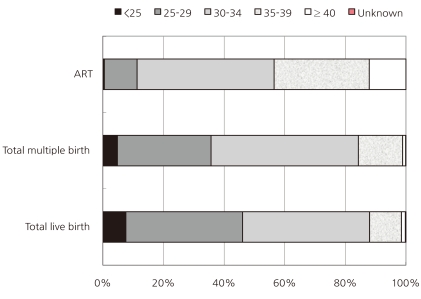
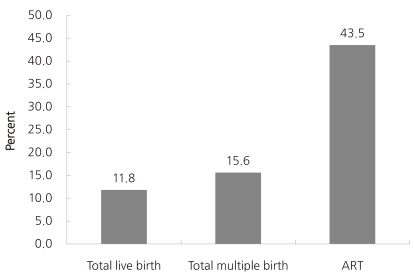
Results: MBs increased from the early 1990s; there was a 275% increase by 2008. The number of total live births was 448,153 and MBs accounted for 10,767; the MB rate was 24.0% in 2006. Among 2,326 deliveries conceived by ART, multiple deliveries accounted for 786 (33.8%). The total number of live births with ART was 3,125 and 1,585 (50.7%) of them were MBs. During 2006, 14.7% of the entire MBs in Korea were associated with ART. The proportion of women of advanced maternal age was much higher in the ART group than in the total live birth group.
Conclusion: MBs in women of advanced maternal age have been increasing in Korea with the use of ART. The results of this study showed that ART was a significant factor associated with the increase in MBs in Korea.
Keywords: Epidemiology; Multiple birth; Newborn; Pregnancy; Pregnancy outcome; Reproductive techniques; assisted/statistics.
Figures
References
-
- Hur YM, Kwon JS. Changes in twinning rates in South Korea: 1981-2002. Twin Res Hum Genet. 2005;8:76–79. - PubMed
-
- Blondel B, Kaminski M. The increase in multiple births and its consequences on perinatal health. J Gynecol Obstet Biol Reprod. 2002;31:725–740. - PubMed
-
- Blondel B. Increase in twin maternities and consequences on health. J Gynecol Obstet Biol Reprod. 2009;38:S7–S17. - PubMed
LinkOut - more resources
Full Text Sources
Miscellaneous