


Review
doi: 10.4161/cc.10.1.14387.
Epub 2011 Jan 1.
Substrate-specific regulation of ubiquitination by the anaphase-promoting complex
Affiliations
- PMID: 21191176
- PMCID: PMC3048074
- DOI: 10.4161/cc.10.1.14387
Item in Clipboard
Review
Substrate-specific regulation of ubiquitination by the anaphase-promoting complex
Cell Cycle.
.
Abstract
By orchestrating the sequential degradation of a large number of cell cycle regulators, the ubiquitin ligase anaphase-promoting complex (APC/C) is essential for proliferation in all eukaryotes. The correct timing of APC/C-dependent substrate degradation, a critical feature of progression through mitosis, was long known to be controlled by mechanisms targeting the core APC/C-machinery. Recent experiments, however, have revealed an important contribution of substrate-specific regulation of the APC/C to achieve accurate cell division. In this perspective, we describe different mechanisms of substrate-specific APC/C-regulation and discuss their importance for cell division.
Figures
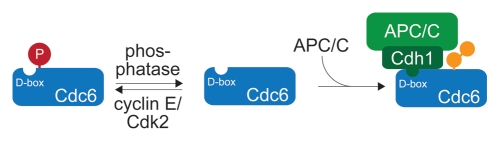
Inhibition of APC/C-dependent ubiquitination by posttranslational modifications. The ubiquitination of Cdc6 by the APC/C can be inhibited by phosphorylation of serine residues in proximity to an important D-box in the substrate. Cdc6 is phosphorylated by the cyclin E/Cdk2 kinase during late stages of G1. It can be assumed that a phosphatase is required for Cdc6 degradation during the next G1 phase.
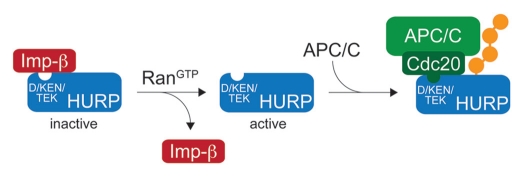
Inhibition of APC/C-dependent ubiquitination by reversible protein interactions. The ubiquitination of the spindle assembly factor HURP by the APC/C can be inhibited by importin-β, which binds to sites in HURP that overlap with the D-, KEN- and TEK-boxes required for HURP-degradation. GTP-charged Ran can dissociate importin-β from HURP, thereby exposing it to recognition by Cdc20/Cdh1 and ubiquitination by the APC/C.
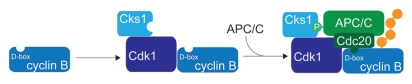
Stimulation of APC/C-dependent ubiquitination by activator-independent APC/C-binding motifs. The ubiquitination of cyclin B1 is stimulated by Cks1, a component of the cyclin B1/Cdk1 complex. Cks1 contains a phospho-peptide binding motif, which interacts with phosphorylated APC3 during mitosis. The multivalency resulting from the simultaneous recognition of the D-box in cyclin B1 and Cks1 by phosphorylated APC/C accelerates cyclin B1 ubiquitination and degradation during mitosis.
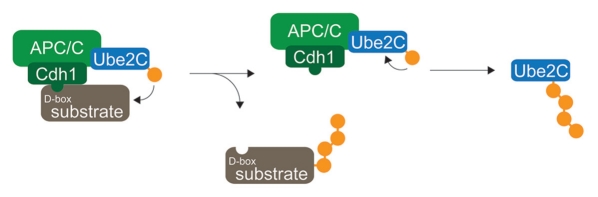
Competitive inhibition of APC/C-dependent ubiquitination. Ube2C is the physiological chain-initiating E2 for the APC/C. When substrates are bound to the APC/C, Ube2C transfers ubiquitin to substrates lysine residues. By contrast, after substrates have been degradation, Ube2C modifies lysine residues within itself, leading to Ube2C-degradation.
References
-
- Peters JM. The anaphase promoting complex/cyclosome: a machine designed to destroy. Nat Rev Mol Cell Biol. 2006;7:644–656. - PubMed
Publication types
MeSH terms
Substances
LinkOut - more resources
Full Text Sources
