


Appreciative Inquiry for quality improvement in primary care practices
- PMID: 21192206
- PMCID: PMC4222905
- DOI: 10.1097/QMH.0b013e31820311be
Appreciative Inquiry for quality improvement in primary care practices
Abstract
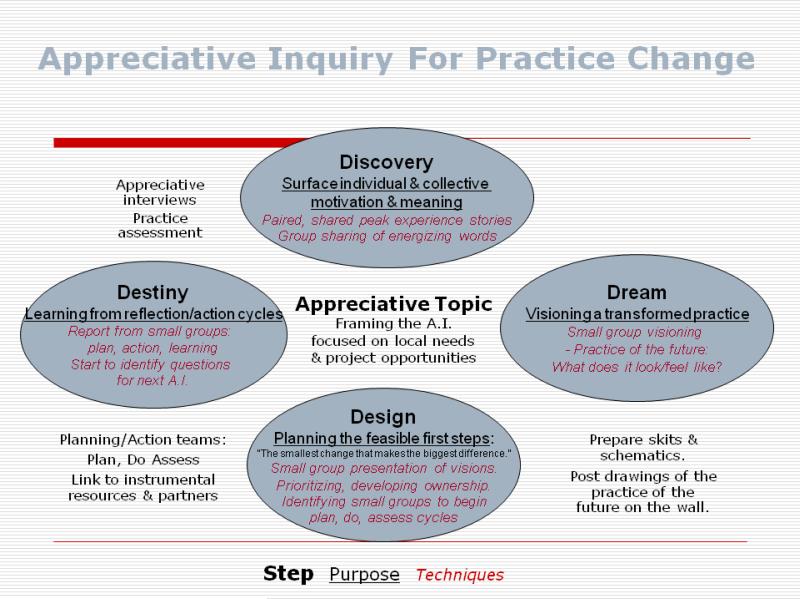
Purpose: To test the effect of an Appreciative Inquiry (AI) quality improvement strategy on clinical quality management and practice development outcomes. Appreciative inquiry enables the discovery of shared motivations, envisioning a transformed future, and learning around the implementation of a change process.
Methods: Thirty diverse primary care practices were randomly assigned to receive an AI-based intervention focused on a practice-chosen topic and on improving preventive service delivery (PSD) rates. Medical-record review assessed change in PSD rates. Ethnographic field notes and observational checklist analysis used editing and immersion/crystallization methods to identify factors affecting intervention implementation and practice development outcomes.
Results: The PSD rates did not change. Field note analysis suggested that the intervention elicited core motivations, facilitated development of a shared vision, defined change objectives, and fostered respectful interactions. Practices most likely to implement the intervention or develop new practice capacities exhibited 1 or more of the following: support from key leader(s), a sense of urgency for change, a mission focused on serving patients, health care system and practice flexibility, and a history of constructive practice change.
Conclusions: An AI approach and enabling practice conditions can lead to intervention implementation and practice development by connecting individual and practice strengths and motivations to the change objective.
Figures
References
-
- Cohen SJ, Halvorson HW, Gosselink CA. Changing physician behavior to improve disease prevention. Prev Med. 1994;23(3):284–291. - PubMed
-
- Solberg LI, Kottke TE, Brekke ML, et al. Failure of a continuous quality improvement intervention to increase the delivery of preventive services. A randomized trial. Eff Clin Pract. 2000;3(3):105–115. - PubMed
-
- Woolf SH. Changing physician practice behavior: the merits of a diagnostic approach. J Fam Pract. 2000;49(2):126–129. - PubMed
-
- Cohen D, McDaniel RR, Jr., Crabtree BF, et al. A practice change model for quality improvement in primary care practice. J Healthc Manag. 2004;49(3):155–168. discussion 169-170. - PubMed
Publication types
MeSH terms
Grants and funding
LinkOut - more resources
Full Text Sources
