


Case Reports
doi: 10.3201/eid1701.091895.
Seasonal influenza A (H1N1) infection in early pregnancy and second trimester fetal demise
Affiliations
- PMID: 21192867
- PMCID: PMC3204617
- DOI: 10.3201/eid1701.091895
Item in Clipboard
Case Reports
Seasonal influenza A (H1N1) infection in early pregnancy and second trimester fetal demise
Emerg Infect Dis.
2011 Jan.
Abstract
A second trimester fetal demise followed influenza-like illness in early pregnancy. Influenza A virus (H1N1) was identified in maternal and fetal tissue, confirming transplacental passage. These findings suggested a causal relationship between early exposure and fetal demise. Management of future influenza outbreaks should include evaluation of products of conception associated with fetal loss.
Figures
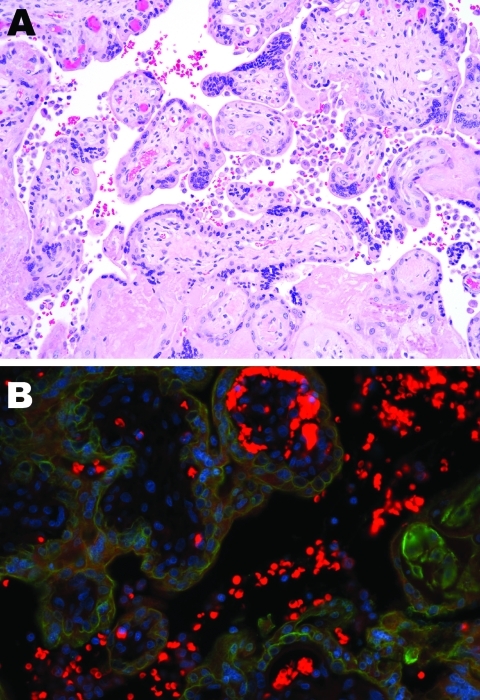
Tissue sample from 30-year-old primigravida patient exposed to seasonal influenza (H1N1). A) Intervillous (maternal) spaces with clusters/sheets of histiocytes (chronic intervillositis) and fibrotic fetal chorionic villi with Hofbauer cells–histiocytic inflammation (hematoxylin and eosin stain, original magnification ×200). B) Dual-stained immunofluorescent assay showing antibodies to influenza A virus (H1N1) (tetramethylrhodamine isothiocyanate, red) and cytokeratin (fluorescein isothiocyanate, green) in intravillous (fetal) and intervillous (maternal) space.
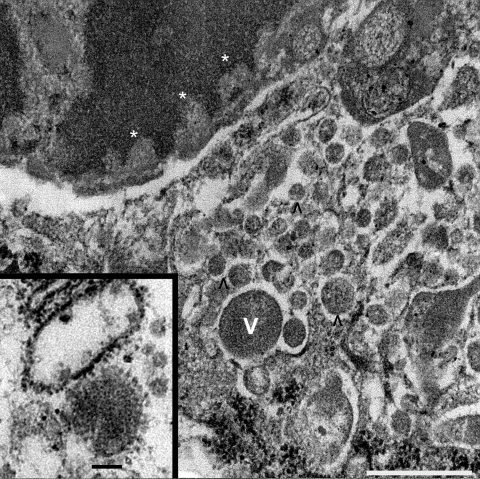
Tissue sample from 30-year-old primigravida patient exposed to seasonal influenza (H1N1). Electron microscopy (original magnification ×70,000) of maternal intervillous space and fetal chorionic villi, showing intranuclear viral transcription aligning along the nuclear envelope–electron hypodensities (asterisks), and intracytoplasmic viral production in varying stages shown by numerous electron densities (V and ^). Scale bar = 500 nm. Inset: enlarged image of mature virion with capsular projections. Ultrastructural features are characteristic of influenza viruses. Scale bar = 100 nm.
References
-
- Centers for Disease Control and Prevention. Novel influenza A (H1N1) virus infections in three pregnant women—United States, April–May 2009. [Erratum in MMWR Morb Mortal Wkly Rep. 2009;58:541]. MMWR Morb Mortal Wkly Rep. 2009;58:497–500. - PubMed
-
- Harris JW. Influenza occurring in pregnant women: a statistical study of 1350 cases. J Am Med Assoc. 1919;72:970–2.
Publication types
MeSH terms
LinkOut - more resources
Full Text Sources
Medical