


The association between frontal-striatal connectivity and sensorimotor control in cocaine users
- PMID: 21193273
- PMCID: PMC3499027
- DOI: 10.1016/j.drugalcdep.2010.11.008
The association between frontal-striatal connectivity and sensorimotor control in cocaine users
Abstract
Background: In addition to cognitive and emotional processing dysfunction, chronic cocaine users are also impaired at simple sensorimotor tasks. Many diseases characterized by compulsive movements, repetitive actions, impaired attention and planning are associated with dysfunction in frontal-striatal circuits. The aim of this study was to determine whether cocaine users had impaired frontal-striatal connectivity during a simple movement task and whether this was associated with sensorimotor impairment.
Methods: Functional MRI data were collected from 14 non-treatment seeking cocaine users and 15 healthy controls as they performed a finger-tapping task. Functional coupling was quantified by correlating the timecourses of each pair of anatomically connected regions of interest. Behavioral performance was correlated with all functional coupling coefficients.
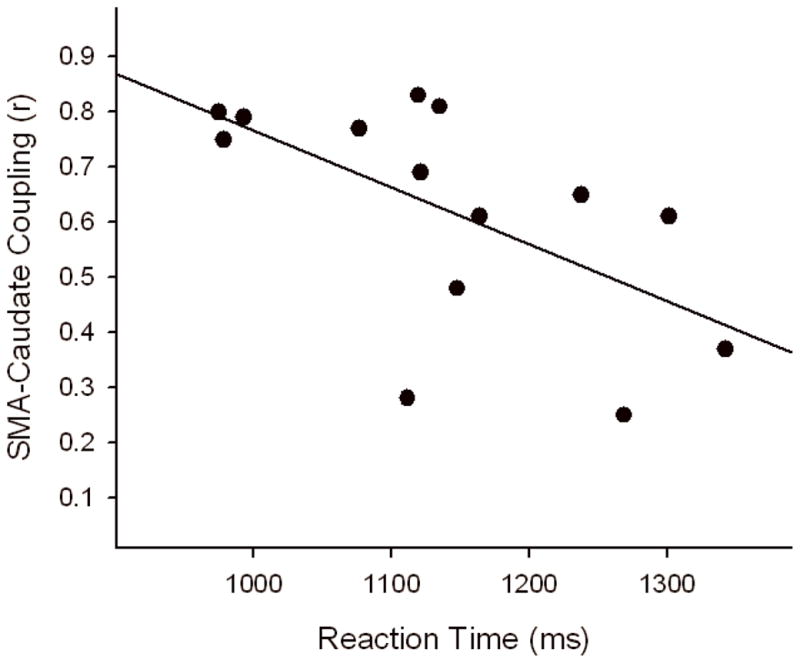
Results: In controls there was a significant relationship between the primary motor cortex and the supplementary motor area (SMA), as well as the SMA and the dorsal striatum during ongoing movement. Cocaine users exhibited weaker fronto-striatal coupling than controls, while the cortical-cortical coupling was intact. Coupling strength between the SMA and the caudate was negatively correlated with reaction time in the users.
Conclusions: The observation that cocaine users have impaired cortical-striatal connectivity during simple motor performance, suggests that these individuals may have a fundamental deficit in information processing that influences more complex cognitive processes.
Copyright © 2010. Published by Elsevier Ireland Ltd.
Figures

References
-
- Biswal B, Yetkin FZ, Haughton VM, Hyde JS. Functional connectivity in the motor cortex of resting human brain using echo-planar MRI. Magn Reson Med. 1995;34(4):537–41. - PubMed
-
- Breiter HC, Gollub RL, Weisskoff RM, Kennedy DN, Makris N, Berke JD, Goodman JM, Kantor HL, Gastfriend DR, Riorden JP, Mathew RT, Rosen BR, Hyman SE. Acute effects of cocaine on human brain activity and emotion. Neuron. 1997;19(3):591–611. - PubMed
-
- Cao X, Cao Q, Long X, Sun L, Sui M, Zhu C, Zuo X, Zang Y, Wang Y. Abnormal resting-state functional connectivity patterns of the putamen in medication-naive children with attention deficit hyperactivity disorder. Brain Res. 2009;1303:195–206. - PubMed
-
- Desjardins AE, Kiehl KA, Liddle PF. Removal of confounding effects of global signal in functional MRI analyses. Neuroimage. 2001;13(4):751–8. - PubMed
Publication types
MeSH terms
Substances
Grants and funding
LinkOut - more resources
Full Text Sources
Medical
