


Perilipin polymorphism interacts with saturated fat and carbohydrates to modulate insulin resistance
- PMID: 21193293
- PMCID: PMC3117106
- DOI: 10.1016/j.numecd.2010.09.003
Perilipin polymorphism interacts with saturated fat and carbohydrates to modulate insulin resistance
Abstract
Background and aims: Macronutrient intakes and genetic variants have been shown to interact to alter insulin resistance, but replications of gene-nutrient interactions across independent populations are rare, despite their critical importance in establishing credibility. We aimed to investigate a previously demonstrated saturated fat and carbohydrate interaction for insulin resistance for perilipin (PLIN1), a regulator of adipocyte metabolism.
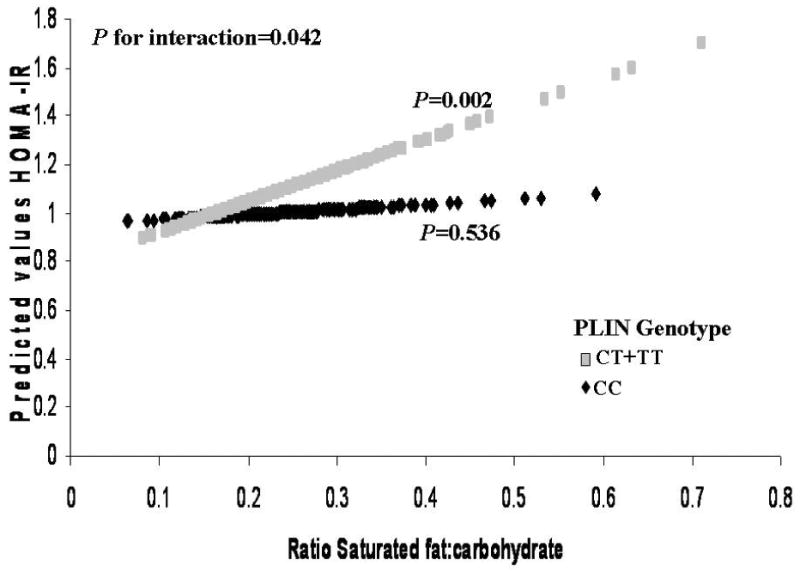
Methods and results: We investigated the previously shown interaction for PLIN1 11482G > A (rs894160) on insulin resistance in US men (n = 462) and women (n = 508) (mean ± SD, 49 ± 16 years). In multivariable linear regression models, we found an interaction (P < 0.05) between the ratio of saturated fat to carbohydrate intake as a continuous variable and PLIN1 11482G > A for HOMA-IR (homeostasis model assessment of insulin resistance) in women. For carriers of the minor allele but not for non-carriers, as the ratio of saturated fat to carbohydrate intake increased, predicted HOMA-IR increased (P = 0.002). By dichotomizing the ratio of saturated fat to carbohydrate intake into high and low, we found significant interaction terms for insulin and HOMA-IR (P < 0.05). When the ratio of saturated fat to carbohydrate was high, insulin and HOMA-IR were higher in minor allele carriers (P = 0.004 and P = 0.003, respectively), but did not differ when the ratio was low. Similar patterns or trends were observed when saturated fat and carbohydrate were dichotomized into high and low as individual macronutrients.
Conclusions: Replication of the previously reported interaction between macronutrient intakes and PLIN1 genotype for insulin resistance reinforces the potential usefulness of applying genotype information in the dietary management of insulin resistance.
Copyright © 2010. Published by Elsevier B.V.
Conflict of interest statement
Author disclosures: C. E. Smith, D. K. Arnett, D. Corella, M. Y. Tsai, C. Q. Lai, L. D. Parnell, Y. C. Lee, J. M. Ordovás, have no conflicts of interest.
Figures
References
-
- Nguyen NT, Magno CP, Lane KT, Hinojosa MW, Lane JS. Association of hypertension, diabetes, dyslipidemia, and metabolic syndrome with obesity: findings from the National Health and Nutrition Examination Survey, 1999 to 2004. J Am Coll Surg. 2008;207(6):928–34. - PubMed
-
- Pan Y, Pratt CA. Metabolic syndrome and its association with diet and physical activity in US adolescents. J Am Diet Assoc. 2008;108(2):276–86. - PubMed
-
- Due A, Larsen TM, Hermansen K, Stender S, Holst JJ, Toubro S, Martinussen T, Astrup A. Comparison of the effects on insulin resistance and glucose tolerance of 6-mo high-monounsaturated-fat, low-fat, and control diets. Am J Clin Nutr. 2008;87(4):855–62. - PubMed
-
- Lopez S, Bermudez B, Pacheco YM, Villar J, Abia R, Muriana FJ. Distinctive postprandial modulation of beta cell function and insulin sensitivity by dietary fats: monounsaturated compared with saturated fatty acids. Am J Clin Nutr. 2008;88(3):638–44. - PubMed
-
- Kabir M, Skurnik G, Naour N, Pechtner V, Meugnier E, Rome S, Quignard-Boulangé A, Vidal H, Slama G, et al. Treatment for 2 mo with n–3 polyunsaturated fatty acids reduces adiposity and some atherogenic factors but does not improve insulin sensitivity in women with type 2 diabetes: a randomized controlled study. Am J Clin Nutr. 2007;86:1670–1679. - PubMed
Publication types
MeSH terms
Substances
Grants and funding
LinkOut - more resources
Full Text Sources
Medical
Molecular Biology Databases
