


Airway microbiota and bronchial hyperresponsiveness in patients with suboptimally controlled asthma
- PMID: 21194740
- PMCID: PMC3037020
- DOI: 10.1016/j.jaci.2010.10.048
Airway microbiota and bronchial hyperresponsiveness in patients with suboptimally controlled asthma
Abstract
Background: Improvement in lung function after macrolide antibiotic therapy has been attributed to reduction in bronchial infection by specific bacteria. However, the airway might be populated by a more diverse microbiota, and clinical features of asthma might be associated with characteristics of the airway microbiota present.
Objective: We sought to determine whether relationships exist between the composition of the airway bacterial microbiota and clinical features of asthma using culture-independent tools capable of detecting the presence and relative abundance of most known bacteria.
Methods: In this pilot study bronchial epithelial brushings were collected from 65 adults with suboptimally controlled asthma participating in a multicenter study of the effects of clarithromycin on asthma control and 10 healthy control subjects. A combination of high-density 16S ribosomal RNA microarray and parallel clone library-sequencing analysis was used to profile the microbiota and examine relationships with clinical measurements.
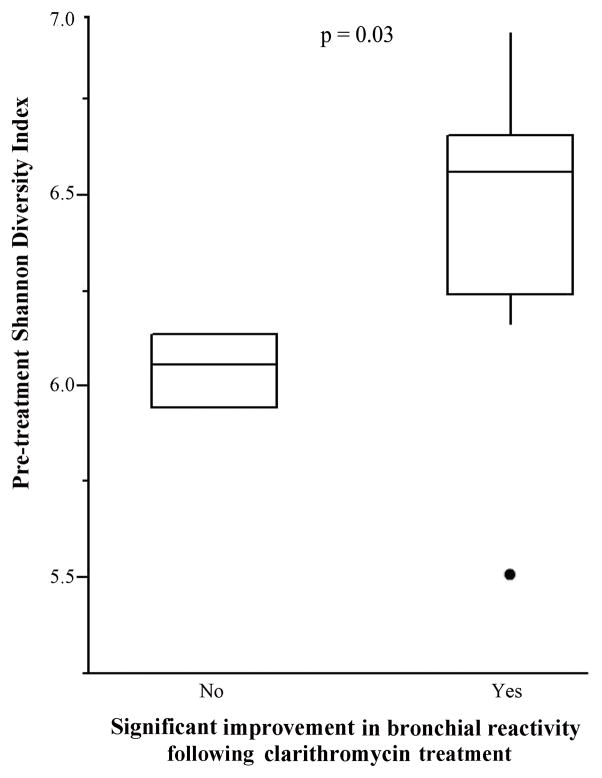
Results: Compared with control subjects, 16S ribosomal RNA amplicon concentrations (a proxy for bacterial burden) and bacterial diversity were significantly higher among asthmatic patients. In multivariate analyses airway microbiota composition and diversity were significantly correlated with bronchial hyperresponsiveness. Specifically, the relative abundance of particular phylotypes, including members of the Comamonadaceae, Sphingomonadaceae, Oxalobacteraceae, and other bacterial families were highly correlated with the degree of bronchial hyperresponsiveness.
Conclusion: The composition of bronchial airway microbiota is associated with the degree of bronchial hyperresponsiveness among patients with suboptimally controlled asthma. These findings support the need for further functional studies to examine the potential contribution of members of the airway microbiota in asthma pathogenesis.
Copyright © 2010 American Academy of Allergy, Asthma & Immunology. Published by Mosby, Inc. All rights reserved.
Figures


Comment in
-
Bacteria and asthma: more there than we thought.Expert Rev Respir Med. 2011 Jun;5(3):329-32. doi: 10.1586/ers.11.33. Expert Rev Respir Med. 2011. PMID: 21702654 Free PMC article.
-
Venous thromboembolism prophylaxis, shorter courses of isoniazid for tuberculosis, and the microbiome in asthma.Am J Respir Crit Care Med. 2012 Aug 1;186(3):286-7. doi: 10.1164/rccm.201204-0618RR. Am J Respir Crit Care Med. 2012. PMID: 22855541 No abstract available.
References
-
- Bisgaard H, Hermansen MN, Buchvald F, Loland L, Halkjaer LB, Bonnelykke K, et al. Childhood asthma after bacterial colonization of the airway in neonates. N Engl J Med. 2007;357:1487–95. - PubMed
-
- Martin RJ, Kraft M, Chu HW, Berns EA, Cassell GH. A link between chronic asthma and chronic infection. J Allergy Clin Immunol. 2001;107:595–601. - PubMed
-
- Black PN, Blasi F, Jenkins CR, Scicchitano R, Mills GD, Rubinfeld AR, et al. Trial of roxithromycin in subjects with asthma and serological evidence of infection with Chlamydia pneumoniae. Am J Respir Crit Care Med. 2001;164:536–41. - PubMed
-
- Kostadima E, Tsiodras S, Alexopoulos EI, Kaditis AG, Mavrou I, Georgatou N, et al. Clarithromycin reduces the severity of bronchial hyperresponsiveness in patients with asthma. Eur Respir J. 2004;23:714–7. - PubMed
-
- Kraft M, Cassell GH, Pak J, Martin RJ. Mycoplasma pneumoniae and Chlamydia pneumoniae in asthma: effect of clarithromycin. Chest. 2002;121:1782–8. - PubMed
MeSH terms
Substances
Grants and funding
LinkOut - more resources
Full Text Sources
Other Literature Sources
Medical
