Adipose tissue as a stem cell source for musculoskeletal regeneration
- PMID: 21196358
- PMCID: PMC3636575
- DOI: 10.2741/s133
Adipose tissue as a stem cell source for musculoskeletal regeneration
Abstract
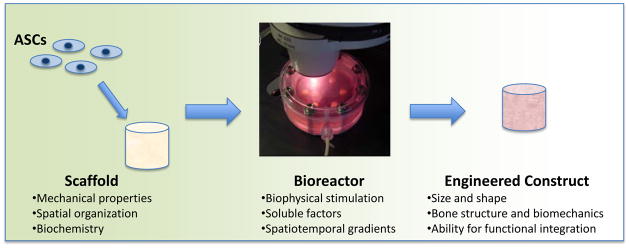
Adipose tissue is an abundant, easily accessible, and reproducible cell source for musculo-skeletal regenerative medicine applications. Initial derivation steps yield a heterogeneous population of cells of stromal vascular fraction (SVF) cells. Subsequent adherent selection of the SVF results in a relatively homogeneous population of adipose-derived stromal/stem cells (ASCs) capable of adipogenic, chondrogenic, myogenic, and osteogenic differentiation in vitro on scaffolds in bioreactors and in vivo in pre-clinical animal models. Unlike hematopoietic cells, ASCs do not elicit a robust lymphocyte reaction and instead release immunosuppressive factors, such as prostaglandin E2. These immunomodulatory features suggest that allogeneic and autologous ASCs will engraft successfully for tissue regeneration purposes. The differentiation and expansion potential of ASCs can be modified by growth factors, bio-inductive scaffolds, and bioreactors providing environmental control and biophysical stimulation. Gene therapy approaches using lentiviral transduction can be used to direct differentiation of ASCs to particular lineages. We discuss the utility of ASCs for musculo-skeletal tissue repair and some of the technologies that can be implemented to unlock the full regenerative potential of these highly valuable cells.
Figures
References
-
- Muschler GF, Midura RJ. Connective tissue progenitors: practical concepts for clinical applications. Clin Orthop Relat Res. 2002:66–80. - PubMed
-
- Gimble JM. Adipose tissue-derived therapeutics. Expert Opin Biol Ther. 2003;3:705–713. - PubMed
-
- Strem BM, Hedrick MH. The growing importance of fat in regenerative medicine. Trends Biotechnol. 2005;23:64–66. - PubMed
-
- Fraser JK, Wulur I, Alfonso Z, Hedrick MH. Fat tissue: an underappreciated source of stem cells for biotechnology. Trends Biotechnol. 2006;24:150–154. - PubMed
Publication types
MeSH terms
Substances
Grants and funding
- AG15768/AG/NIA NIH HHS/United States
- R01 AR048852/AR/NIAMS NIH HHS/United States
- AR48852/AR/NIAMS NIH HHS/United States
- 2P41-EB002520/EB/NIBIB NIH HHS/United States
- R15AA017546/AA/NIAAA NIH HHS/United States
- R01 DE016525/DE/NIDCR NIH HHS/United States
- P41 EB002520/EB/NIBIB NIH HHS/United States
- R01DE16525/DE/NIDCR NIH HHS/United States
- R01 AR048182/AR/NIAMS NIH HHS/United States
- AR50245/AR/NIAMS NIH HHS/United States
- P01 AR050245/AR/NIAMS NIH HHS/United States
- R01 AG015768/AG/NIA NIH HHS/United States
- AR48182/AR/NIAMS NIH HHS/United States
LinkOut - more resources
Full Text Sources
Other Literature Sources
Medical