


Tracking cognition-health changes from 55 to 95 years of age
- PMID: 21196437
- PMCID: PMC3132770
- DOI: 10.1093/geronb/gbq093
Tracking cognition-health changes from 55 to 95 years of age
Abstract
Objectives: Among the key targets of inquiry in cognitive aging are (1) the description of cognitive changes with advancing age and (2) the association of such cognitive changes with modulating factors in the changing epidemiological context.
Methods: In the current study, we assemble multi-occasion (up to 12 years) cognitive (speed, episodic memory, and semantic memory) and self-reported health data from the Victoria Longitudinal Study (n = 988; ages 55-95 years).
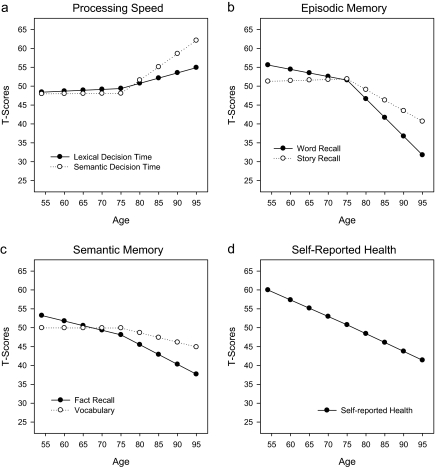
Results: The results from piecewise random effects models using age as a basis indicated that only selected measures of episodic memory and semantic memory showed evidence of significant declines prior to age 75. After age 75, all cognitive abilities showed evidence for statistically significant declines, although the magnitude of these changes varied considerably. Performance at age 75 was correlated with self-reported health for measures of processing speed and episodic memory. Changes in health status were related to changes in some aspects of processing speed.
Discussions: The results indicated that (1) for many cognitive abilities declines in performance did not manifest until after age 75 and (2) self-reported health was related to level of performance more than changes over age.
Figures
References
-
- Anstey KJ. Alcohol exposure and cognitive development: An example of why we need a contextualized, dynamic life course approach to cognitive ageing: A mini-review. Gerontology. 2008;54:283–291. doi:10.1159/000161735. - PubMed
-
- Atkinson HH, Rapp SR, Williamson JD, Lovato J, Absher JR, Gass M, Espeland MA. The relationship between cognitive function and physical performance in older women: Results from the women's health initiative memory study. Journal of Gerontology: Medical Sciences. 2010;65:300–306. doi:10.1093/gerona/glp149. - PMC - PubMed
-
- Baddeley A, Logie R, Nimmo-Smith I. Components of fluent reading. Journal of Memory and Language. 1985;24:119–131. doi:10.1016/0749-596X%2885%2990019-1.
-
- Baltes PB, Nesselroade JR. History and rationale of longitudinal research. In: Nesselroade JR, Baltes PB, editors. Longitudinal research in the study of behavior and development. New York, NY: Academic Press; 1979. pp. 1–39.
Publication types
MeSH terms
Grants and funding
LinkOut - more resources
Full Text Sources
Other Literature Sources
Medical
