


Role of IL-17 and Th17 cells in liver diseases
- PMID: 21197451
- PMCID: PMC3010664
- DOI: 10.1155/2011/345803
Role of IL-17 and Th17 cells in liver diseases
Abstract
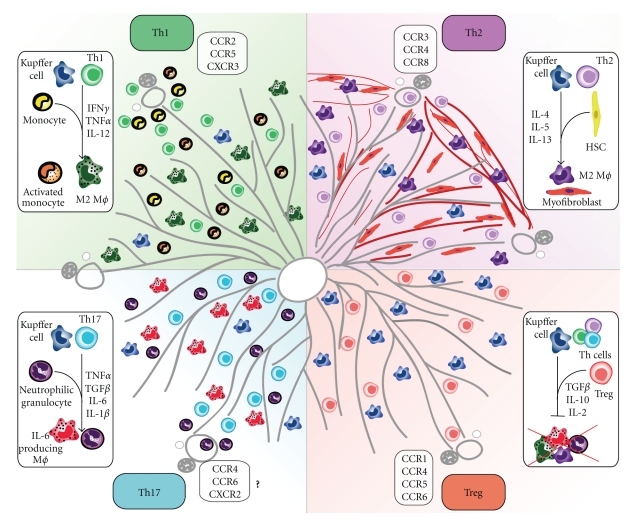
Unbalanced Th1/Th2 T-cell responses in the liver are a characteristic of hepatic inflammation and subsequent liver fibrosis. The recently discovered Th17 cells, a subtype of CD4(+) T-helper cells mainly producing IL-17 and IL-22, have initially been linked to host defense against infections and to autoimmunity. Their preferred differentiation upon TGFβ and IL-6, two cytokines abundantly present in injured liver, makes a contribution of Th17 cells to hepatic inflammation very likely. Indeed, initial studies in humans revealed activated Th17 cells and Th17-related cytokines in various liver diseases. However, functional experiments in mouse models are not fully conclusive at present, and the pathogenic contribution of Th17 cells to liver inflammation might vary upon the disease etiology, for example, between infectious and autoimmune disorders. Understanding the chemokines and chemokine receptors promoting hepatic Th17 cell recruitment (possibly CCR6 or CCR4) might reveal new therapeutic targets interfering with Th17 migration or differentiation in liver disease.
Figures

References
-
- Tacke F, Luedde T, Trautwein C. Inflammatory pathways in liver homeostasis and liver injury. Clinical Reviews in Allergy and Immunology. 2009;36(1):4–12. - PubMed
-
- Wallace K, Burt AD, Wright MC. Liver fibrosis. Biochemical Journal. 2008;411(1):1–18. - PubMed
-
- Karlmark KR, Weiskirchen R, Zimmermann HW, et al. Hepatic recruitment of the inflammatory Gr1+ monocyte subset upon liver injury promotes hepatic fibrosis. Hepatology. 2009;50(1):261–274. - PubMed
-
- Racanelli V, Rehermann B. The liver as an immunological organ. Hepatology. 2006;43(2, supplement 1):S54–S62. - PubMed
Publication types
MeSH terms
Substances
LinkOut - more resources
Full Text Sources
Other Literature Sources
Medical
Research Materials
