


Cyclic AMP signalling in mycobacteria: redirecting the conversation with a common currency
- PMID: 21199259
- PMCID: PMC3785248
- DOI: 10.1111/j.1462-5822.2010.01562.x
Cyclic AMP signalling in mycobacteria: redirecting the conversation with a common currency
Abstract
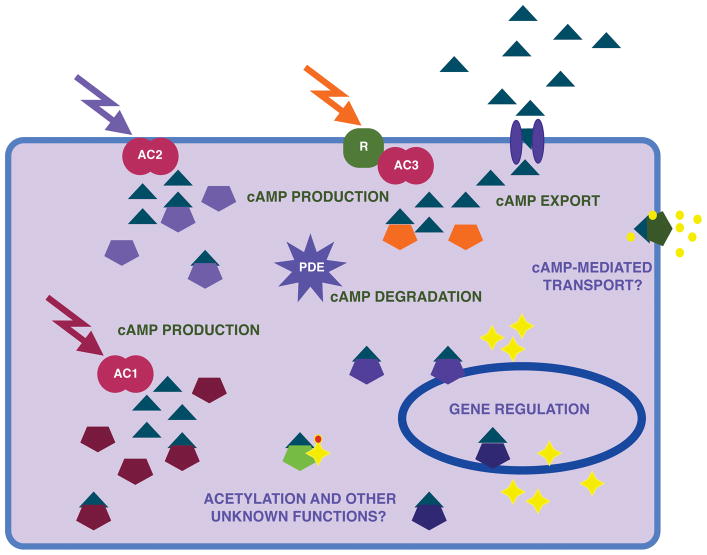
cAMP is an ancient second messenger, and is used by many organisms to regulate a wide range of cellular functions. Mycobacterium tuberculosis complex bacteria are exceptional in that they have genes for at least 15 biochemically distinct adenylyl cyclases, the enzymes that generate cAMP. cAMP-associated gene regulation within tubercle bacilli is required for their virulence, and secretion of cAMP produced by M. tuberculosis bacteria into host macrophages disrupts the host's immune response to infection. In this review, we discuss recent advances in our understanding of the means by which cAMP levels are controlled within mycobacteria, the importance of cAMP to M. tuberculosis during host infection, and the role of cAMP in mycobacterial gene regulation. Understanding the myriad aspects of cAMP signalling in tubercle bacilli will establish new paradigms for cAMP signalling, and may contribute to new approaches for prevention and/or treatment of tuberculosis disease.
© 2010 Blackwell Publishing Ltd.
Figures
References
-
- Agarwal N, Lamichhane G, Gupta R, Nolan S, Bishai WR. Cyclic AMP intoxication of macrophages by a Mycobacterium tuberculosis adenylate cyclase. Nature. 2009;460:98–102. - PubMed
-
- Agarwal N, Raghunand TR, Bishai WR. Regulation of the expression of whiB1 in Mycobacterium tuberculosis: role of cAMP receptor protein. Microbiology. 2006;152:2749–2756. - PubMed
-
- Akhter Y, Yellaboina S, Farhana A, Ranjan A, Ahmed N, Hasnain SE. Genome scale portrait of cAMP-receptor protein (CRP) regulons in mycobacteria points to their role in pathogenesis. Gene. 2008;407:148–158. - PubMed
Publication types
MeSH terms
Substances
Grants and funding
LinkOut - more resources
Full Text Sources
Other Literature Sources
Medical
