


Hyperuricaemia, chronic kidney disease, and outcomes in heart failure: potential mechanistic insights from epidemiological data
- PMID: 21199831
- PMCID: PMC3056205
- DOI: 10.1093/eurheartj/ehq473
Hyperuricaemia, chronic kidney disease, and outcomes in heart failure: potential mechanistic insights from epidemiological data
Abstract
Aim: To determine if the association between hyperuricaemia and poor outcomes in heart failure (HF) varies by chronic kidney disease (CKD).
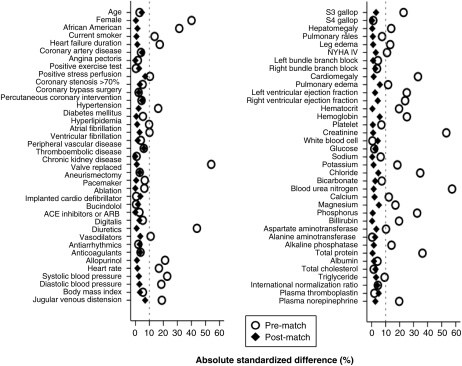
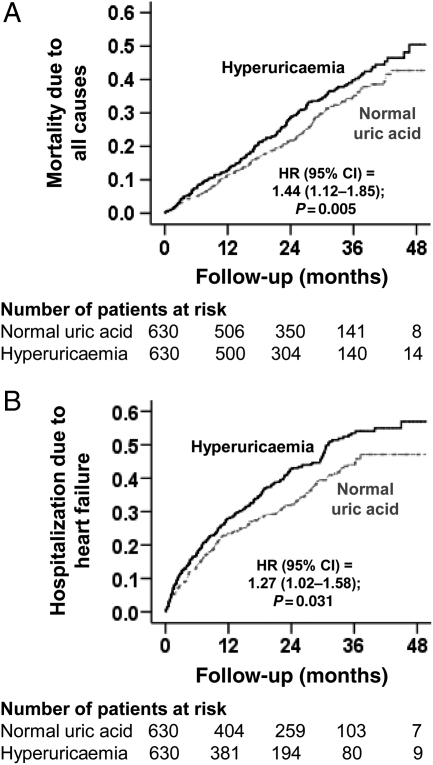
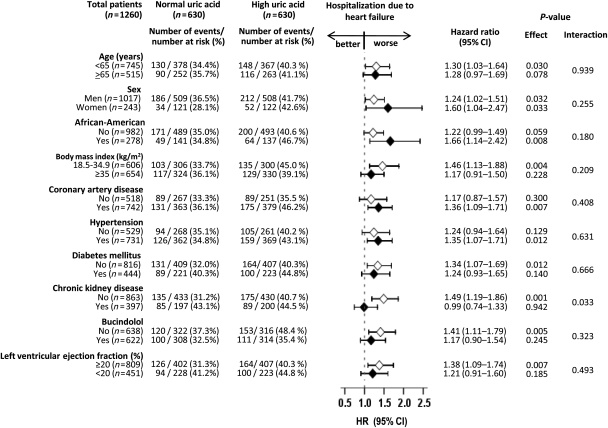
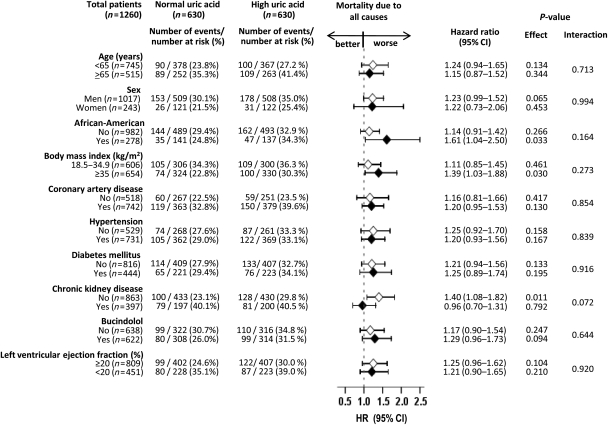
Methods and results: Of the 2645 systolic HF patients in the Beta-Blocker Evaluation of Survival Trial with data on baseline serum uric acid, 1422 had hyperuricaemia (uric acid ≥6 mg/dL for women and ≥8 mg/dL for men). Propensity scores for hyperuricaemia, estimated for each patient, were used to assemble a matched cohort of 630 pairs of patients with and without hyperuricaemia who were balanced on 75 baseline characteristics. Associations of hyperuricaemia with outcomes during 25 months of median follow-up were examined in all patients and in those with and without CKD (estimated glomerular filtration rate of <60 mL/min/1.73 m(2)). Hyperuricaemia-associated hazard ratios (HRs) and 95% confidence intervals (CI) for all-cause mortality and HF hospitalization were 1.44 (1.12-1.85, P = 0.005) and 1.27 (1.02-1.58, P = 0.031), respectively. Hazard ratios (95% CIs) for all-cause mortality among those with and without CKD were 0.96 (0.70-1.31, P = 0.792) and 1.40 (1.08-1.82, P = 0.011), respectively (P for interaction, 0.071), and those for HF hospitalization among those with and without CKD were 0.99 (0.74-1.33, P = 0.942) and 1.49 (1.19-1.86, P = 0.001), respectively (P for interaction, 0.033).
Conclusion: Hyperuricaemia has a significant association with poor outcomes in HF patients without CKD but not in those with CKD, suggesting that hyperuricaemia may predict poor outcomes when it is primarily a marker of increased xanthine oxidase activity, but not when it is primarily due to impaired renal excretion of uric acid.
Figures
References
-
- Leyva F, Anker S, Swan JW, Godsland IF, Wingrove CS, Chua TP, Stevenson JC, Coats AJ. Serum uric acid as an index of impaired oxidative metabolism in chronic heart failure. Eur Heart J. 1997;18:858–865. - PubMed
-
- Doehner W, Rauchhaus M, Florea VG, Sharma R, Bolger AP, Davos CH, Coats AJ, Anker SD. Uric acid in cachectic and noncachectic patients with chronic heart failure: relationship to leg vascular resistance. Am Heart J. 2001;141:792–799. - PubMed
-
- Anker SD, Doehner W, Rauchhaus M, Sharma R, Francis D, Knosalla C, Davos CH, Cicoira M, Shamim W, Kemp M, Segal R, Osterziel KJ, Leyva F, Hetzer R, Ponikowski P, Coats AJ. Uric acid and survival in chronic heart failure: validation and application in metabolic, functional, and hemodynamic staging. Circulation. 2003;107:1991–1997. - PubMed
-
- Jankowska EA, Ponikowska B, Majda J, Zymlinski R, Trzaska M, Reczuch K, Borodulin-Nadzieja L, Banasiak W, Ponikowski P. Hyperuricaemia predicts poor outcome in patients with mild to moderate chronic heart failure. Int J Cardiol. 2007;115:151–155. - PubMed
-
- Pascual-Figal DA, Hurtado-Martinez JA, Redondo B, Antolinos MJ, Ruiperez JA, Valdes M. Hyperuricaemia and long-term outcome after hospital discharge in acute heart failure patients. Eur J Heart Fail. 2007;9:518–524. - PubMed
Publication types
MeSH terms
Substances
Grants and funding
LinkOut - more resources
Full Text Sources
Medical
Research Materials
Miscellaneous
