


Lucy's flat feet: the relationship between the ankle and rearfoot arching in early hominins
- PMID: 21203433
- PMCID: PMC3010983
- DOI: 10.1371/journal.pone.0014432
Lucy's flat feet: the relationship between the ankle and rearfoot arching in early hominins
Abstract
Background: In the Plio-Pleistocene, the hominin foot evolved from a grasping appendage to a stiff, propulsive lever. Central to this transition was the development of the longitudinal arch, a structure that helps store elastic energy and stiffen the foot during bipedal locomotion. Direct evidence for arch evolution, however, has been somewhat elusive given the failure of soft-tissue to fossilize. Paleoanthropologists have relied on footprints and bony correlates of arch development, though little consensus has emerged as to when the arch evolved.
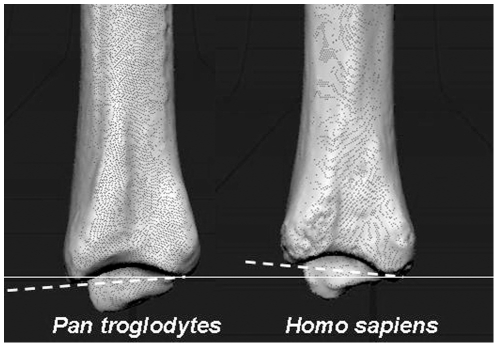
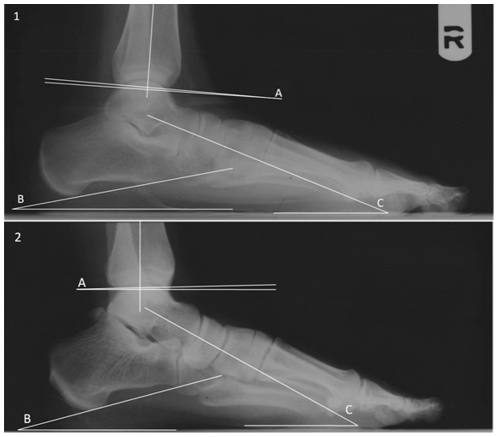
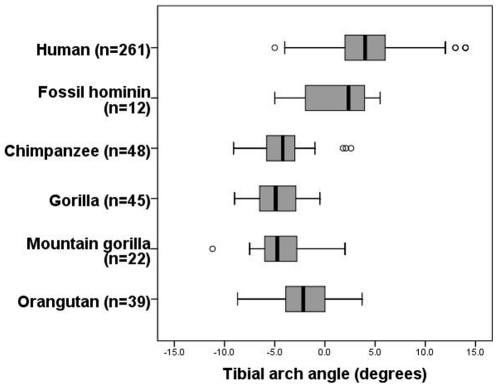
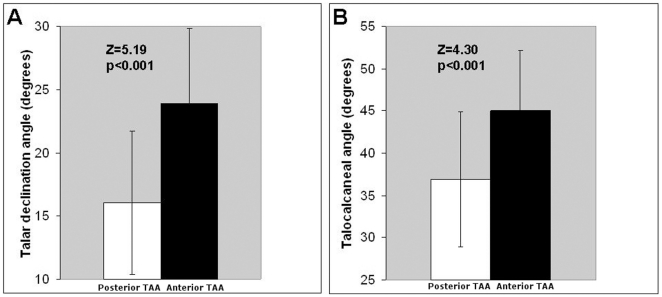
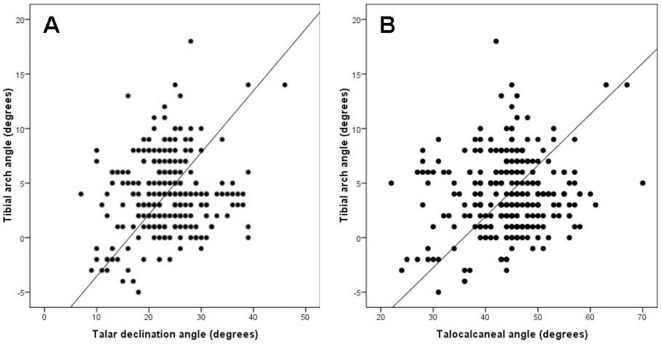
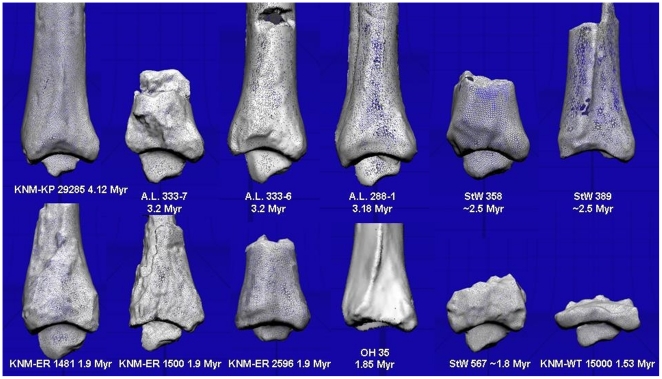
Methodology/principal findings: Here, we present evidence from radiographs of modern humans (n = 261) that the set of the distal tibia in the sagittal plane, henceforth referred to as the tibial arch angle, is related to rearfoot arching. Non-human primates have a posteriorly directed tibial arch angle, while most humans have an anteriorly directed tibial arch angle. Those humans with a posteriorly directed tibial arch angle (8%) have significantly lower talocalcaneal and talar declination angles, both measures of an asymptomatic flatfoot. Application of these results to the hominin fossil record reveals that a well developed rearfoot arch had evolved in Australopithecus afarensis. However, as in humans today, Australopithecus populations exhibited individual variation in foot morphology and arch development, and "Lucy" (A.L. 288-1), a 3.18 Myr-old female Australopithecus, likely possessed asymptomatic flat feet. Additional distal tibiae from the Plio-Pleistocene show variation in tibial arch angles, including two early Homo tibiae that also have slightly posteriorly directed tibial arch angles.
Conclusions/significance: This study finds that the rearfoot arch was present in the genus Australopithecus. However, the female Australopithecus afarensis "Lucy" has an ankle morphology consistent with non-pathological flat-footedness. This study suggests that, as in humans today, there was variation in arch development in Plio-Pleistocene hominins.
Conflict of interest statement
Figures
References
-
- Ker RF, Bennett MB, Bibby SR, Kester RC, Alexander RMcN. The spring in the arch of the human foot. Nature. 1987;325:147–149. - PubMed
-
- Sarrafian SK. Functional characteristics of the foot and plantar aponeurosis under tibiotalar loading. Foot Ankle. 1987;8:4–18. - PubMed
-
- Morton DJ. The Human Foot. New York: Columbia University Press; 1935. 257
-
- Harris EJ. The natural history and pathophysiology of flexible flatfoot. Clin Pod Med Surg. 2010;27:1–23. - PubMed
MeSH terms
LinkOut - more resources
Full Text Sources
Medical
