. 2010 Dec 23;6(12):e1001261.
doi: 10.1371/journal.pgen.1001261.

Self-mating in the definitive host potentiates clonal outbreaks of the apicomplexan parasites Sarcocystis neurona and Toxoplasma gondii

Affiliations

Self-mating in the definitive host potentiates clonal outbreaks of the apicomplexan parasites Sarcocystis neurona and Toxoplasma gondii

Jered M Wendte et al. PLoS Genet. .

Abstract

Tissue-encysting coccidia, including Toxoplasma gondii and Sarcocystis neurona, are heterogamous parasites with sexual and asexual life stages in definitive and intermediate hosts, respectively. During its sexual life stage, T. gondii reproduces either by genetic out-crossing or via clonal amplification of a single strain through self-mating. Out-crossing has been experimentally verified as a potent mechanism capable of producing offspring possessing a range of adaptive and virulence potentials. In contrast, selfing and other life history traits, such as asexual expansion of tissue-cysts by oral transmission among intermediate hosts, have been proposed to explain the genetic basis for the clonal population structure of T. gondii. In this study, we investigated the contributing roles self-mating and sexual recombination play in nature to maintain clonal population structures and produce or expand parasite clones capable of causing disease epidemics for two tissue encysting parasites. We applied high-resolution genotyping against strains isolated from a T. gondii waterborne outbreak that caused symptomatic disease in 155 immune-competent people in Brazil and a S. neurona outbreak that resulted in a mass mortality event in Southern sea otters. In both cases, a single, genetically distinct clone was found infecting outbreak-exposed individuals. Furthermore, the T. gondii outbreak clone was one of several apparently recombinant progeny recovered from the local environment. Since oocysts or sporocysts were the infectious form implicated in each outbreak, the expansion of the epidemic clone can be explained by self-mating. The results also show that out-crossing preceded selfing to produce the virulent T. gondii clone. For the tissue encysting coccidia, self-mating exists as a key adaptation potentiating the epidemic expansion and transmission of newly emerged parasite clones that can profoundly shape parasite population genetic structures or cause devastating disease outbreaks.


Conflict of interest statement

The authors have declared that no competing interests exist.

Figures

Figure 1
Figure 1. Genotype analysis of Toxoplasma gondii strains associated with an outbreak in Santa Isabel do Ivai, Brazil.
All T. gondii isolates were analyzed directly by sequencing at microsatellite (MS) loci and PCR-RFLP at the remaining loci except for Outbreak 1 and Outbreak 2 which were directly sequenced at all loci. Outbreak 1, Outbreak 2, TgCatBr85, and TgCkBr98–103 all possess one of two alleles at each locus, suggesting they are sibling progeny from a recent outcross. Outbreak 1 and Outbreak 2 were oocyst samples isolated from two separate water filters from water supplies implicated in the outbreak and possess identical genotypes indicative of a clonal outbreak. This suggests an outcross preceded the outbreak and was followed by a selfing event in the definitive host that enhanced the clonal expansion and transmission of the newly emerged, recombinant outbreak genotype. Shaded alleles indicate those which are identical to the Outbreak genotype. *Serotype, DNA sequence, and PCR RFLP data from Vaudaux et al. ; **Numbers indicate dinucleotide repeat count and letters indicate distinguishing SNPs surrounding the repeat region; MS: microsatellite; WC: water cistern; Ch: chicken; Lab: laboratory strain; na: not available.
Figure 2
Figure 2. Sarocystis neurona genotyping results.
Distribution of the 12 Ag types (A) and 33 MS types (B) identified among all Sarcocystis neurona samples studied (n = 87). Ag type I and II accounted for the majority of all samples with 27 and 29 samples, respectively. The most numerous MS type identified was type g, accounting for 26 total samples. (C) Further analysis of MS types using the eBURST program on default settings for 9 loci (Sn2–Sn5, Sn7–Sn11), revealed that 64% of all isolates belonged to two clonal complexes. Clonal complex 1 (CC1) was comprised of MS types a, b, c, d, e, and gg and CC2 of types g, h, i, j, and k. All MS types in CC1 possessed Ag type I. MS types g, h, i, and j of CC2 possessed Ag type II, whereas MS type k possessed Ag type III. *MS type c was found in 11/12 examined S. neurona strains from sea otters that died during the 2004 epizootic.
Figure 3
Figure 3. Modified eBURST analysis output.
Default eBURST settings were used to analyze Sarcocystis neurona sequence types based on MS markers Sn2–Sn5 and Sn7–Sn11. MS types identified are represented as small circles and designated by lowercase letters. Lines connect MS types that are identical at 8 out of 9 MS loci and are therefore considered part of a clonal complex (CC). eBURST identified 8 clonal complexes (designated CC1–CC8) and 8 singletons. Large colored ovals are overlain to indicate the Ag type (Ag types I–XII) that characterizes each MS type identified by eBURST. MS and Ag type color schemes refer to those described in Table S1. Results support an intermediate population structure with both clonal propagation and sexual recombination. All members of CC1 possess an identical Ag type (Ag type I). MS types x and bb were found in samples with different Ag types (VII and VIII). Ag types VII and VIII differ by a single di-nucleotide indel at Ag marker SnSAG3, likely representative of drift rather than recombination as a mechanism to account for allele differences in this case. In contrast, MS type k has a markedly different Ag type (III) compared to other members of the CC2, which all possess Ag type II. Ag types II and III have different alleles at all Ag loci examined, making a recombination event the most parsimonious explanation for the difference between MS type k and other members of CC2 rather than genetic drift.
Figure 4
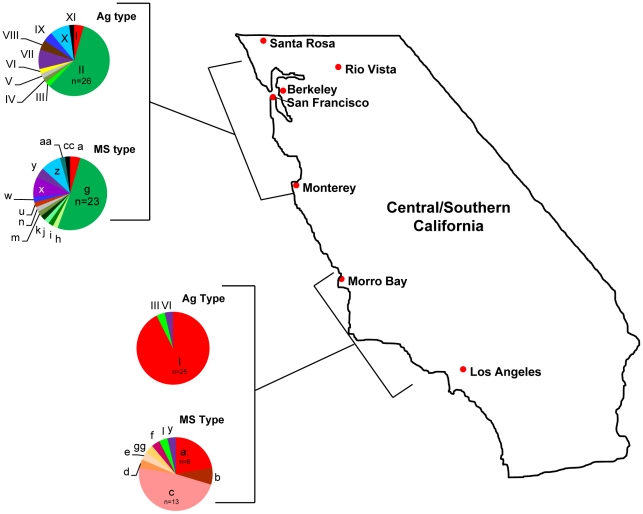
Figure 4. Geographic distribution of Sarcocystis neurona Ag and MS types in California.
All sea otter samples were collected in two distinct, ∼200 km stretches along the California coast: one in central California from just north of San Francisco Bay to just south of Monterey Bay, and one to the south from just north of Morro Bay to just north of Los Angeles. Nearly all (93%) of the 27 samples from the southern region belonged to eBURST defined clonal complex (CC) 1 and none were identified as CC2. In the north, 63% of 45 samples belong to CC2 and only two representatives of CC1 were found. Terrestrial isolates from California were from 10 opossums and 4 horses. These, along with one sample from a porpoise, were from the northern range and included as such. The majority of sea otter samples were from two small areas of coastline: one near Monterey Bay in the north and the other near Morro Bay in the south (see Table S1 for details).
Figure 5
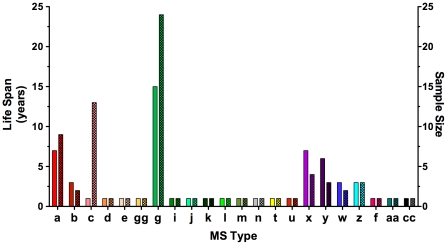
Figure 5. Sarocystis neurona MS type lifespan and sample size in California.
Lifespans for microsatellite (MS) types (solid bars) were defined as the time period from identification the first representative sample to the last during the 15 years (1994–2009) encompassed in this study. Sample sizes are indicated by checkered bars. MS type ‘g,’ a member of eBURST defined clonal complex 2 (CC2), was the longest lived and most prevalent MS type, having a representative sample in all of the years for which samples were available. There were no S. neurona samples available for testing during 1996–1998. MS type ‘c,’ the genotype implicated in the sea otter epizootic, was only found in 2004 during the month of the outbreak and four months thereafter in the same region.
Figure 6
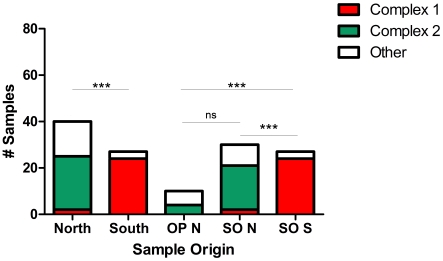
Figure 6. Geographic partitioning and host associations of Sarcocystis neurona strains.
Distinct S. neurona populations as defined by the proportion of the population belonging to the dominant eBURST defined clonal complexes (CC) 1 or 2 were found infecting animals in the northern and southern ranges examined in California (see Figure 4). This difference remained significant by Chi-Square analysis when only sea otter samples were compared. When samples from sea otters from the northern range were compared to opossum samples from the adjacent terrestrial environment, no significant difference was found. There were no samples from terrestrial mammals in the southern range. OP N: opossum samples from the northern range; SO N: sea otter samples from the northern range; SO S: sea otter samples from the southern range; ns: not significant; ***p<0.00001.

References

    1. Li W, Raoult D, Fournier PE. Bacterial strain typing in the genomic era. FEMS Microbiol Rev. 2009;33:892–916. - PubMed
    1. Feil EJ, Spratt BG. Recombination and the population structures of bacterial pathogens. Annu Rev Microbiol. 2001;55:561–590. - PubMed
    1. Smith GJ, Vijaykrishna D, Bahl J, Lycett SJ, Worobey M, et al. Origins and evolutionary genomics of the 2009 swine-origin H1N1 influenza A epidemic. Nature. 2009;459:1122–1125. - PubMed
    1. Powers C, DeFilippis V, Malouli D, Fruh K. Cytomegalovirus immune evasion. Curr Top Microbiol Immunol. 2008;325:333–359. - PubMed
    1. Aires-de-Sousa M, Correia B, de Lencastre H. Changing patterns in frequency of recovery of five methicillin-resistant Staphylococcus aureus clones in Portuguese hospitals: surveillance over a 16-year period. J Clin Microbiol. 2008;46:2912–2917. - PMC - PubMed

Publication types

MeSH terms