


Large number discrimination by mosquitofish
- PMID: 21203508
- PMCID: PMC3008722
- DOI: 10.1371/journal.pone.0015232
Large number discrimination by mosquitofish
Abstract
Background: Recent studies have demonstrated that fish display rudimentary numerical abilities similar to those observed in mammals and birds. The mechanisms underlying the discrimination of small quantities (<4) were recently investigated while, to date, no study has examined the discrimination of large numerosities in fish.
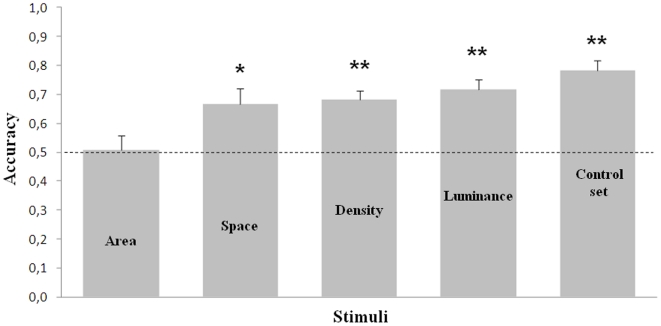
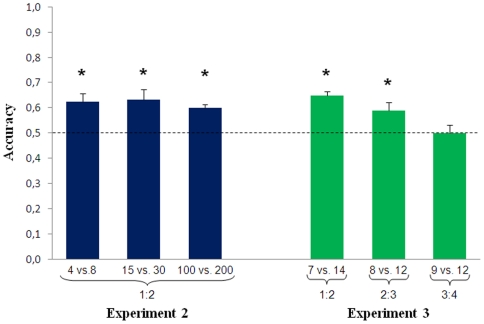
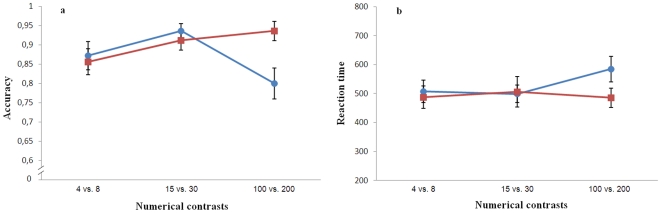
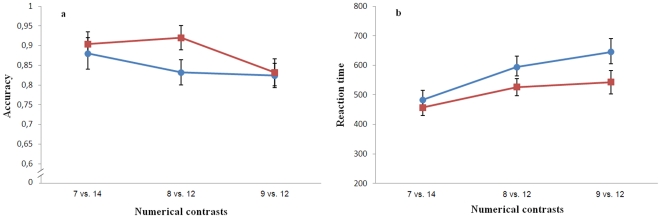
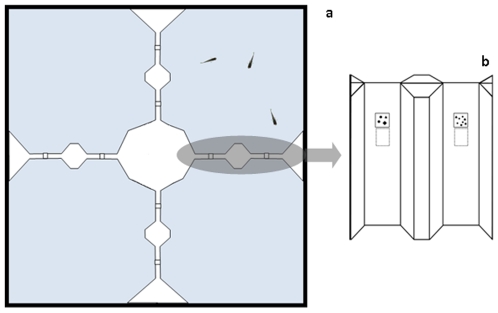
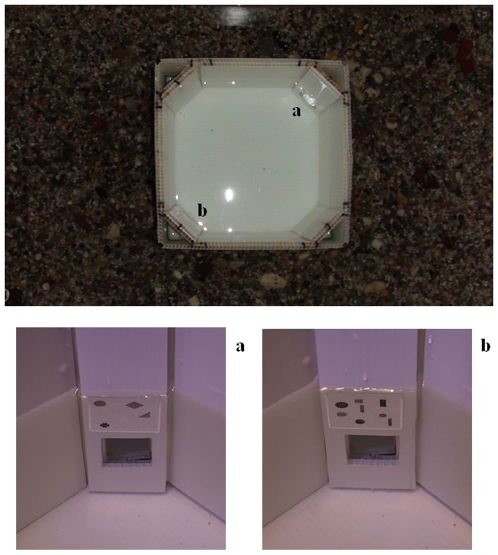
Methodology/principal findings: Subjects were trained to discriminate between two sets of small geometric figures using social reinforcement. In the first experiment mosquitofish were required to discriminate 4 from 8 objects with or without experimental control of the continuous variables that co-vary with number (area, space, density, total luminance). Results showed that fish can use the sole numerical information to compare quantities but that they preferentially use cumulative surface area as a proxy of the number when this information is available. A second experiment investigated the influence of the total number of elements to discriminate large quantities. Fish proved to be able to discriminate up to 100 vs. 200 objects, without showing any significant decrease in accuracy compared with the 4 vs. 8 discrimination. The third experiment investigated the influence of the ratio between the numerosities. Performance was found to decrease when decreasing the numerical distance. Fish were able to discriminate numbers when ratios were 1:2 or 2:3 but not when the ratio was 3:4. The performance of a sample of undergraduate students, tested non-verbally using the same sets of stimuli, largely overlapped that of fish.
Conclusions/significance: Fish are able to use pure numerical information when discriminating between quantities larger than 4 units. As observed in human and non-human primates, the numerical system of fish appears to have virtually no upper limit while the numerical ratio has a clear effect on performance. These similarities further reinforce the view of a common origin of non-verbal numerical systems in all vertebrates.
Conflict of interest statement
Figures
References
-
- McComb K, Packer C, Pusey A. Roaring and numerical assessment in contests between groups of female lions, Panthera leo. Animal Behaviour. 1994;47:379–387.
-
- Lyon BE. Egg recognition and counting reduce costs of avian conspecific brood parasitism. Nature. 2003;422:495–499. - PubMed
-
- Beran MJ, Evans TA, Leighty KA, Harris EH, Rice D. Summation and quantity judgments of sequentially presented sets by capuchin monkeys (Cebus apella). American Journal of Primatology. 2008;70:191–194. - PubMed
-
- Kilian A, Yaman S, von Fersen L, Güntürkün O. A bottlenose dolphin discriminates visual stimuli differing in numerosity. Learning & Behavior. 2003;31:133–142. - PubMed
-
- Matsuzawa T. Symbolic representation of number in chimpanzees. Current Opinion in Neurobiology. 2009;19:92–98. - PubMed
Publication types
MeSH terms
LinkOut - more resources
Full Text Sources
