doi: 10.1158/1940-6207.CAPR-10-0345.
The search for unaffected individuals with Lynch syndrome: do the ends justify the means?
Affiliations
- PMID: 21205737
- PMCID: PMC3076593
- DOI: 10.1158/1940-6207.CAPR-10-0345
Item in Clipboard
The search for unaffected individuals with Lynch syndrome: do the ends justify the means?
Cancer Prev Res (Phila).
2011 Jan.
Abstract
Lynch syndrome is the most common cause of inherited colorectal and endometrial cancers yet it is underrecognized in clinical practice. The relative merits of screening for Lynch syndrome among healthy adults without cancer versus among adults with colorectal or endometrial cancer are discussed in this Perspective article. Newly diagnosed colorectal cancer patients are a much easier target population for screening and this approach leads to more informative genetic test results, at a lower cost in most cases.
©2011 AACR.
Conflict of interest statement
Ms. Hampel has received honoraria from Myriad Genetic Laboratories, Inc., for serving on a Lynch syndrome Advisory Panel.
Figures

Family history of colorectal cancer not due to Lynch syndrome. This family does not have LS despite the strong history of early-onset colorectal cancer. Tumor testing in the proband (bottom row, left) and his affected sister (bottom row, right) was normal (microsatellite stable and all mismatch repair proteins present on immunohistochemistry). Genetic testing was performed on the proband anyway as part of a research study, and he did not have a mutation in any of the mismatch repair genes. This family would be considered to have familial colorectal cancer of undetermined genetic origins (23). If testing had been initiated with his unaffected 35-year-old brother (bottom row, middle), he would have tested negative.
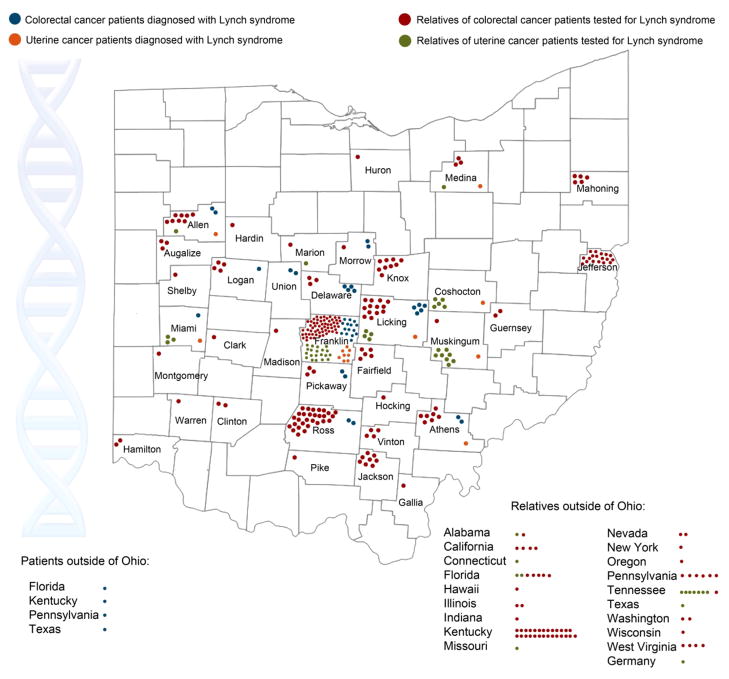
Impact of cascade testing among the relatives of colorectal and endometrial cancer patients found to have Lynch syndrome in the Columbus-area Lynch syndrome study. This study illustrates how testing all newly diagnosed colorectal and endometrial cancer patients at six hospitals in Columbus, Ohio, during a five-year period can benefit relatives throughout the state and country, many of whom are unaffected at-risk individuals.
References
-
- Hampel H, Frankel WL, Martin E, Arnold M, Khanduja K, Kuebler P, Clendenning M, Sotamaa K, Prior T, Westman JA, Panescu J, Fix D, Lockman J, LaJeunesse J, Comeras I, de la Chapelle A. Feasibility of screening for Lynch syndrome among patients with colorectal cancer. J Clin Oncol. 2008;26:5783–5788. - PMC - PubMed
-
- Hampel H, Frankel WL, Martin E, Arnold M, Khanduja K, Kuebler P, Nakagawa H, Sotamaa K, Prior TW, Westman J, Panescu J, Fix D, Lockman J, Comeras I, de la Chapelle A. Screening for the Lynch syndrome (hereditary nonpolyposis colorectal cancer) N Engl J Med. 2005;352:1851–1860. - PubMed
-
- American Cancer Society. Colorectal Cancer Facts & Figures. 2008–2010. http://www.cancer.org/Research/CancerFactsFigures/colorectal-cancer-fact....
-
- Jenkins MA, Baglietto L, Dowty JG, Van Vliet CM, Smith L, Mead LJ, Macrae FA, St John DJ, Jass JR, Giles GG, Hopper JL, Southey MC. Cancer risks for mismatch repair gene mutation carriers: a population-based early onset case-family study. Clin Gastroenterol Hepatol. 2006;4:489–498. - PubMed
-
- Jarvinen HJ, Renkonen-Sinisalo L, Aktan-Collan K, Peltomaki P, Aaltonen LA, Mecklin JP. Ten years after mutation testing for Lynch syndrome: cancer incidence and outcome in mutation-positive and mutation-negative family members. J Clin Oncol. 2009;27:4793–4797. - PubMed
Publication types
MeSH terms
Grants and funding
LinkOut - more resources
Full Text Sources
Other Literature Sources
Medical