


Lipid packing drives the segregation of transmembrane helices into disordered lipid domains in model membranes
- PMID: 21205902
- PMCID: PMC3029762
- DOI: 10.1073/pnas.1009362108
Lipid packing drives the segregation of transmembrane helices into disordered lipid domains in model membranes
Abstract
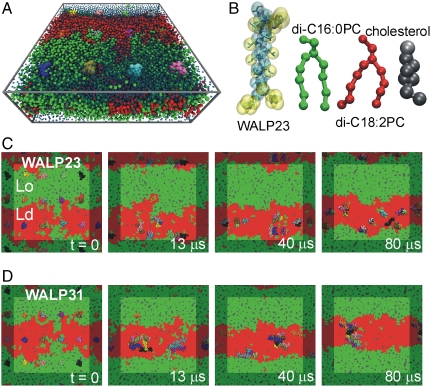
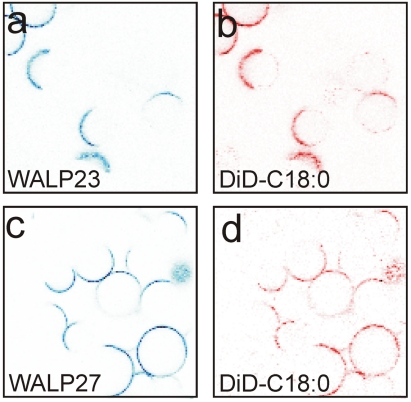
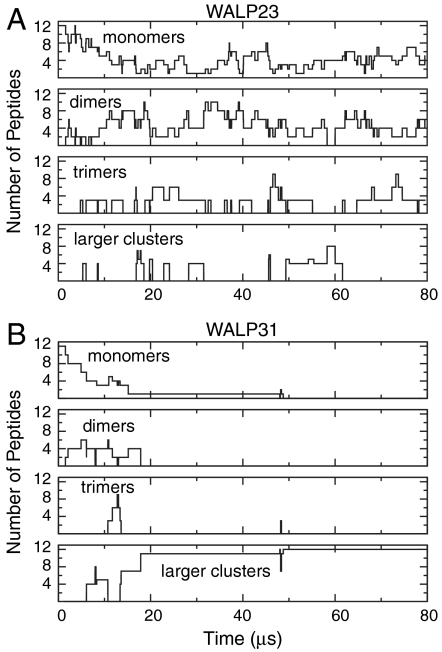
Cell membranes are comprised of multicomponent lipid and protein mixtures that exhibit a complex partitioning behavior. Regions of structural and compositional heterogeneity play a major role in the sorting and self-assembly of proteins, and their clustering into higher-order oligomers. Here, we use computer simulations and optical microscopy to study the sorting of transmembrane helices into the liquid-disordered domains of phase-separated model membranes, irrespective of peptide-lipid hydrophobic mismatch. Free energy calculations show that the enthalpic contribution due to the packing of the lipids drives the lateral sorting of the helices. Hydrophobic mismatch regulates the clustering into either small dynamic or large static aggregates. These results reveal important molecular driving forces for the lateral organization and self-assembly of transmembrane helices in heterogeneous model membranes, with implications for the formation of functional protein complexes in real cells.
Conflict of interest statement
The authors declare no conflict of interest.
Figures
References
-
- Lingwood D, Simons K. Lipid rafts as a membrane-organizing principle. Science. 2010;327:46–50. - PubMed
-
- Simons K, Ikonen E. Functional rafts in cell membranes. Nature. 1997;387:569–572. - PubMed
-
- Eggeling C, et al. Direct observation of the nanoscale dynamics of membrane lipids in a living cell. Nature. 2009;457:1159–1162. - PubMed
-
- Edidin M. The state of lipid rafts: From model membranes to cells. Annu Rev Biophys Biomol Struct. 2003;32:257–283. - PubMed
Publication types
MeSH terms
Substances
LinkOut - more resources
Full Text Sources
Other Literature Sources
