Review
. 2011 Apr;68(8):1395-403.
doi: 10.1007/s00018-010-0613-2. Epub 2011 Jan 5.

Regulation of ribosomal RNA gene copy number and its role in modulating genome integrity and evolutionary adaptability in yeast

Affiliations
Review

Regulation of ribosomal RNA gene copy number and its role in modulating genome integrity and evolutionary adaptability in yeast

Takehiko Kobayashi. Cell Mol Life Sci. 2011 Apr.

Abstract

The genes encoding ribosomal RNA (rRNA) are the most abundant genes in the eukaryotic genome. They reside in tandem repetitive clusters, in some cases totaling hundreds of copies. Due to their repetitive structure and highly active transcription, the rRNA gene repeats are some of the most fragile sites in the chromosome. A unique gene amplification system compensates for loss of copies, thus maintaining copy number, albeit with some fluctuations. The unusual nature of rRNA gene repeats affects cellular functions such as senescence. In addition, we recently found that the repeat number determines sensitivity to DNA damage. In this review, I would like to introduce a new aspect of the rRNA gene repeat (called rDNA) as a center of maintenance of genome integrity and discuss its contribution to evolution.


Figures
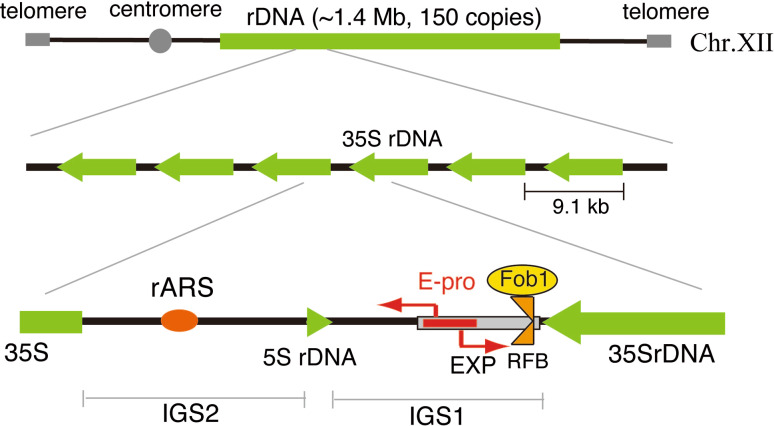
Fig. 1
Fig. 1
Structure of the budding yeast rDNA locus. The rDNA is a tandem repeating array on chromosome XII. A repeating unit (9.1 kb) has 5S and 35S rRNA genes and two intergenic spacer regions (IGS1, 2). rARS and RFB are the replication origin and replication fork barrier site, respectively. EXP (~500 bp) is an expansion sequence that contains RFB and E-pro. E-pro is a bidirectional promoter for non-coding transcripts that function in the regulation of rDNA repeat numbers. The rDNA structure is broadly conserved from yeast to human, though in the human genome the 5S rDNA is found in independent arrays
Fig. 2
Fig. 2
Repair of damage in the rDNA repeats results in the reduction of copy number. a Recombinational repair between the repeats. During G1, DNA damage in one rDNA repeat may be repaired by recombination with another rDNA repeat. rDNA repeats located between the damaged and template copies may be lost by the recombination. b Single-strand annealing (SSA) pathway for repair of repeating genes. When double-strand break (DSB) occurs in a repeat, single-stranded regions are created adjacent to the break and they extend to the complementary strands. Then the strands anneal to each other to repair. In this case, a copy will be lost
Fig. 3
Fig. 3
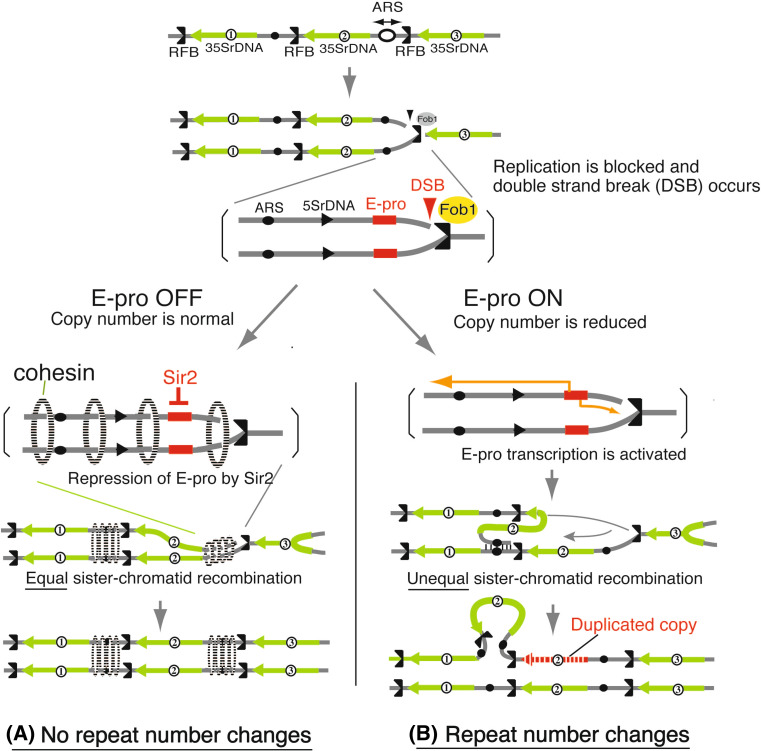
rDNA amplification model. a In normal situations, the silencing protein, Sir2, represses E-pro activity, allowing the cohesin protein complex (dotted ellipse) to associate with the IGS. DSBs are repaired by equal sister chromatid recombination, with no change in rDNA copy number. b In situations where copy number is reduced, Sir2 repression is removed and E-pro is activated. This E-pro transcription displaces cohesin from the IGS. The lack of cohesion means that unequal sister chromatids can be used as templates for repair of DSBs, resulting in changes in rDNA copy number. The gray lines represent single chromatids (double-strand DNA) (see text for the details)
Fig. 4
Fig. 4
Asymmetrical cell division in budding yeast. a Life cycle of budding yeast. Budding yeast divides asymmetrically. The mother (bigger) cell ages with each cell division, leading to senescence after ~20 cell cycles. However, the daughter cell (smaller) rejuvenates and maintains the capability for division. b rDNA is unstable in the mother. Defective cellular constituents such as oxidized proteins, vacuoles, episomes, and old mitochondria stay and accumulate in the mother cell. Stable rDNA segregates to the daughter cell while unstable rDNA remains in the mother
Fig. 5
Fig. 5
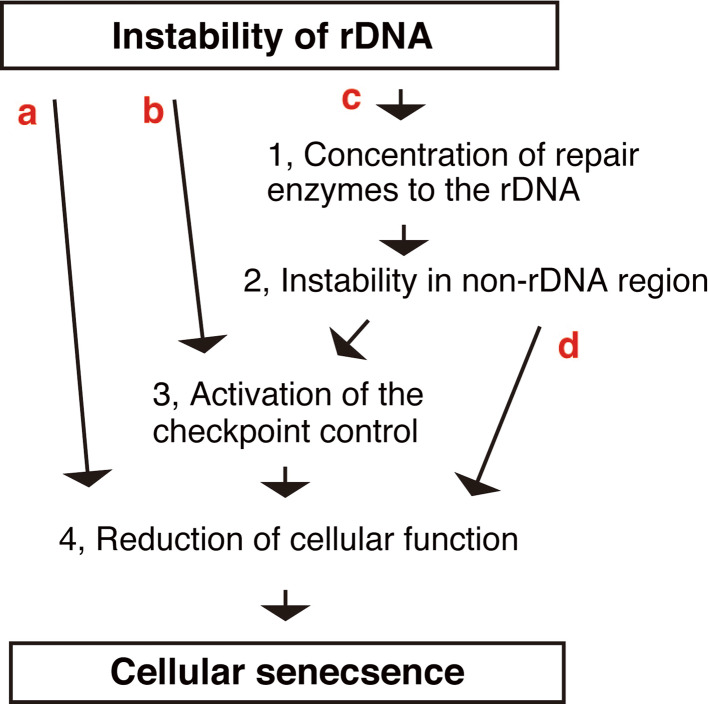
The rDNA theory for aging. The rDNA is one of the most unstable regions in the genome. Therefore, its instability affects cellular functions. rDNA instability a directly reduces cellular functions through dysfunction of ribosomes, b activates the damage checkpoint control that reduces cellular functions through elongation of cell cycle, c sequesters repair enzymes, resulting in the instability of non-rDNA regions and d the instability of non-rDNA regions reduces cellular functions through the checkpoint control and dysfunction of important genes (see [1])
Fig. 6
Fig. 6
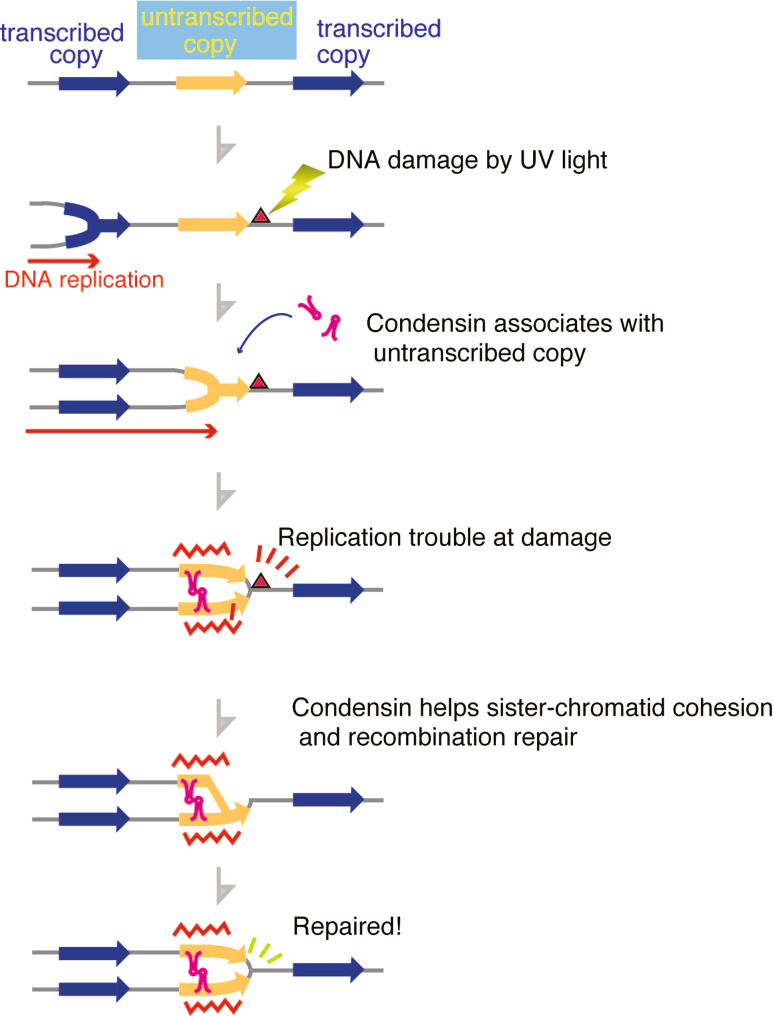
Untranscribed copies repair DNA damage. In the rDNA repeats, about half of the copies are not transcribed. Such untranscribed copies in the rDNA are the “foothold” for condensin, a protein that facilitates DNA repair by mediating sister-chromatid cohesion. The cohesion makes recombinational repair possible (see text for detail)

References

    1. Kobayashi T. A new role of the rDNA and nucleolus in the nucleus—rDNA instability maintains genome integrity. BioEssays. 2008;30:267–272. doi: 10.1002/bies.20723. - DOI - PubMed
    1. Watson JD, et al. Molecular biology of the gene. 5. New York: CSHL Press; 2004.
    1. Warner JR. The economics of ribosome biosynthesis in yeast. Trends Biochem Sci. 1999;24:437–440. doi: 10.1016/S0968-0004(99)01460-7. - DOI - PubMed
    1. Sakai M, Ohta T, Minoshima S, Kudoh J, Wang Y, de Jong PJ, et al. Human ribosomal RNA gene cluster: identification of the proximal end containing a novel tandem repeat sequence. Genomics. 1995;26:521–526. doi: 10.1016/0888-7543(95)80170-Q. - DOI - PubMed
    1. Ingle J, Timmis JN, Sinclair J. The relationship between satellite deoxyribonucleic acid, ribosomal ribonucleic acid gene redundancy, and genome size in plants. Plant Physiol. 1975;55:496–501. doi: 10.1104/pp.55.3.496. - DOI - PMC - PubMed

Publication types