Comparative Study
. 2011 Mar;81(2):198-205.
doi: 10.2319/060510-309.1.

Esthetics and smile characteristics evaluated by laypersons

Affiliations
Comparative Study

Esthetics and smile characteristics evaluated by laypersons

Catherine McLeod et al. Angle Orthod. 2011 Mar.

Abstract

Objective: To collect data regarding Canadian laypersons' perceptions of smile esthetics and compare these data to US data in order to evaluate cultural differences.

Materials and methods: Using Adobe Photoshop 7, a digital image of a posed smile of a sexually ambiguous lower face was prepared so that hard and soft tissue could be manipulated to alter buccal corridor (BC), gingival display (GD), occlusal cant (OC), maxillary midline to face discrepancy (MMFD), and lateral central gingival discrepancy (LCGD). Adult Canadian laypersons (n = 103) completed an interactive computer-based survey of 29 randomized images to compare smile preferences for these variables. The custom survey was developed to display fluid, continuously appearing modifiable smile variables using MATLAB R2008 for presentation. These data were compared with previously published data for US laypersons. Statistical inference was determined using Wilcoxon rank sum tests.

Results: Canadian laypersons were more sensitive in detecting deviations from ideal and had a narrower range of acceptability thresholds for BC, GD, OC, MMFD, and LCGD. Ideal esthetic values were significantly different only for BC.

Conclusions: It appears that cultural differences do exist related to smile characteristics. Clinically significant differences in the preference of the smile characteristics were found between Canadian and US laypersons. Canadian laypersons, on average, were more discriminating to deviations from ideal and had a narrower range of acceptability.


Figures

Figure 1
Figure 1
Example of filmstrip of maxillary cant changing from severe to less severe. Ker AJ, Chan R, Fields HW, Beck M, Rosenstiel S. Esthetics and smile characteristics from the layperson's perspective: a computer-based survey study. J Am Dent Assoc. 2008;139(10):1318–1327. Copyright © 2008 American Dental Association. All rights reserved. Reprinted by permission.
Figure 2
Figure 2
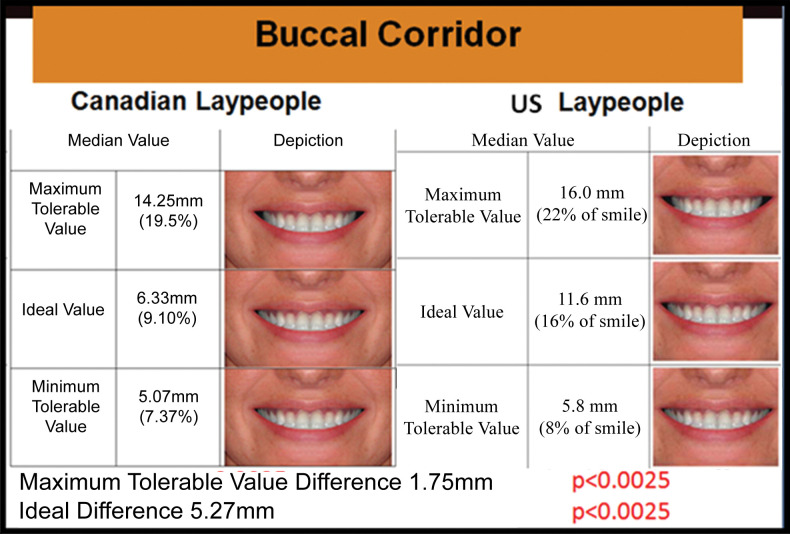
Summary of statistics for defining the ideal and acceptable smile characteristics: buccal corridor. Ker AJ, Chan R, Fields HW, Beck M, Rosenstiel S. Esthetics and smile characteristics from the layperson's perspective: a computer-based survey study. J Am Dent Assoc. 2008;139(10):1318–1327. Copyright © 2008 American Dental Association. All rights reserved. Reprinted by permission.
Figure 3
Figure 3
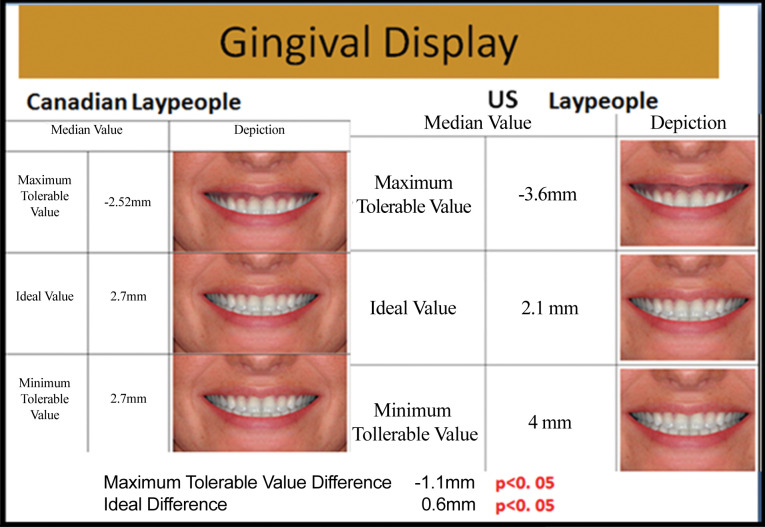
Summary of statistics for defining the ideal and acceptable smile characteristics: gingival display. Ker AJ, Chan R, Fields HW, Beck M, Rosenstiel S. Esthetics and smile characteristics from the layperson's perspective: a computer-based survey study. J Am Dent Assoc. 2008;139(10):1318–1327. Copyright © 2008 American Dental Association. All rights reserved. Reprinted by permission.
Figure 4
Figure 4
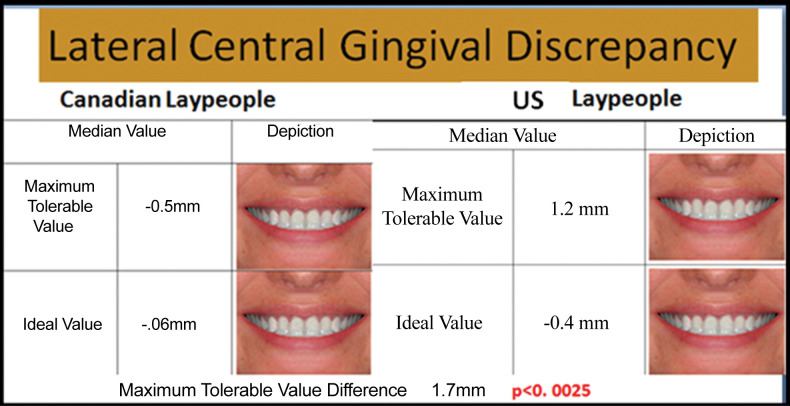
Summary of statistics for defining the ideal and acceptable smile characteristics: lateral central gingival discrepancy. Ker AJ, Chan R, Fields HW, et al. Esthetics and smile characteristics from the layperson's perspective: a computer-based survey study. J Am Dent Assoc. 2008;139(10):1318–1327. Copyright © 2008 American Dental Association. All rights reserved. Reprinted by permission.
Figure 5
Figure 5
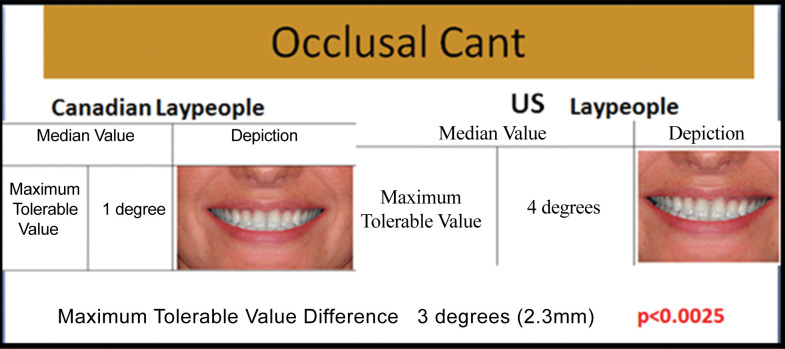
Summary of statistics for defining the ideal and acceptable smile characteristics: occlusal cant. Ker AJ, Chan R, Fields HW, Beck M, Rosenstiel S. Esthetics and smile characteristics from the layperson's perspective: a computer-based survey study. J Am Dent Assoc. 2008;139(10):1318–1327. Copyright © 2008 American Dental Association. All rights reserved. Reprinted by permission.
Figure 6
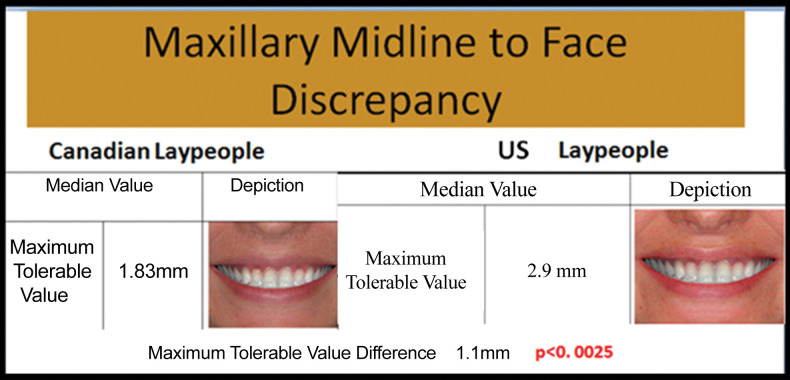
Figure 6
Summary of statistics for defining the ideal and acceptable smile characteristics: maxillary midline to face discrepancy. Ker AJ, Chan R, Fields HW, Beck M, Rosenstiel S. Esthetics and smile characteristics from the layperson's perspective: a computer-based survey study. J Am Dent Assoc. 2008;139(10):1318–1327. Copyright © 2008 American Dental Association. All rights reserved. Reprinted by permission.
Figure 7
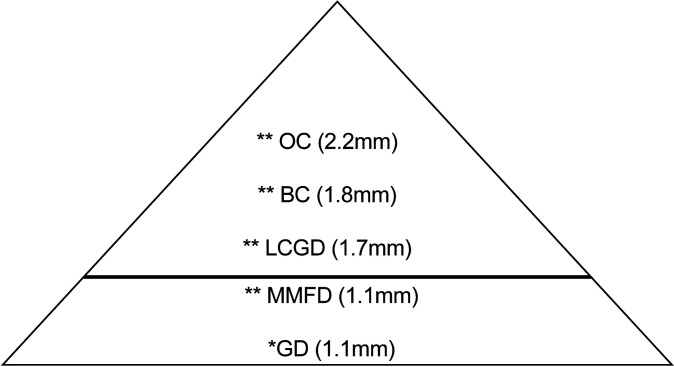
Figure 7
Hierarchy of differences between the US and Canadian median maximum tolerable limit of acceptability. In each case, the Canadian raters were less tolerant of deviations from the ideal than US raters. * P < .05; ** P < .0025.

References

    1. Gracco A, Cozzani M, D'Elia L, Manfrini M, Peverada C, Siciliani G. The smile buccal corridors: aesthetic value for dentists and laypersons. Prog Orthod. 2006;7:56–65. - PubMed
    1. Gul E. E, Fida M. Changes in smile parameters as perceived by orthodontists, dentists, artists, and laypeople. World J Orthod. 2008;9:132–140. - PubMed
    1. Moore T, Southard K. A, Casko J. S, Qian F, Southard T. E. Buccal corridors and smile esthetics. Am J Orthod Dentofacial Orthop. 2005;127:208–213. - PubMed
    1. Kokich V. O, Jr, Kiyak H. A, Shapiro P. A. Comparing the perception of dentists and lay people to altered dental esthetics. J Esthet Dent. 1999;11:311–324. - PubMed
    1. Parekh S. M, Fields H. W, Beck M, Rosenstiel S. Attractiveness of variations in the smile arc and buccal corridor space as judged by orthodontists and laymen. Angle Orthod. 2006;76:557–563. - PubMed

LinkOut - more resources