. 2011 Jan 6:12:9.
doi: 10.1186/1471-2164-12-9.

The genome sequence of E. coli W (ATCC 9637): comparative genome analysis and an improved genome-scale reconstruction of E. coli

Affiliations

The genome sequence of E. coli W (ATCC 9637): comparative genome analysis and an improved genome-scale reconstruction of E. coli

Colin T Archer et al. BMC Genomics. .

Abstract

Background: Escherichia coli is a model prokaryote, an important pathogen, and a key organism for industrial biotechnology. E. coli W (ATCC 9637), one of four strains designated as safe for laboratory purposes, has not been sequenced. E. coli W is a fast-growing strain and is the only safe strain that can utilize sucrose as a carbon source. Lifecycle analysis has demonstrated that sucrose from sugarcane is a preferred carbon source for industrial bioprocesses.

Results: We have sequenced and annotated the genome of E. coli W. The chromosome is 4,900,968 bp and encodes 4,764 ORFs. Two plasmids, pRK1 (102,536 bp) and pRK2 (5,360 bp), are also present. W has unique features relative to other sequenced laboratory strains (K-12, B and Crooks): it has a larger genome and belongs to phylogroup B1 rather than A. W also grows on a much broader range of carbon sources than does K-12. A genome-scale reconstruction was developed and validated in order to interrogate metabolic properties.

Conclusions: The genome of W is more similar to commensal and pathogenic B1 strains than phylogroup A strains, and therefore has greater utility for comparative analyses with these strains. W should therefore be the strain of choice, or 'type strain' for group B1 comparative analyses. The genome annotation and tools created here are expected to allow further utilization and development of E. coli W as an industrial organism for sucrose-based bioprocesses. Refinements in our E. coli metabolic reconstruction allow it to more accurately define E. coli metabolism relative to previous models.


Figures
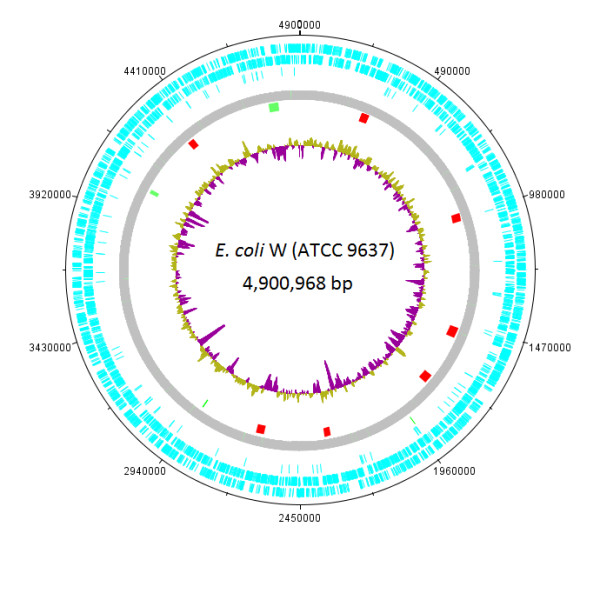
Figure 1
Figure 1
Circular map of the E. coli W chromosome. The outer circle shows position in bp. The second, third and fourth circles (blue) show forward ORFs, reverse ORFs, and pseudogenes, respectively. The fifth circle (green) shows pseudoknots. The seventh circle shows large mobile elements (see Table 2 for details); pLEs are in green and prophages are in red. The inner circle shows a plot of G+C content, with purple being G+C and tan being A+T.
Figure 2
Figure 2
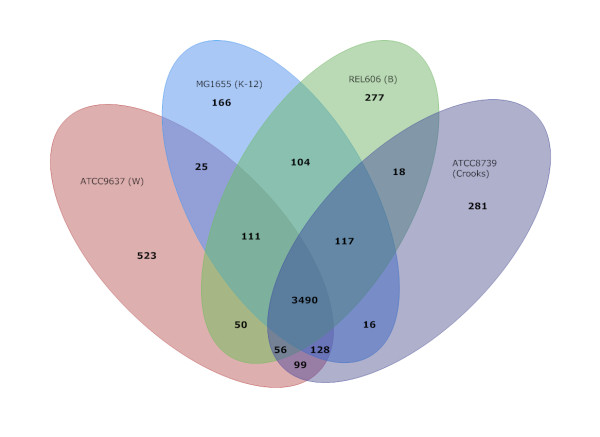
Comparison of orthologous CDSs between W, K-12, B and Crooks strains. The number of shared genes, as well and the number of unique genes and genes shared between one, two, and three strains are shown. All-against-All BLASTP for amino acids (E-value ≤ 1E-5, identity ≥ 90%, coverage ≥ 80%) was used to assign orthologs. Total CDS counts for K-12, B & Crooks differ by 8, 14 & 5 respectively as some CDSs had more than one ortholog in another genome (Additional File 1).
Figure 3
Figure 3
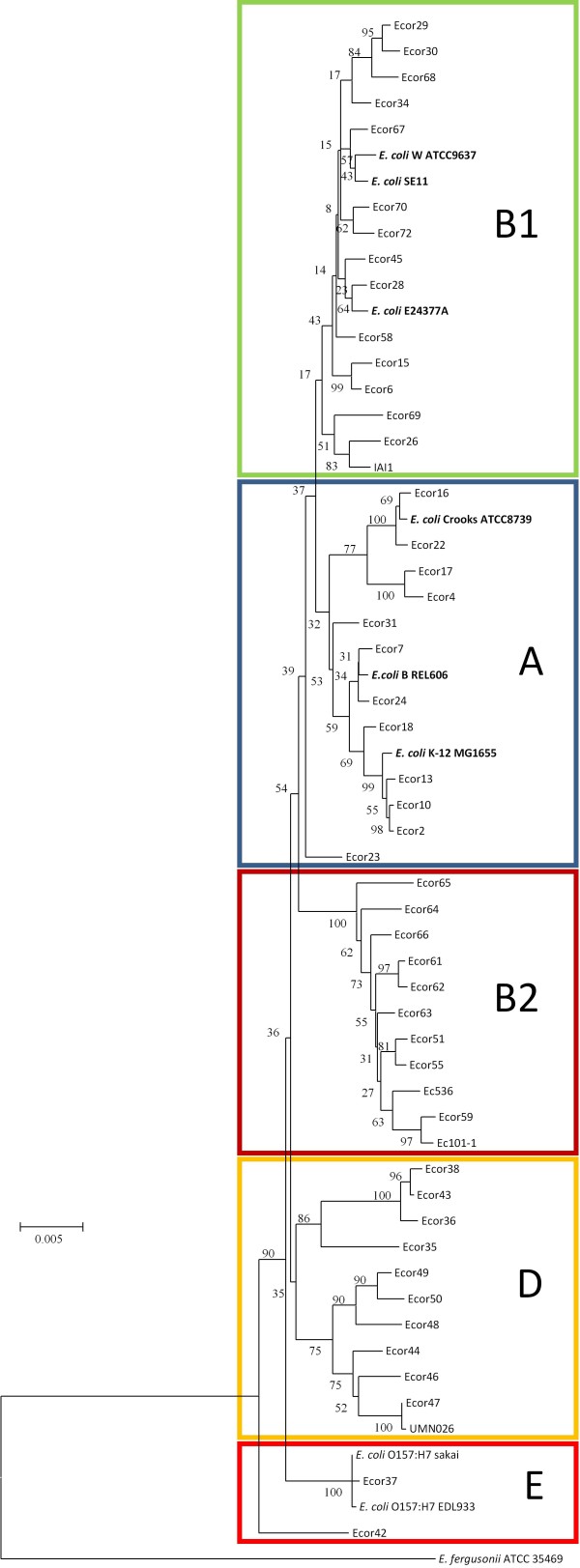
Phylogenetic analysis of sequenced E. coli strains. Phylogenetic relationships based on seven housekeeping genes (adk, fumC, gyrB, icd, mdh, purA, and recA). Strains cluster into phylogroups; W can be found in group B1, whereas the other three laboratory strains are in group A. Escherichia fergusonii (ATCC 35469) was used as an out-group. The tree shows bootstrap values (percentage per 1000 replicates). The scale bar represents divergence time.
Figure 4
Figure 4
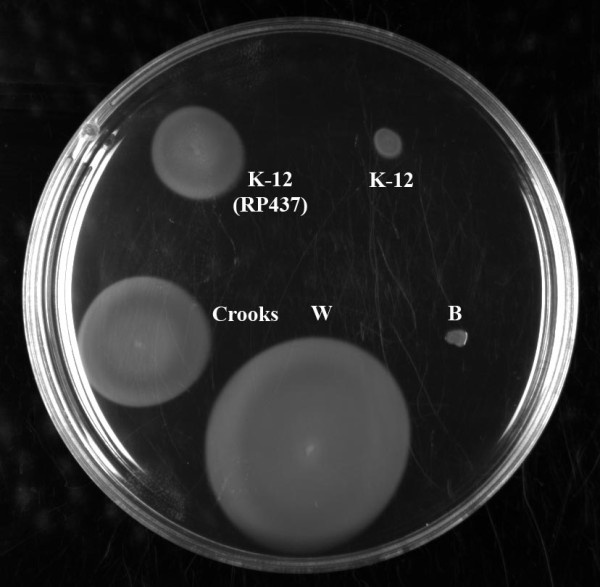
Swarming motility assay. A swarming motility assay was performed using E. coli strains W, Crooks, K-12 (MG1655), K-12 (RP437), and B. B was negative; K-12 (MG1655) showed very minimal swarming, while K-12 (RP437), Crooks and W were positive. Assays were performed in triplicate at 25°C and at 37°C; results were similar at both temperatures (figure shows representative results from 25°C incubation).

References

    1. Bauer A P, Dieckmann S M. et al.Rapid identification of Escherichia coli safety and laboratory strain lineages based on Multiplex-PCR. FEMS Microbiology Letters . 2007;269(1):36–40. doi: 10.1111/j.1574-6968.2006.00594.x. - DOI - PubMed
    1. Bauer A P, Ludwig W. et al.A novel DNA microarray design for accurate and straightforward identification of Escherichia coli safety and laboratory strains. Systematic and Applied Microbiology. 2008;31(1):50–61. doi: 10.1016/j.syapm.2008.01.001. - DOI - PubMed
    1. Esselen WB Jr, Fuller JE. The oxidation of ascorbic acid as influenced by intestinal bacteria. J Bacteriol. 1939;37(5):501–521. - PMC - PubMed
    1. Gunsalus IC, Hand DB. The use of bacteria in the chemical determination of total vitamin C. J Biol Chem. 1941;141(3):853–858.
    1. Gunsalus CF, Tonzetich J. Transaminases for pyridoxamine and purines. Nature. 1952;170(4317):162. doi: 10.1038/170162a0. - DOI - PubMed

Publication types