. 2011 Feb;127(2):430-438.e1-2.
doi: 10.1016/j.jaci.2010.11.013. Epub 2011 Jan 5.

Specificity protein 1 is pivotal in the skin's antiviral response

Affiliations

Specificity protein 1 is pivotal in the skin's antiviral response

Lianghua Bin et al. J Allergy Clin Immunol. 2011 Feb.

Abstract

Background: Previous studies have found specificity protein (Sp) 1 transcription factor in the viral replication machinery and postulated that Sp1 was required for viral replication in host cells.

Objectives: We investigated the role of Sp1 in the skin's antiviral responses from the perspective of host defense and its biological relevance in patients with atopic dermatitis and a history of eczema herpeticum (ADEH(+)).

Methods: Small interfering RNA duplexes were used to knock down Sp1 in keratinocytes. The expression of vaccinia virus (VV), herpes simplex virus 1, and other genes were evaluated by real-time PCR, or combined with Western blot and immunohistofluorescence staining. A total of 106 human subjects participated in this study.

Results: Both VV and herpes simplex virus 1 replication were enhanced in Sp1 knocked-down keratinocytes. Sp1 gene expression was significantly decreased in ADEH(+) subjects compared with patients with atopic dermatitis without a history of eczema herpeticum and nonatopic subjects (P < .0001) and inversely correlated with VV DNA copy number in human skin explants incubated with VV in vitro (partial correlation r = -0.256; P = .009). Gene profiling revealed that the antiviral genes, double-stranded RNA-dependent protein kinase (PKR) and 2'5'-oligoadenylate synthetase 2 (OAS2), were significantly downregulated in Sp1-silenced keratinocytes. Gene expression of PKR and OAS2 was also significantly decreased in skin biopsies from ADEH(+) subjects compared with patients with atopic dermatitis without a history of eczema herpeticum and nonatopic subjects. IFN-γ augmented the antiviral capacity of Sp1-silenced keratinocytes.

Conclusion: Specificity protein 1 knockdown enhances viral replication in keratinocytes by downregulating gene expression of PKR and OAS2. Sp1 deficiency in ADEH(+) patients may contribute to their increased propensity to disseminated skin viral infections. IFN-γ augmentation may be a potential treatment for ADEH(+) patients.


Conflict of interest statement

CONFLICT OF INTEREST STATEMENT

The authors declare that they have no financial conflict of interests.

Figures

Figure 1
Figure 1. Inhibition of Sp1 enhances viral replication in NHK cells
A) Western blot detection of Sp1 and Sp3 protein expression in NHK cells following transfection with three independent siRNA duplexes targeting the Sp1 gene for 48h. TBP is used as a loading control for nuclear protein. B) Relative VV mRNA expression was evaluated by real time quantitative PCR assay. NHK cells were transfected with three different Sp1 siRNA duplexes and scrambled siRNA for 48h and then inoculated with VV (MOI of 0.1) for 24h. C) 24h viral yield of VV was evaluated by a plaque assay. D) Relative HSV-1 mRNA expression was evaluated by real time quantitative PCR assay. NHK cells were transfected with three different Sp1 siRNA duplexes and scrambled siRNA for 48h and then inoculated with HSV-1 (MOI of 0.05) for an additional 24h. All data are presented as mean ± s.e.m., *P<0.05 and **P<0.01 compared with scrambled siRNA. The data shown here are representative of three or four experiments.
Figure 2
Figure 2. Sp1 gene expression is decreased in skin biopsies from ADEH+ patients
A) Relative Sp1 mRNA expression in skin biopsies from non-atopic subjects (n=31), ADEH− subjects (n=55) and ADEH+ subjects (n=20) evaluated by real time quantitative PCR. B) Representative fluorescence images of Sp1 in skin biopsies from non-atopic, ADEH− and ADEH+ subjects. Sp1 (red) presents as nuclear staining, and wheat germ agglutinin conjugated FITC (green) stains the cytoskeleton. Magnification, x 630. C) Mean fluorescence intensity of Sp1 in skin biopsies from non-atopic, ADEH− and ADEH+ subjects.
Figure 3
Figure 3. Sp1 expression level is inversely correlated with VV replication
A) Upper panel: western blot detection of Sp1 expression in NHK cells after transfection with different concentrations of Sp1 siRNA duplexes for 48h. The concentration of Sp1 siRNA duplexes is indicated above each lane. Lower panel: Relative VV mRNA expression was evaluated with different levels of Sp1 silencing in NHK cells with VV inoculation (MOI of 0.01) for 24h (corresponding to upper panel) by real time quantitative PCR. All data are presented as mean ± s.e.m., *P<0.05 and **P<0.01 compared with scrambled siRNA control. B) Sp1 mRNA expression was inversely correlated with VV viral copies in skin explants (Subject group adjusted, partial correlation: r = −0.256, P = 0.009).
Figure 4
Figure 4. PKR/eIF2α pathway is impaired in Sp1 deficient NHK cells and skin of ADEH+ patients
A) Relative PKR mRNA expression in Sp1 silenced NHK cells evaluated by real time quantitative PCR. Data are presented as mean ± s.e.m., representative one of three independent experiments. B) Western blot detection of phosphorylation of eIF2α (p-eIF2α), total eIF2α, Sp1, and β-actin in Sp1 silenced NHK cells and cells transfected with scrambled siRNA duplexes for 48h and then treated with VV (MOI of 0.1) and harvested at various time points. Time after treatment is indicated above each pair of lanes. C) VV mRNA expression in Sp1 and PKR silenced NHK cells as compared to cells transfected with scrambled siRNA as evaluated by real-time PCR. D) Relative PKR mRNA expression in skin explants from ADEH+ subjects (n=20), ADEH− subjects (n=55) and non-atopic subjects (n=31). Data are presented as mean ± s.e.m.
Figure 5
Figure 5. OAS2 is decreased in Sp1 silenced keratinocytes and ADEH+ patients
A–C) Real-time PCR results show that OAS2 is significantly down-regulated, but OAS1 and OAS2 didn’t change significantly in Sp1 silenced NHK. Data are presented as mean ± s.e.m. D) OAS2 gene expression is significantly down-regulated in skin biopsies from ADEH+ subjects as compared to ADEH− and non-atopic subjects.
Figure 6
Figure 6. OAS2 reduction is part of the mechanism resulting in enhanced VV replication in Sp1 silenced keratinocytes
A) OAS2 gene expression in Sp1 and OAS2 silenced NHK cells as compared to cells transfected with scrambled siRNA as evaluated by real-time PCR. B) VV mRNA expression in Sp1 and OAS2 silenced NHK cells as compared to cells transfected with scrambled siRNA as evaluated by real-time PCR. All data are presented as mean ± s.e.m., *P<0.05; **P<0.01; ***P<0.001. The data shown are representative of three experiments.
Figure 7
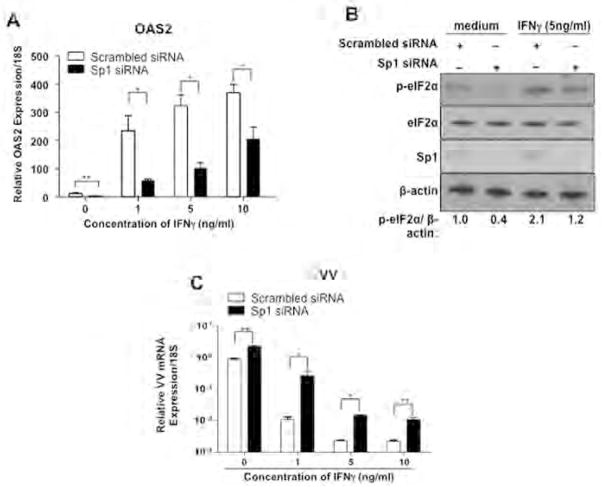
Figure 7. IFNγ treatment significantly augments anti-viral responses in Sp1 deficient keratinocytes
A) OAS2 gene expression in Sp1 silenced NHK and control cells transfected with scrambled siRNA in the presence of different doses of IFNγ as evaluated by real-time PCR. B) Protein phosphorylation of eIF2α in Sp1 silenced NHK and control cells transfected with scrambled siRNA in the absence and presense of IFNγ (5ng/ml) as evaluated by western blot. C) VV mRNA expression in Sp1 silenced NHK and control cells transfected with scrambled siRNA in the presence of different doses of IFNγ as evaluated by real-time PCR. All data are presented as mean ± s.e.m., * P<0.05; ** P<0.01. The data shown here are representative of three experiments.

References

    1. Bieber T. Atopic dermatitis. N Engl J Med. 2008;358:1483–94. - PubMed
    1. Boguniewicz M, Leung DY. Recent insights into atopic dermatitis and implications for management of infectious complications. J Allergy Clin Immunol. 2010;125:4–13. - PMC - PubMed
    1. Beck LA, Boguniewicz M, Hata T, Schneider LC, Hanifin J, Gallo R, et al. Phenotype of atopic dermatitis subjects with a history of eczema herpeticum. J Allergy Clin Immunol. 2009;124:260–9. - PMC - PubMed
    1. Vora S, Damon I, Fulginiti V, Weber SG, Kahana M, Stein SL, et al. Severe eczema vaccinatum in a household contact of a smallpox vaccinee. Clin Infect Dis. 2008;46:1555–61. - PubMed
    1. Bicknell WJ. The case for voluntary smallpox vaccination. N Engl J Med. 2002;346:1323–5. - PubMed

Publication types

MeSH terms