. 2011 Mar;152(3):957-66.
doi: 10.1210/en.2010-1142. Epub 2011 Jan 5.

Kisspeptin regulates gonadotroph and somatotroph function in nonhuman primate pituitary via common and distinct signaling mechanisms

Affiliations

Kisspeptin regulates gonadotroph and somatotroph function in nonhuman primate pituitary via common and distinct signaling mechanisms

Raúl M Luque et al. Endocrinology. 2011 Mar.

Abstract

Kisspeptins (Kps) have emerged as key players in the control of reproductive-axis function, in which they operate as primary regulators of hypothalamic GnRH release. In addition, recent data indicate that Kps can also directly act on the pituitary to stimulate LH and GH release in primary pituitary cell culture prepared from rats, cows, and sheep. We present herein evidence that Kps (specifically Kp-10) can also stimulate LH and GH release in primary pituitary cell cultures prepared from female baboons (Papio anubis), a species that more closely models human physiology. The stimulatory effect of Kp-10 on LH and GH release was dose and time dependent and enhanced the hormonal responses to their major regulators (GnRH for LH; GHRH/ghrelin for GH) without affecting the release of other pituitary hormones (TSH, FSH, ACTH, prolactin). Use of pharmacological intracellular signaling blockers indicated Kp-10 signals through phospholipase C, protein kinase C, MAPK, and intracellular Ca(2+) mobilization, but not adenylyl cyclase, protein kinase A, extracellular Ca(2+) influx (through L-type channels), or nitric oxide synthase, to stimulate both LH and GH release. Interestingly, blockade of mammalian target of rapamycin or phosphoinositol 3-kinase activity fully abolished the stimulatory effect of Kp-10 on LH but not GH release. Of note, estradiol enhanced the relative LH response to Kp-10, alone or in combination with GnRH. In sum, our data are the first to provide evidence that, in a primate model, there is a functional Kp-signaling system within the pituitary, which is dynamically regulated and may contribute to the direct control of gonadotropic and somatotropic axes.


Figures
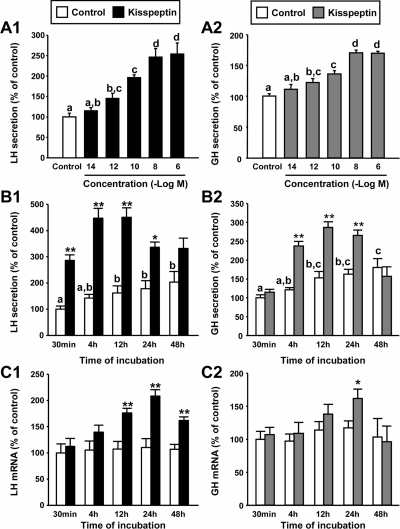
Fig. 1.
Fig. 1.
Direct actions of Kp-10 (10 nm) on baboon LH and GH synthesis and secretion. A, Effect of 4 h treatment with Kp on LH (A1) and GH (A2) release. B, Time-dependent effect of Kp on LH (B1) and GH (B2) release. C, Time-dependent effect of Kp on LH (C1) and GH (C2) mRNA levels. Data are expressed as percent of control (set at 100%) at 4 h (A) or 30 min (B and C). Values represent the mean ± sem (n = 4 individual experiments, three to four wells/experiment). Values that do not share a common letter (a, b, c, d) are statistically different. Asterisks indicate values that significantly differ from their respective control values (same incubation time period). *, P < 0.05; **, P < 0.01.
Fig. 2.
Fig. 2.
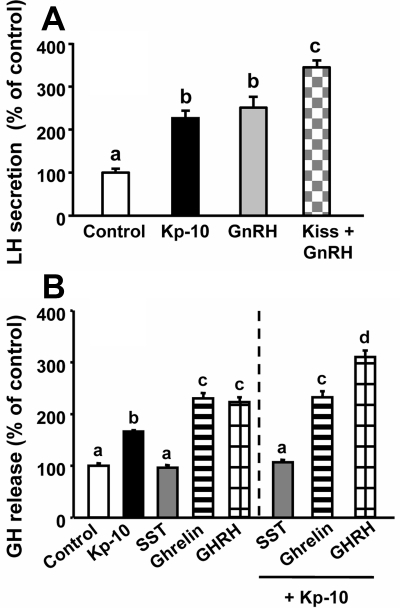
Interaction of Kp-10 (10 nm) with regulators of gonadotrope and somatotrope function in primary pituitary cell cultures from baboons. A, Effect of 4 h treatment of Kp and/or GnRH (10 nm) on LH secretion. B, Effect of 4 h treatment of Kp and/or GHRH, ghrelin (10 nm), or SST (100 nm) on GH secretion. Values are expressed as percentage of controls, set at 100% within each experiment, and represent the mean ± sem of four independent experiments (three to four wells/experiment). Values that do not share a common letter (a, b, c, d) differ significantly (P < 0.05).
Fig. 3.
Fig. 3.
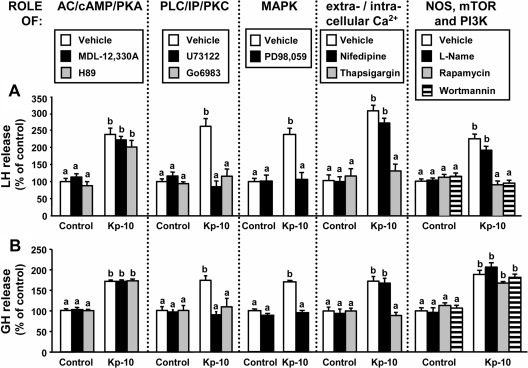
Intracellular signaling pathways of Kp-10-stimulated baboon LH and GH release. Effect of the inhibition of AC (MDL-12,330A; 10 μm), protein kinase A (H89; 15 μm), PLC (U73122; 50 μm), protein kinase C (Go6983; 20 μm), MAPK (PD-98,059; 10 μm), extracellular Ca2+ L-type channels (nifedipine; 1 μm), intracellular Ca2+ channels (thapsigargin; 10 μm), NOS (L-arginine methyl ester hydrochloride; 10 μm), mTOR (rapamycin; 10 nm), and PI3K (wortmannin; 1 μm) on kisspeptin-stimulated LH (A) and GH (B) release. On the day of the experiment, inhibitors were added to the incubation media 90 min before Kp treatment (4 h; 10 nm). Values are expressed as percentage of vehicle-treated controls without inhibitor (set at 100%) within each experiment, and represent the mean ± sem of three to five independent experiments (three to four wells/treatment per experiment). Values that do not share a common letter (a or b) significantly differ (P < 0.05).
Fig. 4.
Fig. 4.
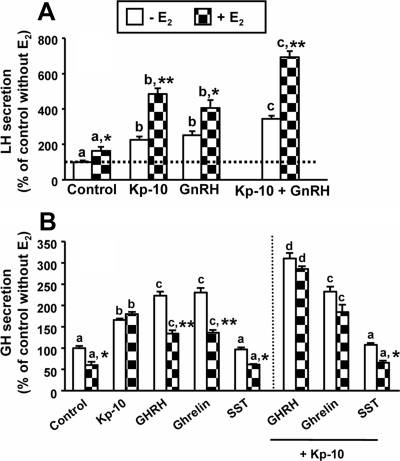
Interaction of Kp-10 (10 nm) with regulators of gonadotrope and somatotrope function in the absence or presence of estradiol (−E2 or +E2, respectively; 10 nm) in primary pituitary cell cultures from baboons. A, Effect of 4 h treatment of Kp and/or GnRH (10 nm) on LH secretion. B, Effect of 4 h treatment of Kp and/or GHRH, ghrelin (10 nm), or SST (100 nm) on GH secretion. Data are expressed as percentage of controls without E2 (set at 100%), and represent the mean ± sem of three to four independent experiments (three to four wells per experiment). Values that do not share a common letter (a, b, c, d) are statistically different. Asterisks indicate values that significantly differ from their respective control values (same treatment in the absence of estradiol). *, P < 0.05; **, P < 0.01.

References

    1. de Roux N, Genin E, Carel JC, Matsuda F, Chaussain JL, Milgrom E. 2003. Hypogonadotropic hypogonadism due to loss of function of the KiSS1-derived peptide receptor GPR54. Proc Natl Acad Sci USA 100:10972–10976 - PMC - PubMed
    1. Seminara SB, Messager S, Chatzidaki EE, Thresher RR, Acierno JS, Jr, Shagoury JK, Bo-Abbas Y, Kuohung W, Schwinof KM, Hendrick AG, Zahn D, Dixon J, Kaiser UB, Slaugenhaupt SA, Gusella JF, O'Rahilly S, Carlton MB, Crowley WF, Jr, Aparicio SA, Colledge WH. 2003. The GPR54 gene as a regulator of puberty. N Engl J Med 349:1614–1627 - PubMed
    1. Oakley AE, Clifton DK, Steiner RA. 2009. Kisspeptin signaling in the brain. Endocr Rev 30:713–743 - PMC - PubMed
    1. Smith JT, Cunningham MJ, Rissman EF, Clifton DK, Steiner RA. 2005. Regulation of Kiss1 gene expression in the brain of the female mouse. Endocrinology 146:3686–3692 - PubMed
    1. Smith JT, Dungan HM, Stoll EA, Gottsch ML, Braun RE, Eacker SM, Clifton DK, Steiner RA. 2005. Differential regulation of KiSS-1 mRNA expression by sex steroids in the brain of the male mouse. Endocrinology 146:2976–2984 - PubMed

Publication types

MeSH terms