


Expanding the phenotype and genotype of female GnRH deficiency
- PMID: 21209029
- PMCID: PMC3047229
- DOI: 10.1210/jc.2010-2292
Expanding the phenotype and genotype of female GnRH deficiency
Abstract
Context: GnRH deficiency is a rare genetic disorder of absent or partial pubertal development. The clinical and genetic characteristics of GnRH-deficient women have not been well-described.
Objective: To determine the phenotypic and genotypic spectrum of a large series of GnRH-deficient women.
Design, setting, and subjects: Retrospective study of 248 females with GnRH deficiency evaluated at an academic medical center between 1980 and 2010.
Main outcome measures: Clinical presentation, baseline endogenous GnRH secretory activity, and DNA sequence variants in 11 genes associated with GnRH deficiency.
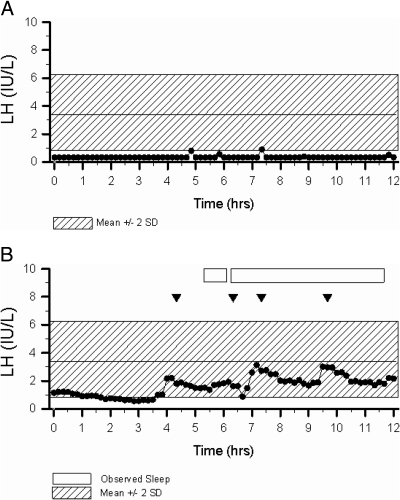
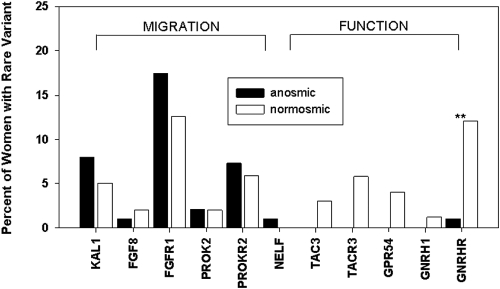
Results: Eighty-eight percent had undergone pubarche, 51% had spontaneous thelarche, and 10% had 1-2 menses. Women with spontaneous thelarche were more likely to demonstrate normal pubarche (P = 0.04). In 27% of women, neuroendocrine studies demonstrated evidence of some endogenous GnRH secretory activity. Thirty-six percent (a large excess relative to controls) harbored a rare sequence variant in a gene associated with GnRH deficiency (87% heterozygous and 13% biallelic), with variants in FGFR1 (15%), GNRHR (6.6%), and PROKR2 (6.6%) being most prevalent. One woman had a biallelic variant in the X-linked gene, KAL1, and nine women had heterozygous variants.
Conclusions: The clinical presentation of female GnRH deficiency varies from primary amenorrhea and absence of any secondary sexual characteristics to spontaneous breast development and occasional menses. In this cohort, rare sequence variants were present in all of the known genes associated with GnRH deficiency, including the novel identification of GnRH-deficient women with KAL1 variants. The pathogenic mechanism through which KAL1 variants disrupt female reproductive development requires further investigation.
Trial registration: ClinicalTrials.gov NCT00392756.
Figures
References
-
- Semple RK, Topaloglu AK. 2010. The recent genetics of hypogonadotrophic hypogonadism – novel insights and new questions. Clin Endocrinol (Oxf) 72:427–435 - PubMed
-
- Georgopoulos NA, Pralong FP, Seidman CE, Seidman JG, Crowley WF, Jr, Vallejo M. 1997. Genetic heterogeneity evidenced by low incidence of KAL-1 gene mutations in sporadic cases of gonadotropin-releasing hormone deficiency. J Clin Endocrinol Metab 82:213–217 - PubMed
-
- Oliveira LM, Seminara SB, Beranova M, Hayes FJ, Valkenburgh SB, Schipani E, Costa EM, Latronico AC, Crowley WF, Jr, Vallejo M. 2001. The importance of autosomal genes in Kallmann syndrome: genotype-phenotype correlations and neuroendocrine characteristics. J Clin Endocrinol Metab 86:1532–1538 - PubMed
-
- Sato N, Katsumata N, Kagami M, Hasegawa T, Hori N, Kawakita S, Minowada S, Shimotsuka A, Shishiba Y, Yokozawa M, Yasuda T, Nagasaki K, Hasegawa D, Hasegawa Y, Tachibana K, Naiki Y, Horikawa R, Tanaka T, Ogata T. 2004. Clinical assessment and mutation analysis of Kallmann syndrome 1 (KAL1) and fibroblast growth factor receptor 1 (FGFR1, or KAL2) in five families and 18 sporadic patients. J Clin Endocrinol Metab 89:1079–1088 - PubMed
-
- Albuisson J, Pecheux C, Carel JC, Lacombe D, Leheup B, Lapuzina P, Bouchard P, Legius E, Matthijs G, Wasniewska M, Delpech M, Young J, Hardelin JP, Dode C. 2005. Kallmann syndrome: 14 novel mutations in KAL1 and FGFR1 (KAL2). Hum Mutat 25:98–99 - PubMed
Publication types
MeSH terms
Substances
Associated data
Grants and funding
- R01 HD042708/HD/NICHD NIH HHS/United States
- T32 HD007396/HD/NICHD NIH HHS/United States
- GM061354/GM/NIGMS NIH HHS/United States
- M01 RR001066/RR/NCRR NIH HHS/United States
- UL1 RR025758/RR/NCRR NIH HHS/United States
- UL1 RR 025758/RR/NCRR NIH HHS/United States
- F32 HD062315/HD/NICHD NIH HHS/United States
- R01 HD056264/HD/NICHD NIH HHS/United States
- R01 HD42708/HD/NICHD NIH HHS/United States
- P01 GM061354/GM/NIGMS NIH HHS/United States
- 5T32 HD007396/HD/NICHD NIH HHS/United States
- U54 HD028138/HD/NICHD NIH HHS/United States
- M01-RR-01066/RR/NCRR NIH HHS/United States
LinkOut - more resources
Full Text Sources
Medical
Miscellaneous
