. 2011 Mar 4;286(9):7490-5.
doi: 10.1074/jbc.M110.198465. Epub 2011 Jan 5.

Generation of a new form of human PrP(Sc) in vitro by interspecies transmission from cervid prions

Affiliations

Generation of a new form of human PrP(Sc) in vitro by interspecies transmission from cervid prions

Marcelo A Barria et al. J Biol Chem. .

Abstract

Prion diseases are infectious neurodegenerative disorders that affect humans and animals and that result from the conversion of normal prion protein (PrP(C)) into the misfolded prion protein (PrP(Sc)). Chronic wasting disease (CWD) is a prion disorder of increasing prevalence within the United States that affects a large population of wild and captive deer and elk. Determining the risk of transmission of CWD to humans is of utmost importance, considering that people can be infected by animal prions, resulting in new fatal diseases. To study the possibility that human PrP(C) can be converted into the misfolded form by CWD PrP(Sc), we performed experiments using the protein misfolding cyclic amplification technique, which mimics in vitro the process of prion replication. Our results show that cervid PrP(Sc) can induce the conversion of human PrP(C) but only after the CWD prion strain has been stabilized by successive passages in vitro or in vivo. Interestingly, the newly generated human PrP(Sc) exhibits a distinct biochemical pattern that differs from that of any of the currently known forms of human PrP(Sc). Our results also have profound implications for understanding the mechanisms of the prion species barrier and indicate that the transmission barrier is a dynamic process that depends on the strain and moreover the degree of adaptation of the strain. If our findings are corroborated by infectivity assays, they will imply that CWD prions have the potential to infect humans and that this ability progressively increases with CWD spreading.


Figures
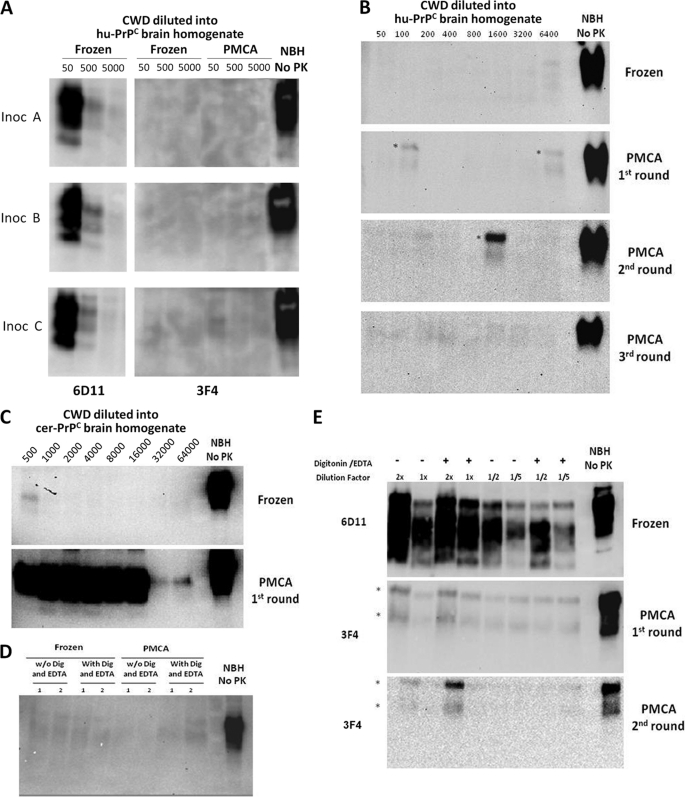
FIGURE 1.
FIGURE 1.
Unsuccessful conversion of human PrPC by CWD PrPSc. A, three different samples of brain homogenates from mule deer naturally affected with CWD were used to attempt conversion of human PrPC (hu-PrPC). 10% CWD brain homogenates were diluted 50-, 500-, or 5000-fold into 10% brain homogenates from transgenic mice expressing the human (129M) PrP gene-coding segment. Samples were either frozen or subjected to 144 cycles of PMCA. Formation of PrPSc was assessed by PK digestion, followed by Western blotting using antibody 3F4, which recognizes human, but not cervid, PrP (22). The amount of cervid PrPSc in the inoculum (Inoc) was checked by Western blotting using antibody 6D11. B, to further attempt conversion of human PrPC with cervid prions, several serial rounds of PMCA were done using standard conditions. As reported previously, three serial rounds of PMCA should lead to ∼100,000-fold amplification of any PrPSc signal present in the sample (24). C, the CWD PrPSc conversion of deer PrPC by PMCA was studied using samples of 10% CWD brain homogenate (inoculum A) that were diluted into 10% brain homogenate prepared from healthy transgenic mice expressing cervid PrPC (cer-PrPC). The formation of cervid PrPSc was assessed by Western blotting using antibody 6D11. D, crossing the cervid-human species barrier was further attempted by adding detergents and EDTA to the conversion buffer, which has been shown to increase PMCA efficiency (37), particularly for human samples (supplemental Fig. 1). E, the CWD inoculum was concentrated by the Sarkosyl procedure described under “Experimental Procedures” to add larger amounts of PrPSc. 2-, 1-, 0.5, or 0.2-fold PrPSc relative to the 10% CWD brain homogenate was added to the human transgenic mouse brain homogenate and subjected to PMCA in either the presence or absence of digitonin (Dig) and EDTA. In the experiments shown in all panels, samples were treated with PK (50 μg/ml), except for the normal brain homogenate (NBH No PK) used as control. The asterisks in B and E represent incomplete digestion of PrPC, which is clearly appreciated because the electrophoretic mobility is identical to that of full-length PrPC.
FIGURE 2.
FIGURE 2.
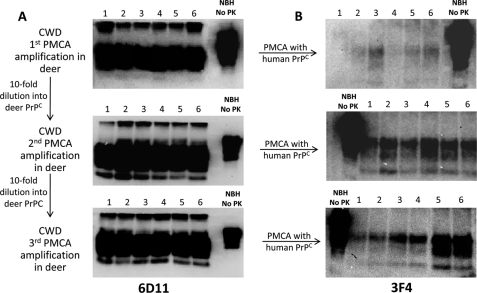
Conversion of human PrPC induced by CWD PrPSc after PMCA strain adaptation. A, six separate samples of a 1000-fold dilution of CWD brain homogenate (inoculum A) were used to convert cervid PrPC in three successive rounds of 144 PMCA cycles. Protease-resistant deer PrPSc was measured by Western blotting using antibody 6D11. B, samples from the amplified material were used to attempt conversion of human PrPC by PMCA, and the protease-resistant signal was checked using the human-specific antibody 3F4. NBH No PK, normal brain homogenate used as a control.
FIGURE 3.
FIGURE 3.
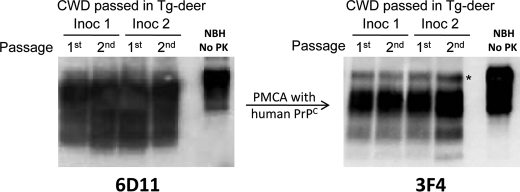
Conversion of human PrPC induced by CWD PrPSc after in vivo strain adaptation. Transgenic (Tg) mice expressing the cervid PrP gene were used to serially passage CWD prions from two different natural inocula (Inoc). Brain homogenate from sick transgenic mice after one or two in vivo passages was used to convert human PrPC by subjecting the sample to 144 PMCA cycles. The generation of human PrPSc after PMCA was assessed by Western blotting employing antibody 3F4 (right panel). The PrPSc reactivity of the CWD inoculum from cervid transgenic mice was evaluated by Western blotting using antibody 6D11 (left panel). All samples were digested with PK (50 μg/ml), except for the normal brain homogenate (NBH No PK), which was used as a marker of full-length PrPC electrophoretic migration. The asterisk represents incomplete digestion of PrPC. As shown before, amplification of the original CWD inoculum at the expense of human PrPC failed to show any PK-resistant PrPSc band.
FIGURE 4.
FIGURE 4.
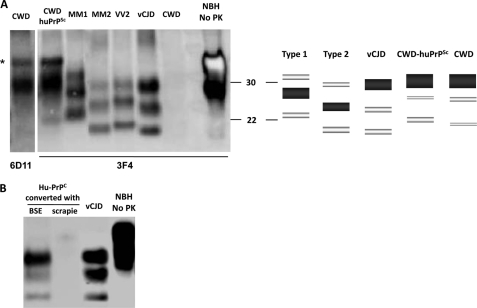
Western blot profile of human PrPSc generated in vitro from CWD. A, aliquots of CWD-huPrPSc obtained by in vitro conversion of human PrPC with CWD after two rounds of PMCA in deer (see Fig. 2) were loaded together with huPrPSc associated with variant CJD (vCJD) and sporadic CJD types MM1 and MM2. Samples were treated with PK and developed using antibody 3F4. A schematic representation of the mobility and intensity of the different PrP glycoforms in each sample is shown to the right. B, samples of PrPSc from either cattle affected with BSE or sheep with typical scrapie were used to induce conversion of human PrPC (Hu-PrPC) by 144 PMCA cycles. Newly generated human PrPSc was detected by Western blotting using antibody 3F4, which recognizes human, but not cattle or sheep, PrP. As a control of the electrophoretic pattern of human PrPSc associated with variant CJD, a brain sample from a patient affected with this disease was loaded. The asterisk represents a signal coming from incomplete digestion of PrPC. NBH No PK, normal brain homogenate used as a control.

References

    1. Miller M. W., Williams E. S. (2004) Curr. Top. Microbiol. Immunol. 284, 193–214 - PubMed
    1. Sigurdson C. J., Aguzzi A. (2007) Biochim. Biophys. Acta 1772, 610–618 - PMC - PubMed
    1. Bosque P. J. (2002) Curr. Neurol. Neurosci. Rep. 2, 488–495 - PubMed
    1. Moore R. A., Vorberg I., Priola S. A. (2005) Arch. Virol. Suppl. 19, 187–202 - PubMed
    1. Belay E. D., Gambetti P., Schonberger L. B., Parchi P., Lyon D. R., Capellari S., McQuiston J. H., Bradley K., Dowdle G., Crutcher J. M., Nichols C. R. (2001) Arch. Neurol. 58, 1673–1678 - PubMed

Publication types