New methods for detection of campylobacters in stool samples in comparison to culture
- PMID: 21209172
- PMCID: PMC3067684
- DOI: 10.1128/JCM.01489-10
New methods for detection of campylobacters in stool samples in comparison to culture
Abstract
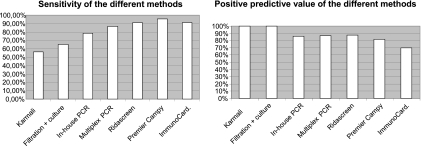
Campylobacter species, especially Campylobacter jejuni and Campylobacter coli, are a major cause of human bacterial enteritis. Current detection in stools is done essentially by culture on selective and nonselective media with filtration. These methods were compared to 2 molecular biology methods, an in-house real-time PCR and a multiplex PCR named Seeplex Diarrhea ACE Detection, and 3 immunoenzymatic methods, Premier Campy, RidaScreen Campylobacter, and ImmunoCard Stat!Campy. Out of 242 stool specimens tested, 23 (9.5%) fulfilled the positivity criteria, i.e., they were positive by one or both culture methods or, in case of a negative culture, by a positive molecular method and a positive immunoenzymatic method. The striking feature of this study is the low sensitivity of culture, in the range of 60%, in contrast to immunoenzymatic and molecular tests.
Figures
References
-
- Dediste A., et al. 2003. Evaluation of the ProSpecT Microplate Assay for detection of Campylobacter: a routine laboratory perspective. Clin. Microbiol. Infect. 9:1085–1090 - PubMed
-
- Lastovica A., Allos B. M. 2008. Clinical significance of Campylobacter and related species other than Campylobacter jejuni and Campylobacter coli, p. 123–149 In Nachamkin I., Szymanski C. M., Blaser M. J. (ed.), Campylobacter, 3rd ed ASM Press, Washington, DC
-
- Mégraud F., Labadi L., Camou C., Lehours P. 2009. A molecular strategy to identify campylobacters and related species. Data from the Campylobacter National Reference Center in France, p. 246 Proceedings of the CHRO, Niigata, Japan
-
- Ménard A., Dachet F., Prouzet-Mauleon V., Oleastro M., Megraud F. 2005. Development of a real-time fluorescence resonance energy transfer PCR to identify the main pathogenic Campylobacter spp. Clin. Microbiol. Infect. 11:281–287 - PubMed
-
- Moore J. E., et al. 2005. Campylobacter. Vet. Res. 36:351–382 - PubMed
Publication types
MeSH terms
LinkOut - more resources
Full Text Sources
Other Literature Sources
Medical
Miscellaneous