


Genome analysis of Treponema pallidum subsp. pallidum and subsp. pertenue strains: most of the genetic differences are localized in six regions
- PMID: 21209953
- PMCID: PMC3012094
- DOI: 10.1371/journal.pone.0015713
Genome analysis of Treponema pallidum subsp. pallidum and subsp. pertenue strains: most of the genetic differences are localized in six regions
Abstract
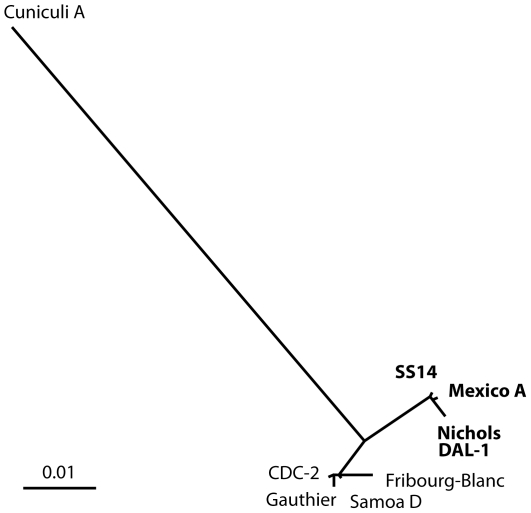
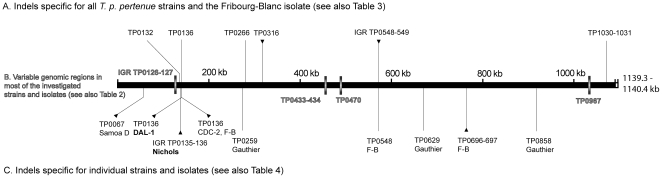
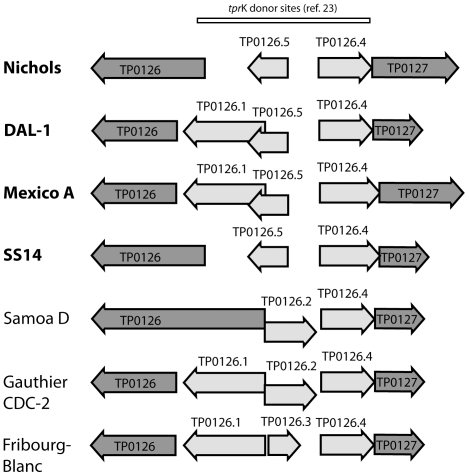
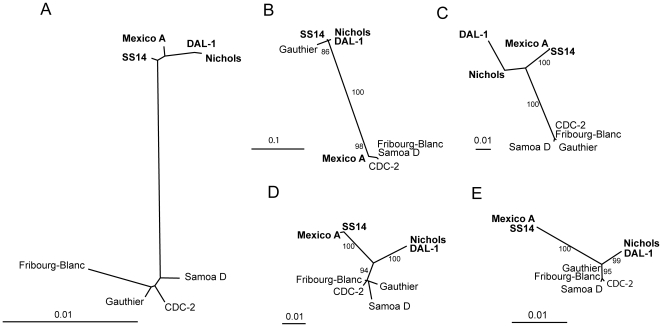
The genomes of eight treponemes including T. p. pallidum strains (Nichols, SS14, DAL-1 and Mexico A), T. p. pertenue strains (Samoa D, CDC-2 and Gauthier), and the Fribourg-Blanc isolate, were amplified in 133 overlapping amplicons, and the restriction patterns of these fragments were compared. The approximate sizes of the genomes investigated based on this whole genome fingerprinting (WGF) analysis ranged from 1139.3-1140.4 kb, with the estimated genome sequence identity of 99.57-99.98% in the homologous genome regions. Restriction target site analysis, detecting the presence of 1773 individual restriction sites found in the reference Nichols genome, revealed a high genome structure similarity of all strains. The unclassified simian Fribourg-Blanc isolate was more closely related to T. p. pertenue than to T. p. pallidum strains. Most of the genetic differences between T. p. pallidum and T. p. pertenue strains were accumulated in six genomic regions. These genome differences likely contribute to the observed differences in pathogenicity between T. p. pallidum and T. p. pertenue strains. These regions of sequence divergence could be used for the molecular detection and discrimination of syphilis and yaws strains.
Conflict of interest statement
Figures
References
-
- Fribourg-Blanc A, Niel G, Mollaret HH. Note of Some Imunological Aspects of the African Cynocephalus. 1. Antigenic Relationship of Its Gamma Globulin with Human Gamma Globulin. 2. Guinean Endemic Focus of Treponematosis. Bull Soc Pathol Exot Filiales. 1963;56:474–485. - PubMed
-
- Fribourg-Blanc A, Mollaret HH, Niel G. Confirmation serologique et microscopique de la treponemose du cynocephale de Guinee. Bull Soc Pathol Exot Filiales. 1966;59:54–59. - PubMed
-
- Fribourg-Blanc A, Mollaret HH. Natural treponematotis of the African primate. Primates Med. 1969;3:113–121. - PubMed
-
- Medina R. WHO Technical Report WHO/VDT/RES 63.64. 1963
Publication types
MeSH terms
Associated data
- Actions
- Actions
- Actions
- Actions
- Actions
- Actions
- Actions
- Actions
- Actions
- Actions
- Actions
- Actions
- Actions
- Actions
- Actions
- Actions
- Actions
- Actions
- Actions
- Actions
- Actions
- Actions
- Actions
- Actions
- Actions
- Actions
- Actions
- Actions
- Actions
- Actions
- Actions
- Actions
- Actions
- Actions
- Actions
- Actions
- Actions
- Actions
- Actions
- Actions
- Actions
- Actions
- Actions
- Actions
- Actions
- Actions
- Actions
- Actions
- Actions
- Actions
- Actions
- Actions
Grants and funding
LinkOut - more resources
Full Text Sources
Medical
Molecular Biology Databases
Miscellaneous
