


[Effect of pharmacist involvement in adherence to medications in patients with high to moderate cardiovascular risk (Study EMDADER-CV-INCUMPLIMIENTO)]
- PMID: 21211865
- PMCID: PMC7024978
- DOI: 10.1016/j.aprim.2010.05.006
[Effect of pharmacist involvement in adherence to medications in patients with high to moderate cardiovascular risk (Study EMDADER-CV-INCUMPLIMIENTO)]
Abstract
Objective: To evaluate the effect of pharmacist involvement, by means of Pharmacotherapy Follow-Up (PFU) in the improvement of medication adherence and therapeutic outcomes.
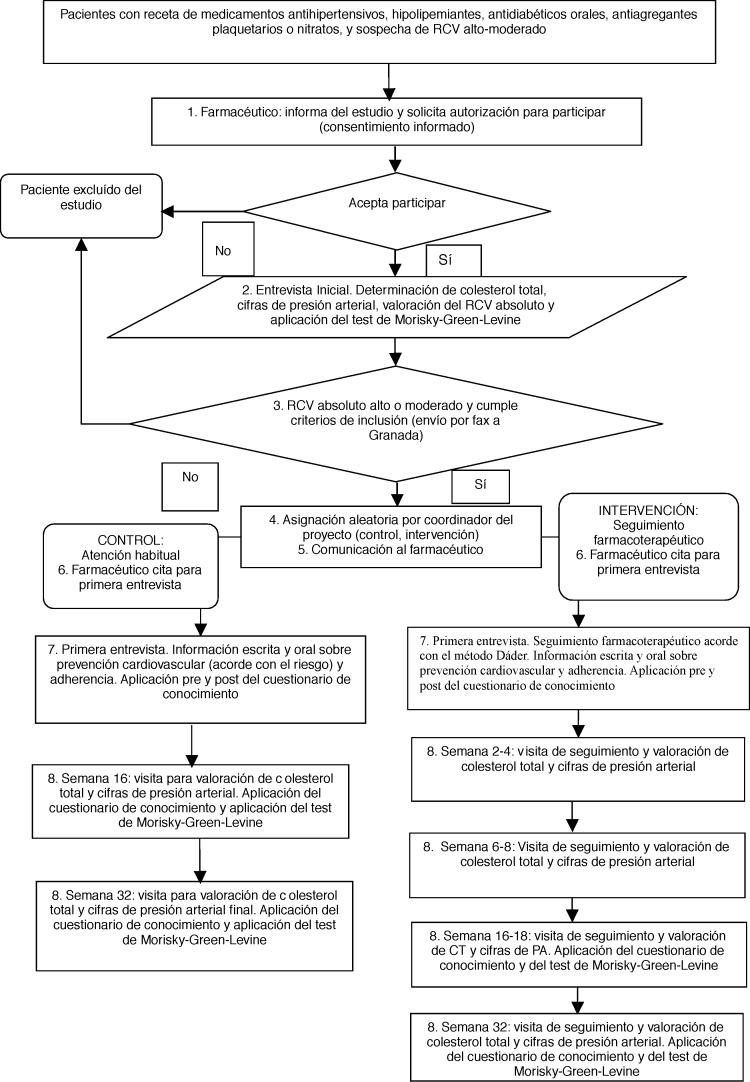
Design: An experimental, controlled, and randomised clinical study comparing a PFU program with the routine process in Spanish community pharmacies improved with health education during 8 months.
Setting: Nine Spanish community pharmacies.
Participants: Patients between 25 and 74 years with a moderate-high cardiovascular risk (CVR), who arrived with a prescription, in their name, for drugs for at least one CVR factor.
Interventions: The patients were randomly assigned to the intervention group (IG), and received PFU and health education, or the control group (CG), who received health education only.
Main measurements: Adherence to treatment, and blood pressure (BP) and total cholesterol (TC) levels at the beginning and end of the study.
Results: Of the 87 patients enrolled, 85 finished the study: 41 from the CG and 44 from the IG. Both groups increased adherence at the end of the [CG: 26.9%; 95% CI: 12.7- 41; IG: 27.3%; 95% CI: 13.6 - 41]. Although the IG showed better results in the variation of BP and TC levels, the differences compared to the CG were not statistically significant.
Conclusions: PFU and health education improves adherence to treatment. To be a patient who completes the study is also associated with improvement in the blood pressure and blood pressure/total cholesterol objectives.
Objetivo: Evaluar el efecto de la actuación del farmacéutico, mediante seguimiento farmacoterapéutico (SFT) en la mejora de la adherencia y de objetivos terapéuticos.
Diseño: Estudio clínico experimental controlado, aleatorizado, comparativo de un programa de SFT con el proceso habitual en farmacias comunitarias españolas mejorado con educación sanitaria, durante 8 meses.
Emplazamiento: Nueve farmacias comunitarias españolas.
Participantes: Pacientes entre 25-74 años con riesgo cardiovascular (RCV) alto-moderado, que acudieron con una receta, a su nombre, de medicamentos para al menos un factor de RCV.
Intervenciones: Los pacientes se asignaron aleatoriamente al grupo intervención (GI), que recibió SFT y educación sanitaria, o al grupo control (GC), que recibió solamente educación sanitaria.
Mediciones principales: Adherencia al tratamiento y cifras de presión arterial (PA) y colesterol total (CT), al inicio y final estudio.
Resultados: De los 87 pacientes reclutados, 85 acabaron el estudio: 41 del GC y 44 del GI. Ambos grupos aumentaron la adherencia al final del estudio [GC: 26,9%; IC95%:12,7 a 41; GI: 27,3%; IC95%:13,6 a 41]. Aunque el GI mostró mejores resultados en la variación de las cifras de PA y CT, las diferencias en relación al GC no fueron estadísticamente significativas.
Conclusiones: El SFT y la educación sanitaria mejoran la adherencia al tratamiento. Además ser paciente cumplidor al final del estudio se relaciona con la mejora de los objetivos de la presión arterial y de presión arterial/colesterol total.
Copyright © 2009 Elsevier España, S.L. All rights reserved.
Figures
References
-
- Adherence to long-therm therapies. Evidence for action. World Health Organization 2004.
-
- Borrás Vivés R. Sistemas personalizados de dispensación desde la farmacia comunitaria. Aula de la farmacia. 2005;20:8–22.
-
- FORO de Atención Farmacéutica. Documento de Consenso. Madrid.2008. Disponible en: www.atencionfarmaceutica-ugr.es
-
- Sanz A. Intervención para mejorar la adherencia al tratamiento. Offarm. 2007;5:118–119.
Publication types
MeSH terms
LinkOut - more resources
Full Text Sources
