


Effect of exercise training on peak oxygen consumption in patients with cancer: a meta-analysis
- PMID: 21212429
- PMCID: PMC3228052
- DOI: 10.1634/theoncologist.2010-0197
Effect of exercise training on peak oxygen consumption in patients with cancer: a meta-analysis
Erratum in
- Oncologist. 2011;16(2):260
Abstract
Background: We conducted a meta-analysis to determine the effects of supervised exercise training on peak oxygen consumption (VO(2peak)) in adults with cancer.
Methods: A literature review using Ovid MEDLINE (1950-2010), the Cochrane Central Register of Controlled Trials (1991-2010), AMED (1985-2010), Embase (1988-2010), PubMed (1966-2010), Scopus (1950-2010), and Web of Science (1950-2010) was performed to identify randomized controlled trials examining the effects of supervised exercise training on measurement of VO(2peak) (via gas exchange analysis) in adults with cancer. Studies were selected using predetermined criteria, and two independent reviewers extracted data. Weighted mean differences (WMDs) were calculated using random effect models.
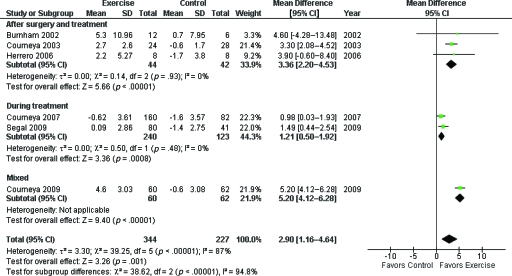
Results: Six studies evaluated VO(2peak) involving a total of 571 adult cancer patients (exercise, n = 344; usual care control, n = 227). Pooled data indicated that exercise training was associated with a statistically significant increase in VO(2peak) (WMD, 2.90 ml·kg(-1)·min(-1); 95% confidence interval [CI], 1.16-4.64); however, significant heterogeneity was evident in this estimate (I(2), 87%). Usual care (control) was associated with a significant decline in VO(2peak) from baseline to postintervention (WMD, -1.02 ml·kg(-1)·min(-1); 95% CI, -1.46 to -0.58; I(2), 22%). Sensitivity analyses indicated superior improvements in VO(2peak) for studies conducted for a shorter duration (<4 months) and following the completion of adjuvant therapy (p-values < .001). Exercise training was not associated with a higher incidence of adverse events, although safety was not rigorously monitored or reported.
Conclusions: Supervised exercise training is associated with significant improvements in VO(2peak) following a diagnosis of early-stage cancer, with minimal adverse events.
Conflict of interest statement
The content of this article has been reviewed by independent peer reviewers to ensure that it is balanced, objective, and free from commercial bias. No financial relationships relevant to the content of this article have been disclosed by the authors or independent peer reviewers.
Figures


References
-
- Myers J, Prakash M, Froelicher V, et al. Exercise capacity and mortality among men referred for exercise testing. N Engl J Med. 2002;346:793–801. - PubMed
-
- Gulati M, Black HR, Shaw LJ, et al. The prognostic value of a nomogram for exercise capacity in women. N Engl J Med. 2005;353:468–475. - PubMed
-
- Ekelund LG, Haskell WL, Johnson JL, et al. Physical fitness as a predictor of cardiovascular mortality in asymptomatic North American men. The Lipid Research Clinics Mortality Follow-up Study. N Engl J Med. 1988;319:1379–1384. - PubMed
-
- Sandvik L, Erikssen J, Thaulow E, et al. Physical fitness as a predictor of mortality among healthy, middle-aged Norwegian men. N Engl J Med. 1993;328:533–537. - PubMed
-
- Erikssen G, Liestøl K, Bjørnholt J, et al. Changes in physical fitness and changes in mortality. Lancet. 1998;352:759–762. - PubMed
Publication types
MeSH terms
Grants and funding
LinkOut - more resources
Full Text Sources
Medical
Miscellaneous
