


Chromatin dynamics and the repair of DNA double strand breaks
- PMID: 21212734
- PMCID: PMC3048797
- DOI: 10.4161/cc.10.2.14543
Chromatin dynamics and the repair of DNA double strand breaks
Abstract
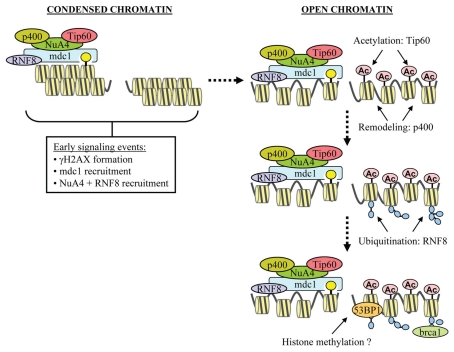
DNA double-strand breaks (DSBs) arise through both replication errors and from exogenous events such as exposure to ionizing radiation. DSBs are potentially lethal, and cells have evolved a highly conserved mechanism to detect and repair these lesions. This mechanism involves phosphorylation of histone H2AX (γH2AX) and the loading of DNA repair proteins onto the chromatin adjacent to the DSB. It is now clear that the chromatin architecture in the region surrounding the DSB has a critical impact on the ability of cells to mount an effective DNA damage response. DSBs promote the direct the formation of open, relaxed chromatin domains which are spatially confined to the area surrounding the break. These relaxed chromatin structures are created through the coupled action of the p400 SWI/SNF ATPase and histone acetylation by the Tip60 acetyltransferase. The resulting destabilization of nucleosomes at the DSB by Tip60 and p400 is required for ubiquitination of the chromatin by the RNF8 ubiquitin ligase, and for the subsequent recruitment of the brca1 complex. Chromatin dynamics at DSBs can therefore exert a powerful influence on the process of DSB repair. Further, there is emerging evidence that the different chromatin structures in the cell, such as heterochromatin and euchromatin, utilize distinct remodeling complexes and pathways to facilitate DSB. The processing and repair of DSB is therefore critically influenced by the nuclear architecture in which the lesion arises.
Figures
References
-
- Stucki M, Clapperton JA, Mohammad D, Yaffe MB, Smerdon SJ, Jackson SP. MDC1 directly binds phosphorylated histone H2AX to regulate cellular responses to DNA double-strand breaks. Cell. 2005;123:1213–1226. - PubMed
Publication types
MeSH terms
Substances
Grants and funding
LinkOut - more resources
Full Text Sources
Miscellaneous
