


Household obesity prevention: Take Action--a group-randomized trial
- PMID: 21212771
- PMCID: PMC5771495
- DOI: 10.1038/oby.2010.328
Household obesity prevention: Take Action--a group-randomized trial
Abstract
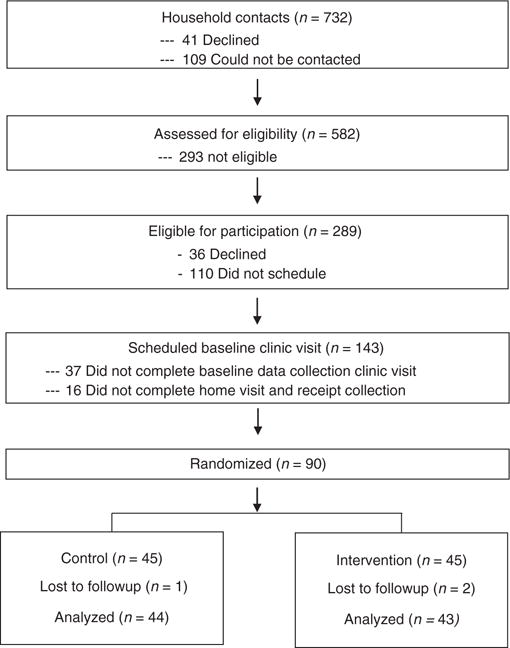
The purpose of the present study was to evaluate an intervention to prevent weight gain among households (HHs) in the community. Ninety HHs were randomized to intervention or control group for 1 year. Intervention consisted of six face-to-face group sessions, placement of a television (TV) locking device on all home TVs, and home-based intervention activities. Measures were collected in person at baseline and 1 year. Weight, height, eating behaviors, physical activity (PA), and TV viewing were measured among HH members ages ≥ 12 years. Follow-up rate at 1 year was 96%. No significant intervention effects were observed for change in HH BMI-z score. Intervention HHs significantly reduced TV viewing, snacks/sweets intake, and dollars per person spent eating out, and increased (adults only) PA and self-weighing frequency compared with control HHs. A 1 year obesity prevention intervention targeting entire HHs was effective in reducing TV viewing, snack/sweets intake and eating out purchases. Innovative methods are needed to strengthen the home food environment intervention component. Longer intervention durations also need to be evaluated.
Conflict of interest statement
The authors declared no conflict of interest.
Figures
Comment in
-
Household obesity prevention: take action-A group-randomized trial.Obesity (Silver Spring). 2013 Feb;21(2):217. doi: 10.1002/oby.20064. Obesity (Silver Spring). 2013. PMID: 23404749 No abstract available.
References
-
- Flegal KM, Carroll MD, Ogden CL, Johnson CL. Prevalence and trends in obesity among US adults, 1999–2000. JAMA. 2002;288:1723–1727. - PubMed
-
- Ogden CL, Carroll MD, Curtin LR, Lamb MM, Flegal KM. Prevalence of high body mass index in US children and adolescents, 2007–2008. JAMA. 2010;303:242–249. - PubMed
-
- Institute of Medicine, Committee on the Prevention of Obesity in Children and Youth. Preventing childhood obesity: Health in the balance. Washington DC: Institute of Medicine, National Academies of Science; 2005.
-
- The White House. Presidential Memorandum: Establishing a Task Force on Childhood Obesity. 2010 Feb 9; < http://www.whitehouse.gov/the-press-office/presidential-memorandum-estab...>. To be published in the Federal Register.
-
- Epstein LH, Valoski A, Wing RR, McCurley J. Ten-year outcomes of behavioral family-based treatment for childhood obesity. Health Psychol. 1994;13:373–383. - PubMed
Publication types
MeSH terms
Grants and funding
LinkOut - more resources
Full Text Sources
Medical
