Review
. 2011 Jan;52 Suppl 1(Suppl 1):28-38.
doi: 10.1111/j.1528-1167.2010.02908.x.

The serotonin axis: Shared mechanisms in seizures, depression, and SUDEP

Affiliations
Review

The serotonin axis: Shared mechanisms in seizures, depression, and SUDEP

George B Richerson et al. Epilepsia. 2011 Jan.

Abstract

There is a growing appreciation that patients with seizures are also affected by a number of comorbid conditions, including an increase in prevalence of depression (Kanner, 2009), sleep apnea (Chihorek et al., 2007), and sudden death (Ryvlin et al., 2006; Tomson et al., 2008). The mechanisms responsible for these associations are unclear. Herein we discuss the possibility that underlying pathology in the serotonin (5-HT) system of patients with epilepsy lowers the threshold for seizures, while also increasing the risk of depression and sudden death. We propose that postictal dysfunction of 5-HT neurons causes depression of breathing and arousal in some epilepsy patients, and this can lead to sudden unexpected death in epilepsy (SUDEP). We further draw parallels between SUDEP and sudden infant death syndrome (SIDS), which may share pathophysiologic mechanisms, and which have both been linked to defects in the 5-HT system.


Conflict of interest statement

Disclosure: The authors have no conflicts of interest to declare.

Figures

Figure 1
Figure 1
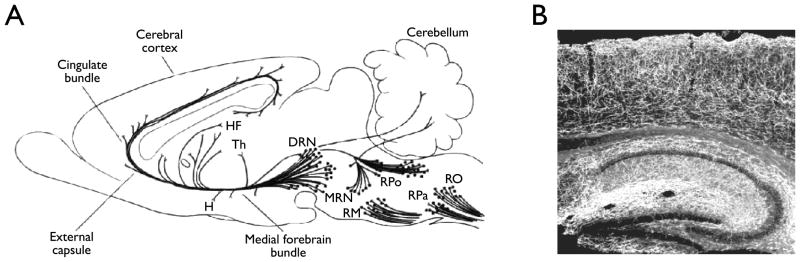
Serotonin neurons from the raphé nuclei send diffuse projections throughout the central nervous system. A) Schematic representation of projections from raphe nuclei. DRN, dorsal raphe nucleus; H, hypothalamus; HF, hippocampal formation; MRN, median raphe nucleus; RM, raphe magnus; RO, raphe obscurus; RPa, raphe pallidus; RPo, raphe pontis; Th, thalamus. Modified from Cooper et al (1996). B) Photomicrograph depicting 5-HT receptor distribution within the hippocampus and neocortex. Reproduced with permission from Donovan (2002).
Figure 2
Figure 2
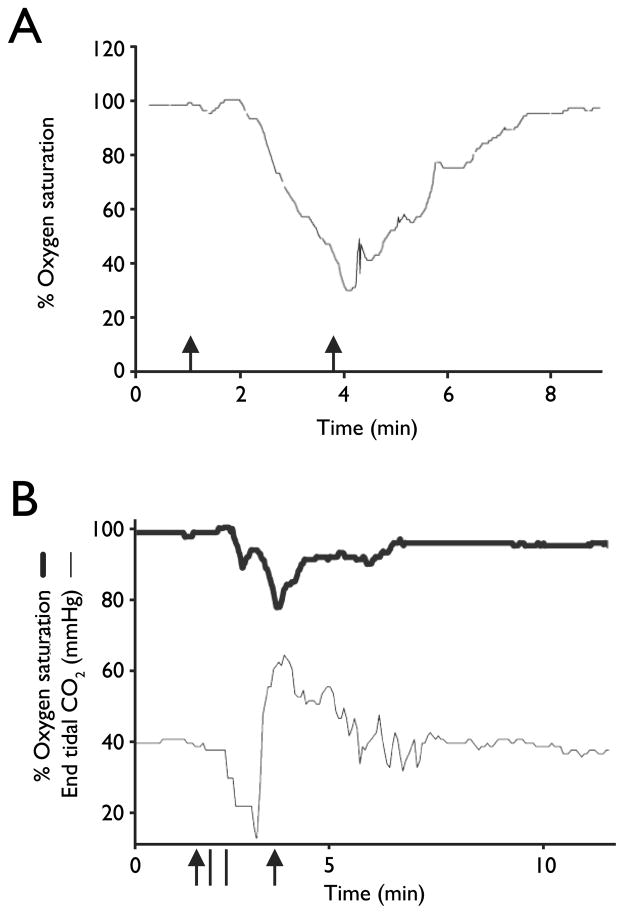
Seizure-related respiratory apnea in patients with epilepsy. A) Pronounced oxygen desaturation with a complex partial left temporal onset seizure without secondary generalization. Modified with permission from Bateman et al (2008). B) Oxygen saturation (thick line) and ETCO2 (thin line) tracings in an 18-year-old man with a right temporal onset seizure followed by a secondarily generalized convulsion. The peak ETCO2 rise was 64 mm Hg. Oxygen saturation nadir was 78%. Duration of seizure is demarcated by the arrowheads. Duration of apnea is demarcated by the vertical bars. Modified with permission from Seyal and Bateman (2009).
Figure 3
Figure 3
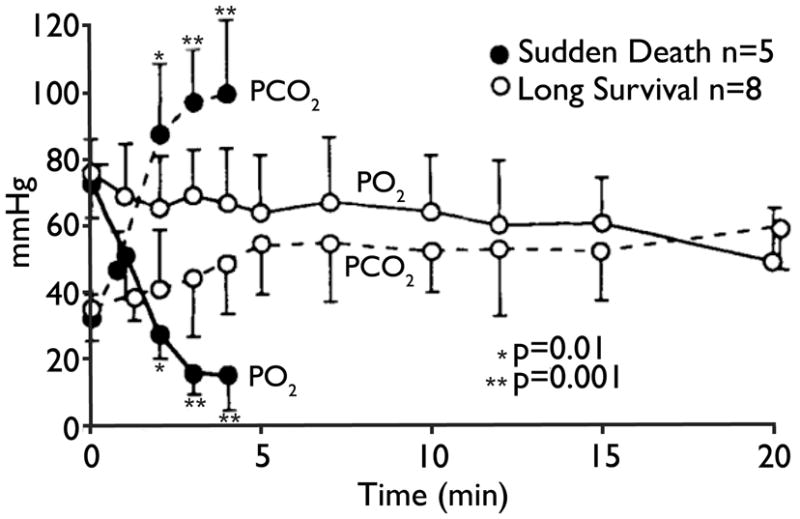
Severe blood gas derangements contribute to seizure related-sudden death. PaO2 and PaCO2 levels during seizures in sudden death (black circles) and long survival (white circles) groups. Dramatic elevations in PaCO2 and declines in PaO2 were demonstrated in sudden death animals. Differences between groups were highly significant (p = 0.001) at 3 and 4 minutes. Reproduced with permission from Johnston et al (1995).
Figure 4
Figure 4
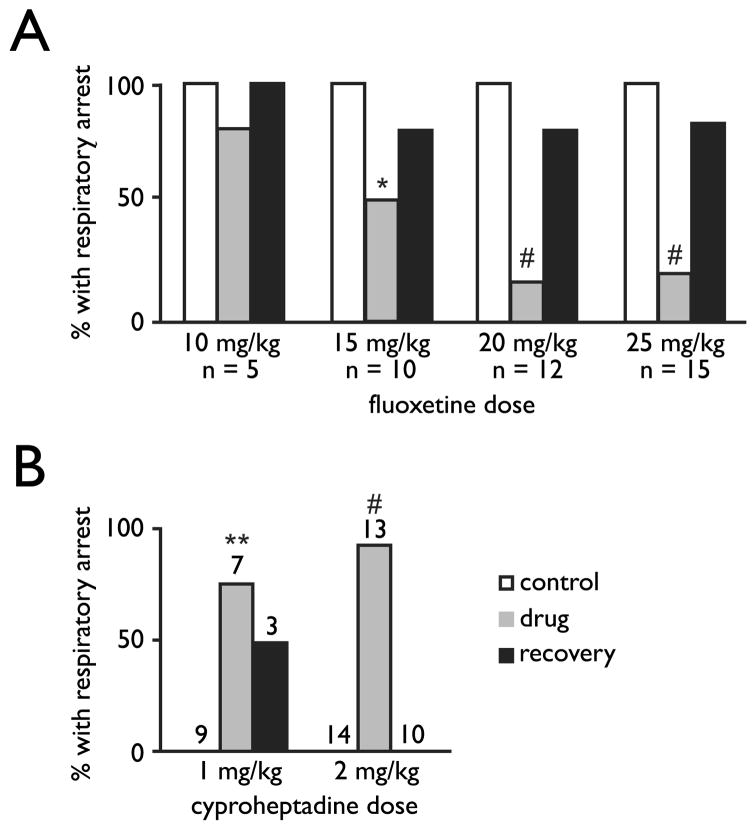
Increasing 5-HT prevents and blocking 5-HT receptors induces seizure-induced respiratory arrest in DBA/2 mice. A) Acute (gray bars) and delayed (black bars) effect of different doses of the serotonin-selective reuptake inhibitor, fluoxetine (i.p.; 30 min prior to first audiogenic seizure trial) in DBA/2 mice that display audiogenic seizure-induced respiratory arrest. Controls (white bars) values are 100% because all mice used for this study were susceptible to seizure-induced respiratory arrest at baseline. *, p < 0.05; #, p < 0.005 (Wilcoxon signed ranks test). B) Acute (gray bars) and delayed (black bars) effect of different doses of the non-selective 5-HT2 receptor antagonist, cyproheptadine (i.p.; 30 min prior to first audiogenic seizure trial) in DBA/2 mice that did not display audiogenic seizure-induced respiratory arrest. Controls (white bars) values are 0% because none of the mice used for this study were susceptible to seizure-induced respiratory arrest at baseline. **, p < 0.01; #, p < 0.005. (Wilcoxon signed ranks test). Modified with permission from Tupal and Faingold (2006).
Figure 5
Figure 5
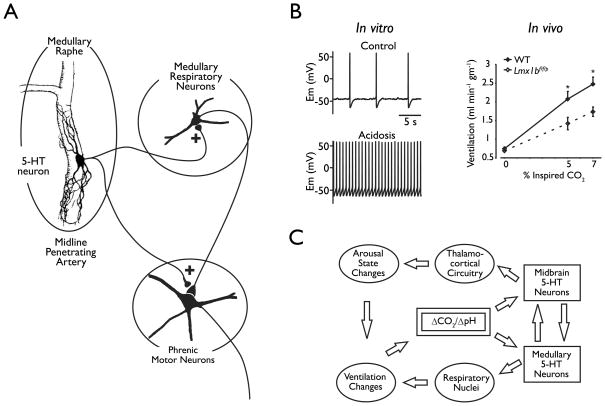
Central 5-HT neurons are chemoreceptors. A) Push-pull model of the role of chemosensitive medullary raphe neurons in respiratory chemoreception. It is proposed that the two subtypes of chemosensitive raphe neurons act in opposite ways to influence respiratory output within the medulla and in phrenic motor neurons. The brainstem sites are not specified in this model, but may include the nucleus tractus solitarius, nucleus ambiguus, pre-Botzinger complex and hypoglossal motor nucleus. Reproduced with permission from Richerson et al (2001). B) Left: Membrane potential under control conditions (5% CO2, pH 7.4) and during hypercapnic acidosis. Reproduced from Wang et al, (2002). Right: Ventilation during normoxic hypercapnia conditions (n = 10 WT, 8 Lmx1bf/f/p). Modified from Hodges et al (2008). C) Schematic depicting the proposed model by which serotonergic neurons mediate ventilatory and vigilance state changes in response to changes in CO2/pH (ΔCO2/ΔpH). Increased CO2 (due to rebreathing, airway obstruction or apnea) leads to decreased pH and activation of midbrain serotonergic neurons. These neurons in turn activate thalamocortical circuitry resulting in an elevation of arousal state. Increased CO2 also leads to activation of medullary serotonergic neurons, which stimulate respiratory nuclei to increase ventilation. Both of these pathways serve to restore CO2 homeostasis. 5-HT, serotonin. Reproduced with permission from Buchanan et al (2008).

References

    1. Ackerman MJ. Cardiac causes of sudden unexpected death in children and their relationship to seizures and syncope: genetic testing for cardiac electropathies. Semin Pediatr Neurol. 2005;12:52–8. - PubMed
    1. Ahmad S, Fowler LJ, Whitton PS. Lamotrigine, carbamazepine and phenytoin differentially alter extracellular levels of 5-hydroxytryptamine, dopamine and amino acids. Epilepsy Res. 2005;63:141–9. - PubMed
    1. Bagdy G, Kecskemeti V, Riba P, Jakus R. Serotonin and epilepsy. J Neurochem. 2007;100:857–73. - PubMed
    1. Bateman LM, Li CS, Seyal M. Ictal hypoxemia in localization-related epilepsy: analysis of incidence, severity and risk factors. Brain. 2008;131:3239–45. - PMC - PubMed
    1. Bateman LM, Spitz M, Seyal M. Ictal hypoventilation contributes to cardiac arrhythmia and SUDEP: report on two deaths and four potentially life-threatening events in video-EEG monitored patients. Epilepsia. 2009;50:410. - PubMed

Publication types

MeSH terms