. 2011 Feb;79(3):600-15.
doi: 10.1111/j.1365-2958.2010.07513.x. Epub 2011 Jan 9.

Cyclic GMP controls Rhodospirillum centenum cyst development

Affiliations

Cyclic GMP controls Rhodospirillum centenum cyst development

Jeremiah N Marden et al. Mol Microbiol. 2011 Feb.

Abstract

Adenylyl cyclases are widely distributed across all kingdoms whereas guanylyl cyclases are generally thought to be restricted to eukaryotes. Here we report that the α-proteobacterium Rhodospirillum centenum secretes cGMP when developing cysts and that a guanylyl cyclase deletion strain fails to synthesize cGMP and is defective in cyst formation. The R. centenum cyclase was purified and shown to effectively synthesize cGMP from GTP in vitro, demonstrating that it is a functional guanylyl cyclase. A homologue of the Escherichia coli cAMP receptor protein (CRP) is linked to the guanylyl cyclase and when deleted is deficient in cyst development. Isothermal calorimetry (ITC) and differential scanning fluorimetry (DSF) analyses demonstrate that the recombinant CRP homologue preferentially binds to, and is stabilized by cGMP, but not cAMP. This study thus provides evidence that cGMP has a crucial role in regulating prokaryotic development. The involvement of cGMP in regulating bacterial development has broader implications as several plant-interacting bacteria contain a similar cyclase coupled by the observation that Azospirillum brasilense also synthesizes cGMP when inducing cysts.


Figures

Figure 1
Figure 1
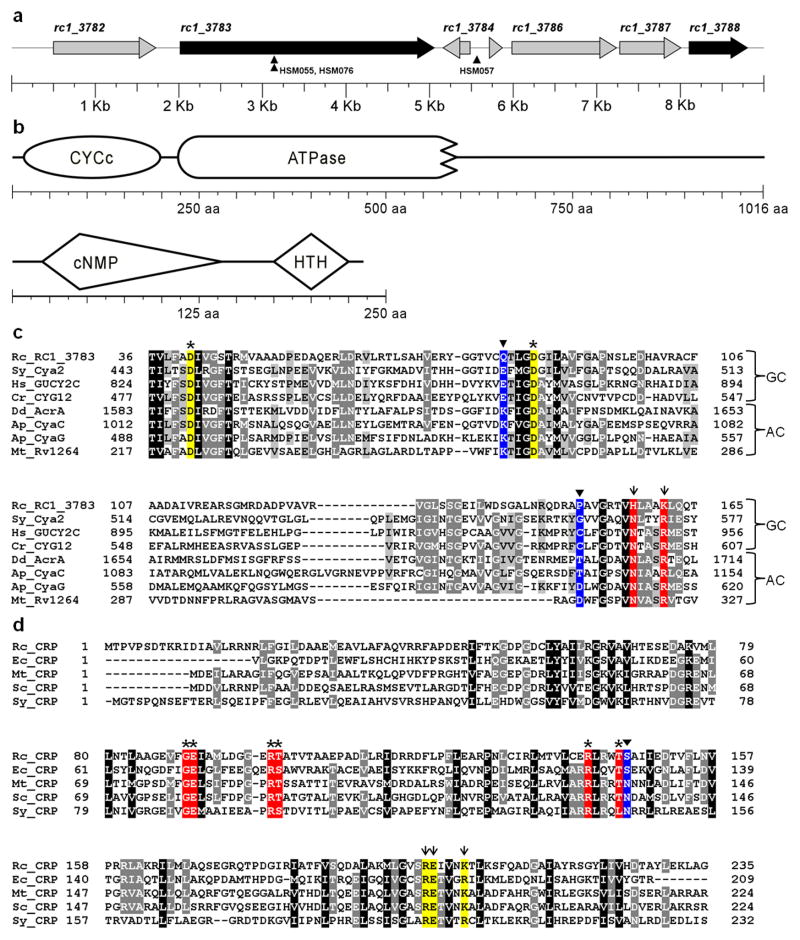
Genetic context of the guanylyl cyclase-CRP gene cluster. (a) Mini-Tn5 insertion sites are denoted by black triangles (b) Identified domains in RC1_3783 include an adenylyl/guanylyl cyclase catalytic domain (CYCc) (aa 14–197), a predicted partial ATPase (aa 221–595), followed by seven tetratricopeptide repeats (TPR). Domains in RC1_3788 include a cyclic nucleotide-monophosphate binding domain (cNMP) (aa 21–139), and a Helix-turn-Helix (HTH) domain (aa 176–226). (c) Amino acid sequence alignment of the RC1_3783 cyclase domain with representative class III cyclase domains. Species abbreviations are: Rhodospirillum centenum (Rc) RC1_3783 (YP_002299938); Synechocystis sp. PCC 6803 (Sy) Cya2 (NP_440289); Homo sapiens (Hs) GUCY2C (NP_004954); Chlamydomonas reinhardtii (Cr) CYG12 (XP_001700847); Dictyostelium discoideum (Dc) ACRA (AAD50121); Arthrospira platensis (Ap) CyaC (BAA22997) & CyaG (BAB19924); Mycobacterium tuberculosis H37Rv (Mt) Rv1264 (NP_215780). Positions of residues involved in metal binding (Yellow), substrate specification (Blue) and transition state stabilization (Red) are indicated by asterisks (*), inverted triangles (▼) and arrows (↓). Shading indicates identically and functionally conserved residues at 100% (Black), 87.5 or 75% (Dark gray shading with white letters), and 62.5% (Light gray shading with dark letters) conservation. (d) Amino acid sequence alignment of RC1_3788 and representative CRP homologous. Sequences and species abbreviations used are as follows: Mycobacterium tuberculosis (Mt) Rv3676 (NP_218193); Escherichia coli (Ec) CRP (NP_417816), Streptomyces coelicolor (Sc) CRPSco (NP_627768), Synechocystis PCC 6803 (Sy) SyCRP1 (NP_440289). The alignment was constructed in MEGA v.4.0 utilizing a BLOSUM matrix, with respective pair-wise and multiple alignment gap opening and extension penalties of 20 and 0.2. Intra-subunit E. coli CRP residues which directly contact cAMP are shaded red and denoted by an asterisk (*) and a single inter-subunit contact (S128) is shaded blue and marked by an inverted triangle (▼). Residues which make direct contacts with DNA shaded yellow and denoted by arrows (↓). Additional shading indicates identically and functionally conserved residues at 100% (Black) and 80% (Dark gray) conservation.
Figure 2
Figure 2
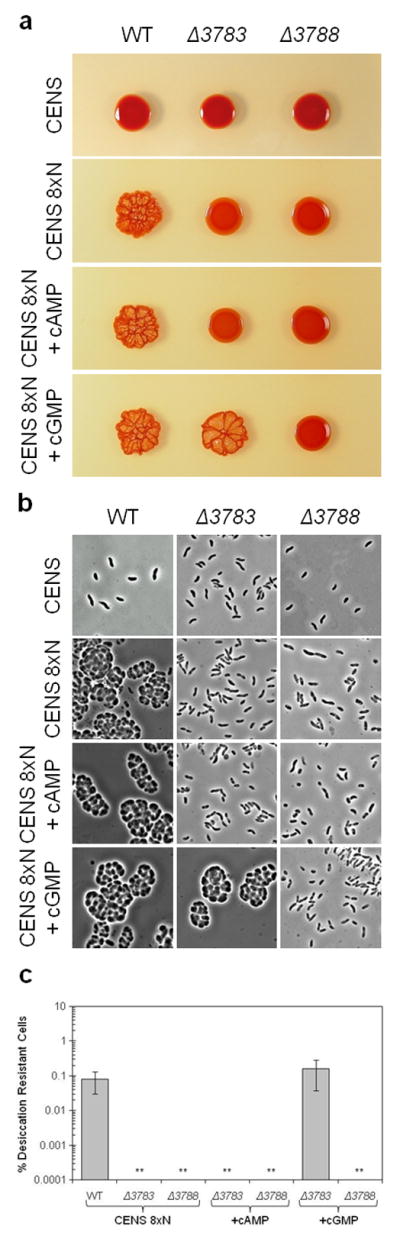
Analyses cyst cell formation in wild-type, Δrc1_3783 (nucleotidyl cyclase) and Δrc1_3788 (CRP homolog) strains after 3 days growth on agar solidified cyst-inducing CENS-8xN media. (a) Wild-type colonies formed dry/ridged cyst containing colonies under all growth conditions whereas a strain deleted for the cyclase (Δ rc1_3783) only formed cyst colonies in the presence of 50 μM cGMP. A strain deleted for the CRP homolog (Δrc1_3788) only formed shiny vegetative colonies (b) Microscopic observations of cyst and vegetative cells within the above shown colonies. (c) Desiccation resistant quantitation of cyst cells in the above colonies. The double asterisk (**) indicates that no cysts were detected in any cell dilution assayed.
Figure 3
Figure 3
Accumulation of exogenous cGMP in cyst inducing liquid CENBA medium by wild-type cells (grey bars), the cyclase deletion strain Δrc1_3783 (black bars), and the CRP homolog strain Δrc1_3788 (white bars). While cGMP accumulates to appreciable levels in the wild type strain, in the Δrc1_3783 and Δrc1_3788 strains levels remain <1 nM.
Figure 4
Figure 4
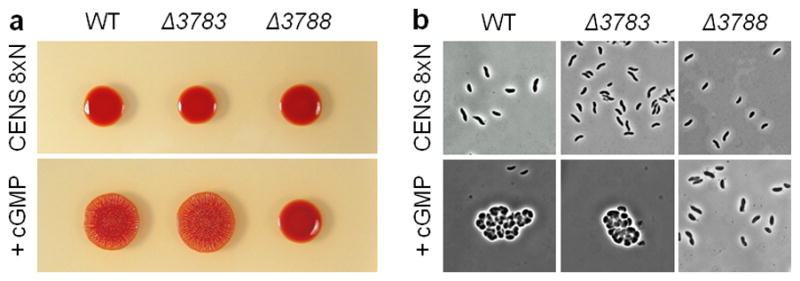
Analyses of cyst cell formation in wild-type, Δrc1_3783 (nucleotidyl cyclase) and Δrc1_3788 (CRP homolog) strains after 3 days growth on agar solidified CENS vegetative media. Media supplemented with cGMP had a final concentration of 200 μM. (a) Top panel shows shiny vegetative colonies forming on CENS media whereas the bottom panel shows dry ridged cyst forming colonies from wild-type and Δrc1_3783 strains grown on CENS medium containing 200 μM cGMP (b) Microscopic observations of cyst and vegetative cells from the above panels.
Figure 5
Figure 5
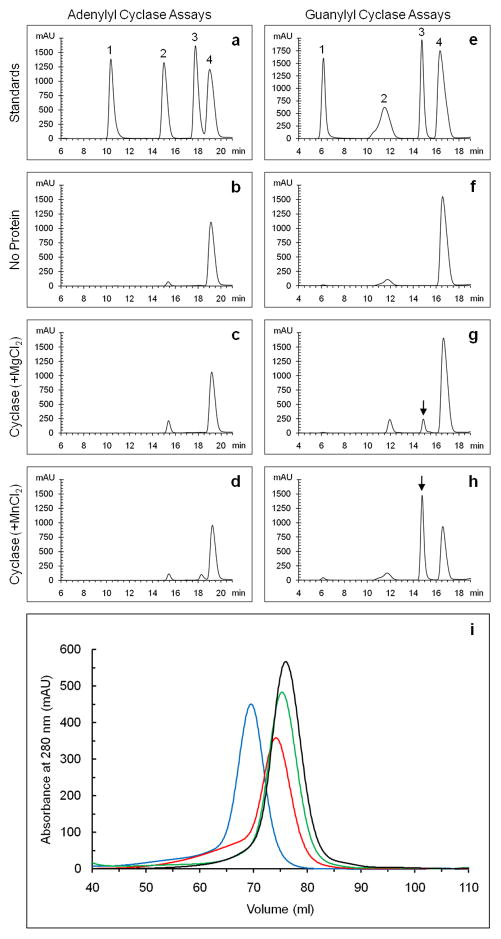
HPLC separation of products and substrates from assays using purified recombinant guanylyl cyclase (RC1_3783). (a) Separation of adenine nucleotide standards AMP (1), ADP (2), cAMP (3) and ATP (4). (e) Separation of guanine nucleotide standards GMP (1), GDP (2), cGMP (3) and GTP (4). All reactions were incubated for 2 hr and contained 0.5 mM ATP (b–d) or GTP (f–h), 10 mM MnCl2 (b, d, f, h) or MgCl2 (c, g) and 0.5 μg/μl purified RC1_3783 (c, d, g, h). Control reactions (b, f) had buffer added in place of enzyme. A small amount of cGMP indicated by a black arrow (↓) is produced in reaction g containing GTP, Mg2+ and recombinant cyclase, with greater activity occurring in reaction h when Mn2+ is substituted for Mg2+. (i) Purified recombinant cyclase elutes as a dimer in the absence of NaCl (Blue line) but as a monomer when chromatographed on a Superose 6 column equilibrated in 100, 50 or 25 mM NaCl (Black, Green & Red lines, respectively).
Figure 6
Figure 6
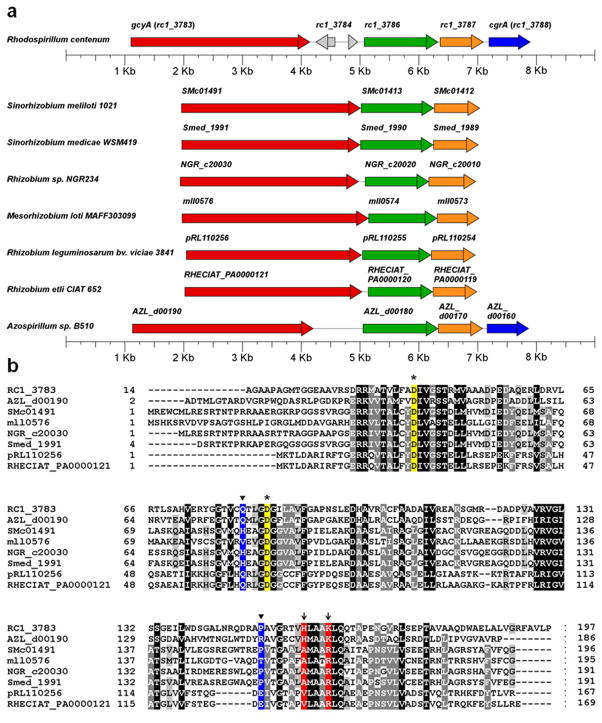
(a) Species containing cyclases with similar genetic contexts as the R. centenum guanylyl cyclase coded by gcyA (rc1_3783), the downstream ORFs needed for cyclase activity (rc1_3786 and rc1_3787) and the CRP homolog coded by cgrA (rc1_3788) in Azosprillum sp. B510. Red (nucleotidyl cyclase), green (COG1944), orange (COG3482) and blue (CRP homolog). (b) Amino acid sequence alignment of the RC1_3783 cyclase domain with putative guanylyl cyclase domains. Species are: Rhodospirillum centenum, RC1_3783 (YP_002299938); Azospirillum sp. B510, AZL_d00190 (YP_003452389); Sinorhizobium meliloti 1021, SMc01491 (NP_386201); Mesorhizobium loti MAFF303099, mll0576 (NP_102350); Rhizobium leguminosarum bv. viciae 3841, pRL110256 (YP_771288); Rhizobium etli CIAT 652, RHECIAT_PA0000121 (YP_001985730); Rhizobium sp. NGR234, NGR_c20030 (YP_002826519); Sinorhizobium medicae WSM419, Smed_1991 (YP_001327660). Domains were identified using the SMART database and aligned in MEGA v.4.0 utilizing a PAM matrix with respective pair-wise and multiple alignment gap opening and extension penalties of 10 and 0.1. Relative positions of residues involved in metal binding (Yellow), substrate specification (Blue) and transition state stabilization (Red) are additionally indicated by asterisks (*), inverted triangles (▼) and arrows (↓). Further shading indicates identically and functionally conserved residues at 100% (Black), 80% (Dark gray, White letters), and 60% (Light gray, Dark letters) conservation.
Figure 7
Figure 7
Analyses of cyst cell formation and cGMP production in wild-type, Δrc1_3786 and Δrc1_3787 deletion strains. (a) After 3 days growth on cyst inducing CENS-8xN media the wild-type strain displayed ridged colony morphology indicative of cyst cell formation, while both deletion strains remained vegetative in appearance. In contrast, on a plate supplemented to 50 μM cGMP, all three strains displayed encysted colony morphologies. (b) Microscopic observations of vegetative and cyst cells from colonies shown in panel a. (c) Exogenous cGMP levels present in culture supernatants after 11 days growth in liquid CENBA media.
Figure 8
Figure 8
Accumulation of exogenous cGMP in culture supernatants of wild-type Azospirillum brasilense grown in cyst inducing MSM medium. Cultures were grown aerobically in MSM media and the culture supernatant was measured for cGMP levels as described in Materials and Methods. Error bars represent standard deviation derived from three replicate assays.
Figure 9
Figure 9
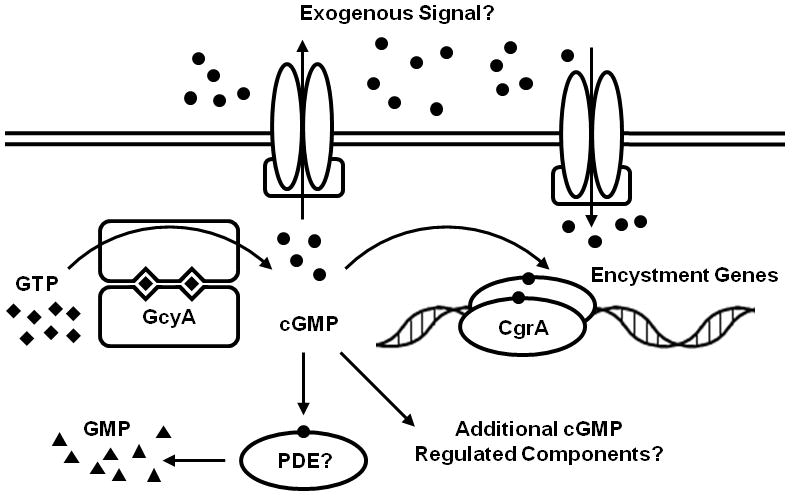
Model of the regulation of R. centenum encystment by cGMP. The guanylyl cyclase coded by gcyA (rc1_3783) synthesizes cGMP in response to an unknown developmental signal. The cNMP binding domain of the CRP homolog coded by cgrA (rc1_3788) binds and is activated by cGMP, resulting in expression of genes required

References

    1. Berleman JE, Bauer CE. Characterization of cyst cell formation in the purple photosynthetic bacterium Rhodospirillum centenum. Microbiology. 2004;150:383–390. - PubMed
    1. Berleman JE, Bauer CE. Involvement of a Che-like signal transduction cascade in regulating cyst cell development in Rhodospirillum centenum. Mol Microbiol. 2005;56:1457–1466. - PubMed
    1. Berleman JE, Hasselbring BM, Bauer CE. Hypercyst mutants in Rhodospirillum centenum identify regulatory loci involved in cyst cell differentiation. J Bacteriol. 2004;186:5834–5841. - PMC - PubMed
    1. Bernlohr RW, Haddox MK, Goldberg ND. Cyclic guanosine 3′:5′-monophosphate in Escherichia coli and Bacillus lichenformis. J Biol Chem. 1974;249:4329–4331. - PubMed
    1. Biswas KH, Shenoy AR, Dutta A, Visweswariah SS. The evolution of guanylyl cyclases as multidomain proteins: conserved features of kinase-cyclase domain fusions. J Mol Evol. 2009;68:587–602. - PubMed

Publication types

MeSH terms