. 2011 Feb 28;301(2):221-8.
doi: 10.1016/j.canlet.2010.12.015. Epub 2011 Jan 7.

Gambogic acid enhances proteasome inhibitor-induced anticancer activity

Affiliations

Gambogic acid enhances proteasome inhibitor-induced anticancer activity

Hongbiao Huang et al. Cancer Lett. .

Abstract

Proteasome inhibition has emerged as a novel approach to anticancer therapy. Numerous natural compounds, such as gambogic acid, have been tested in vitro and in vivo as anticancer agents for cancer prevention and therapy. However, whether gambogic acid has chemosensitizing properties when combined with proteasome inhibitors in the treatment of malignant cells is still unknown. In an effort to investigate this effect, human leukemia K562 cells, mouse hepatocarcinoma H22 cells and H22 cell allografts were treated with gambogic acid, a proteasome inhibitor (MG132 or MG262) or the combination of both, followed by measurement of cellular viability, apoptosis induction and tumor growth inhibition. We report, for the first time, that: (i) the combination of natural product gambogic acid and the proteasome inhibitor MG132 or MG262 results in a synergistic inhibitory effect on growth of malignant cells and tumors in allograft animal models and (ii) there was no apparent systemic toxicity observed in the animals treated with the combination. Therefore, the findings presented in this study demonstrate that natural product gambogic acid is a valuable candidate to be used in combination with proteasome inhibitors, thus representing a compelling anticancer strategy.


Conflict of interest statement

Conflicts of interest

None declared.

Figures

Fig. 1
Fig. 1
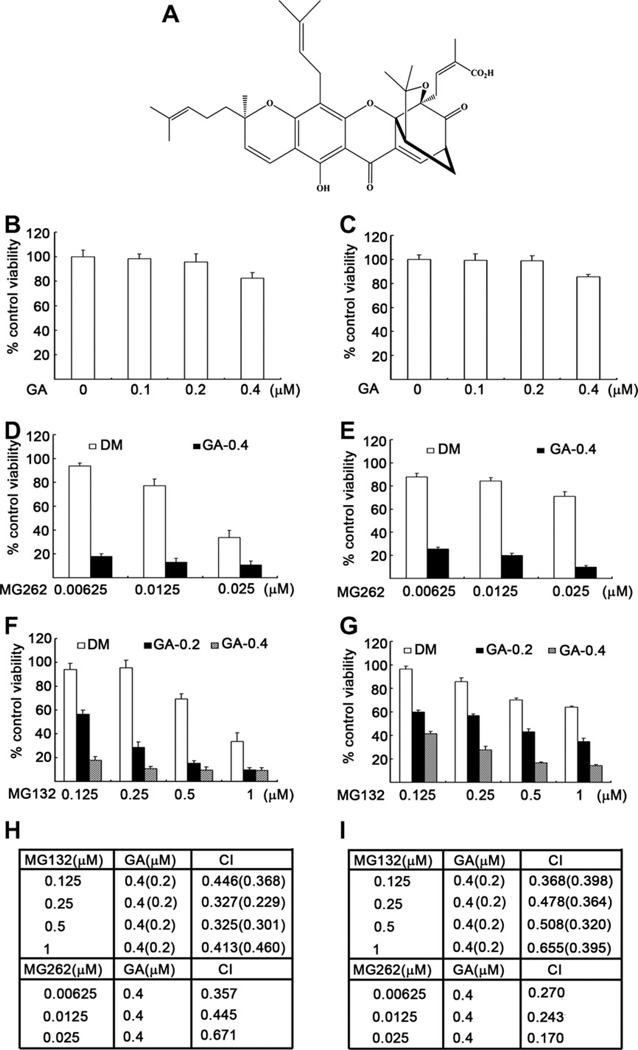
Synergistic effect of GA and proteasome inhibitors on inhibition of cell viability/proliferation in malignant cells. (A) Chemical structure of GA. (B and C) K562 (B) or H22 cells (C) were treated with indicated doses of GA for 48 h, followed by MTS assay. (D and E) K562 (D) or H22 cells (E) were exposed to indicated concentrations of MG262 in the presence or absence of GA (0.4 µM) for 48 h, followed by MTS assay. (F, G) K562 (F) or H22 cells (G) were treated with indicated doses of MG132 in the presence or absence of GA (0.2 or 0.4 µM) for 48 h, followed by MTS assay. (H, I) Combination index (CI) of proteasome inhibitors plus GA in K562 cells (H) or H22 cells (I) was presented. CI < 1 indicates synergistic effect. Bars, SD, mean of four experiments.
Fig. 2
Fig. 2
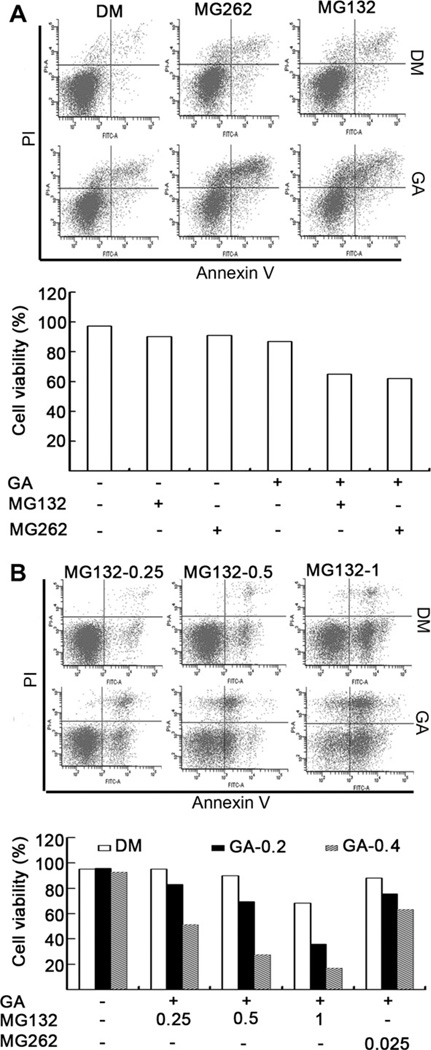
GA sensitizes malignant cells to the proteasome inhibitor-induced cell death. (A) H22 cells were treated with MG132 (0.5 µM) or MG262 (0.025 µM) in the presence or absence of GA (0.4 µM) for 24 h. The treated cells were collected and stained with FITC Annexin V and propidium iodide (PI), followed by flow cytometry analysis. The results of flow images (the upper panel) and summarized bar graphs (the lower panel) were presented. (B) K562 cells were treated with MG132 (0.25, 0.5, 1 µM) or MG262 (0.025 µM) in the presence or absence of GA (0.2, 0.4 µM) for 24 h, followed by staining with Annexin V and PI, and flow cytometry analysis.
Fig. 3
Fig. 3
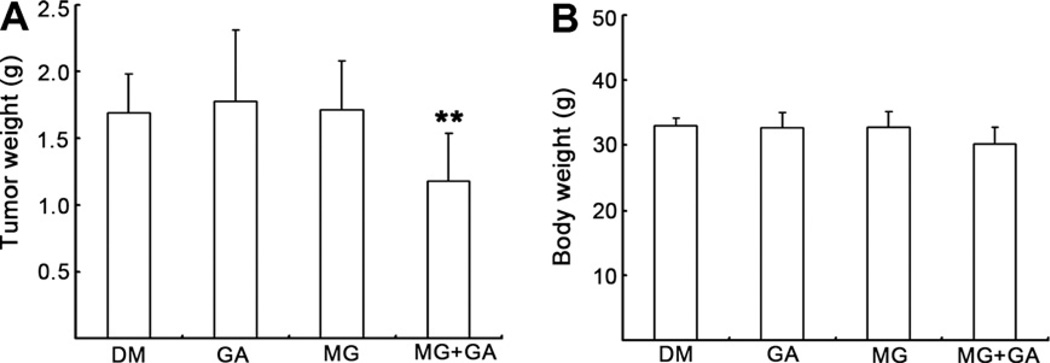
Combinational treatment with GA and MG132 suppresses allograft tumor growth in animal models. H22 allograft was generated in male KMF mice as described in Section 2 and daily treated with either GA (1 mg/kg of body weight), MG132 (2 mg/kg of body weight) alone or combination of these two agents (10 mice per group) for 7 days. Two days after termination of the treatment, the mice were sacrificed and the tumor size (A) and body weigh (B) were analyzed. **P< 0.01, bars, SD, mean of 10 mice.
Fig. 4
Fig. 4
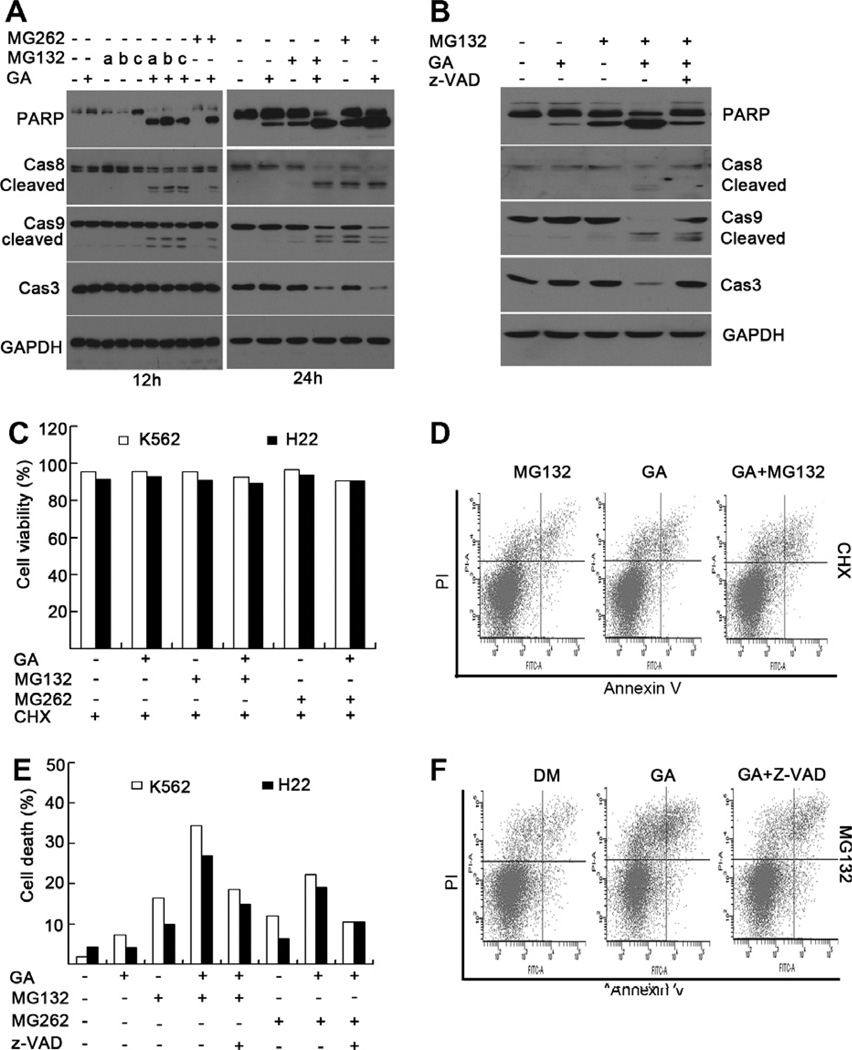
Combinational treatment with GA and proteasome inhibitors can activate caspase pathway and induce cell death, which can be blocked by caspase inhibitor (z-VAD) and protein synthesis inhibitor cycloheximide (CHX). (A) K562 cells were treated with GA (0.4 µM), MG132 (at a-0.25, b-0.5, c-1 µM for 12 h; or 0.5 µM for 24 h), MG262 (0.025 µM) or combined GA and MG132/MG262 for 12 or 24 h. Proteins extracts from the treated cells were subjected to Western blot analysis by using anti-caspase-9, anti-caspase-8, anti-caspase-3, or anti-PARP antibodies. GAPDH blot was used as a loading control. (B) K562 cells were treated with GA (0.4 µM), MG132 (1 µM), or combination of GA and MG132 for 12 h in the presence of a pan-caspase inhibitor z-VAD-fmk (20 µM), followed by Western blot analysis as in (A). (C and D) K562 or H22 cells were treated with GA (0.4 µM), MG132 (1 µM), MG262 (0.025 µM) or combination of GA and MG132/MG262 for 12 h in the presence or absence of cycloheximide (25 µg/ml), followed by flow cytometry. A summary of cell viability was shown in (C) and representative flow images from at least three independent experiments were shown in (D). (E and F) K562 or H22 cells were treated with GA (0.4 µM), MG132 (1 µM), MG262 (0.025 µM) or combination of GA and MG132/MG262 for 12 h in the presence or absence of caspase inhibitor z-VAD-fmk 20 µM), followed by flow cytometry. A summary of cell death was shown in (E) and representative images from at least three independent experiments were shown in (F).

References

    1. Adams J. The proteasome: a suitable antineoplastic target. Nat. Rev. Cancer. 2004;4:349–360. - PubMed
    1. Ciechanover A. The ubiquitin–proteasome proteolytic pathway. Cell. 1994;79:13–21. - PubMed
    1. Goldberg AL. Protein degradation and protection against misfolded or damaged proteins. Nature. 2003;426:895–899. - PubMed
    1. Hochstrasser M, Ubiquitin proteasomes. and the regulation of intracellular protein degradation. Curr. Opin. Cell Biol. 1995;7:215–223. - PubMed
    1. Adams J. The development of proteasome inhibitors as anticancer drugs. Cancer Cell. 2004;5:417–421. - PubMed

Publication types

MeSH terms