


Gene-environment interactions in human disease: nuisance or opportunity?
- PMID: 21216485
- PMCID: PMC3073697
- DOI: 10.1016/j.tig.2010.12.004
Gene-environment interactions in human disease: nuisance or opportunity?
Abstract
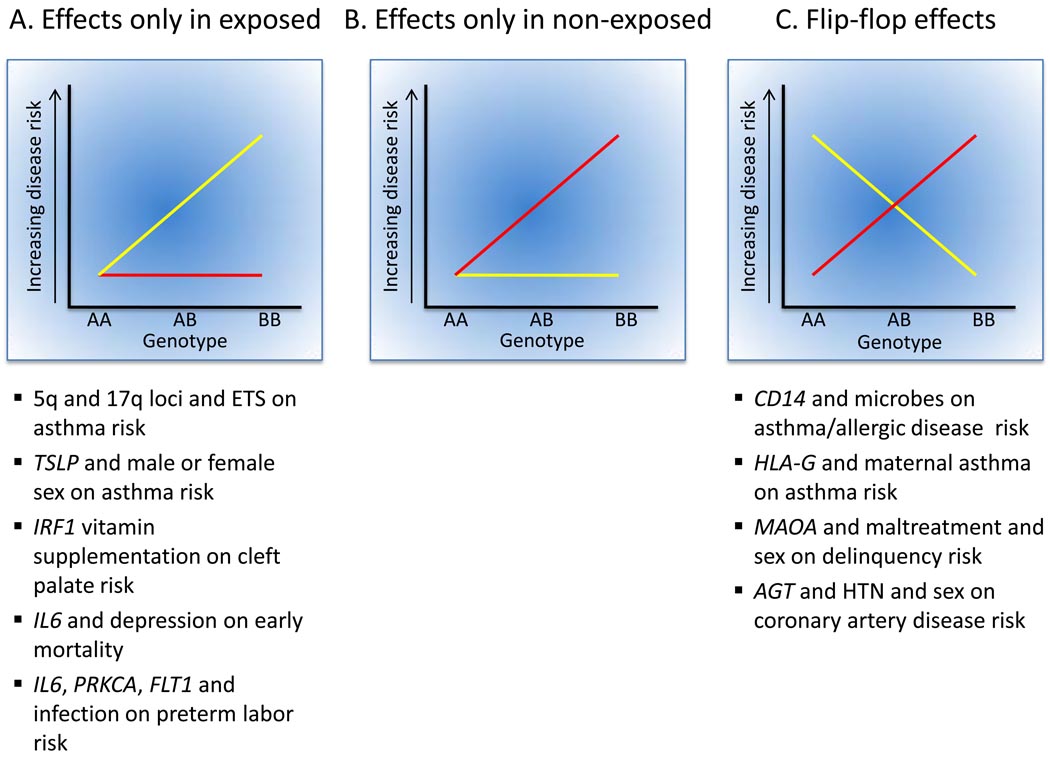
Many environmental risk factors for common, complex human diseases have been revealed by epidemiologic studies, but how genotypes at specific loci modulate individual responses to environmental risk factors is largely unknown. Gene-environment interactions will be missed in genome-wide association studies and could account for some of the 'missing heritability' for these diseases. In this review, we focus on asthma as a model disease for studying gene-environment interactions because of relatively large numbers of candidate gene-environment interactions with asthma risk in the literature. Identifying these interactions using genome-wide approaches poses formidable methodological problems, and elucidating molecular mechanisms for these interactions has been challenging. We suggest that studying gene-environment interactions in animal models, although more tractable, might not be sufficient to shed light on the genetic architecture of human diseases. Lastly, we propose avenues for future studies to find gene-environment interactions.
Copyright © 2010 Elsevier Ltd. All rights reserved.
Figures

References
Publication types
MeSH terms
Grants and funding
- HL101651/HL/NHLBI NIH HHS/United States
- R01 HL066391/HL/NHLBI NIH HHS/United States
- AI076715/AI/NIAID NIH HHS/United States
- R01 HL085197/HL/NHLBI NIH HHS/United States
- RC2 HL101651/HL/NHLBI NIH HHS/United States
- HL66391/HL/NHLBI NIH HHS/United States
- HL100800/HL/NHLBI NIH HHS/United States
- RC1 HL100800/HL/NHLBI NIH HHS/United States
- HL085197/HL/NHLBI NIH HHS/United States
- U01 HL066803/HL/NHLBI NIH HHS/United States
- HL70831/HL/NHLBI NIH HHS/United States
- P01 HL070831/HL/NHLBI NIH HHS/United States
- R21 AI076715/AI/NIAID NIH HHS/United States
