


Type II odontoid fractures of the cervical spine: do treatment type and medical comorbidities affect mortality in elderly patients?
- PMID: 21217435
- PMCID: PMC3261514
- DOI: 10.1097/BRS.0b013e3181e8e77c
Type II odontoid fractures of the cervical spine: do treatment type and medical comorbidities affect mortality in elderly patients?
Abstract
Study design: Retrospective cohort study.
Objective: To determine the influence of age, comorbidities, and treatment type on mortality in elderly patients with acute Type II odontoid fractures.
Summary of background data: Prior studies have documented increased morbidity and mortality among geriatric patients sustaining odontoid fractures. However, there is limited data regarding the effect of patient age, medical comorbidities, and treatment selection on mortality after Type II odontoid (C2) fractures in the elderly.
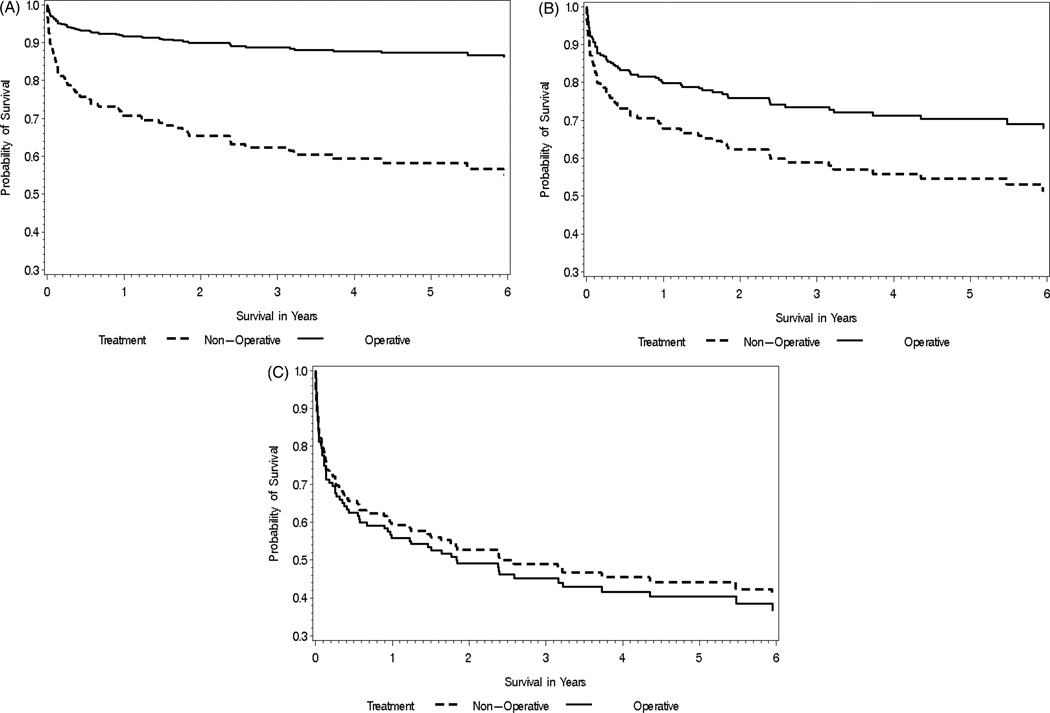
Methods: An institutional registry was used to identify all Type II odontoid fractures sustained by patients aged 65 and older from 1991 to 2006. Demographic information, date of injury, associated injuries, treatment type, and comorbidities were abstracted from medical records. Mortality was ascertained using the National Death Index. Risks of mortality and their associated 95% confidence intervals (CIs) were calculated at 3 months, 1 year, 2 years, and 3 years. Multivariable Cox proportional hazard regression was used to evaluate independent factors affecting mortality stratified by age (65-74 years, 75-84 years, ≥ 85 years) and treatment type (operative or nonoperative treatment, and halo or collar immobilization).
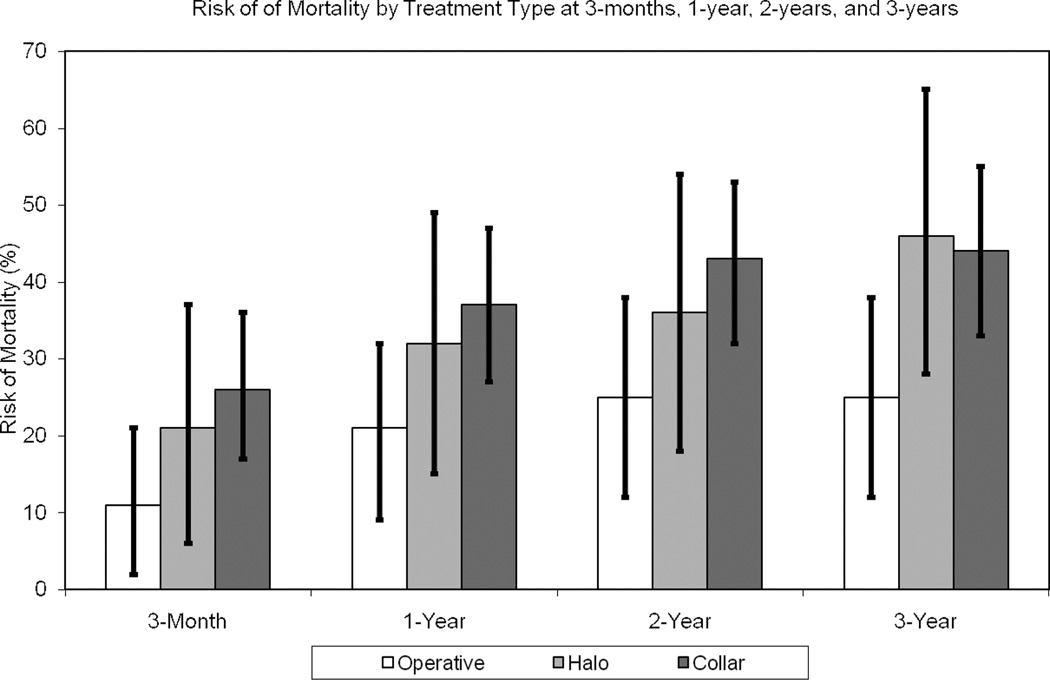
Results: Of 156 patients identified with Type II odontoid fracture, the average age was 82 years (SD = 7.8; Range: 65-101). One hundred and twelve patients (72%) were treated nonoperatively. At 3 years postinjury, there was a 39% (95% CI: 32-47) mortality rate for the entire cohort. Mortality for the operative group was 11% (95% CI: 2-21) at 3 months and 21% (95% CI: 9-32) at 1 year compared with 25% (95% CI: 17-33) at 3 months and 36% (95% CI: 27-45) at 1 year in the nonoperative group. The Cox regression model showed that the protective effect of surgery was seen in patients aged 65 to 74 years, in whom the hazard ratio associated with surgery for mortality after odontoid fracture was 0.4 (95% CI: 0.1-1.5). Those aged 75 to 84 years had a hazard ratio of 0.8 (95% CI: 0.3-2.3), and patients 85 years or older had a hazard ratio of 1.9 (95% CI: 0.6-6.1; P value for interaction between age and treatment = 0.09) with operative treatment having a protective effect in patients aged 65 to 74 years.
Conclusion: In a cohort of elderly patients, Type II odontoid fractures were associated with a high rate of mortality, regardless of intervention.
Figures
References
-
- Chutkan NB, King AG, Harris MB. Odontoid fractures: evaluation and management. J Am Acad Orthop Surg. 1997;5(4):199–204. - PubMed
-
- Spivak JM, Weiss MA, Cotler JM, et al. Cervical spine injuries in patients 65 and older. Spine. 1994;19(20):2302–2306. - PubMed
-
- Frangen TM, Zilkens C, Muhr G, et al. Odontoid fractures in the elderly: dorsal C1/C2 fusion is superior to halo-vest immobilization. J Trauma. 2007;63(1):83–89. - PubMed
-
- Bednar DA, Parikh J, Hummel J. Management of type II odontoid process fractures in geriatric patients: a prospective study of sequential cohorts with attention to survivorship. J Spinal Dis. 1995;8(2):166–169. - PubMed
MeSH terms
Grants and funding
LinkOut - more resources
Full Text Sources
Other Literature Sources
Medical
Miscellaneous
