


Sleep deprivation in critical illness: its role in physical and psychological recovery
- PMID: 21220271
- PMCID: PMC3299928
- DOI: 10.1177/0885066610394322
Sleep deprivation in critical illness: its role in physical and psychological recovery
Abstract
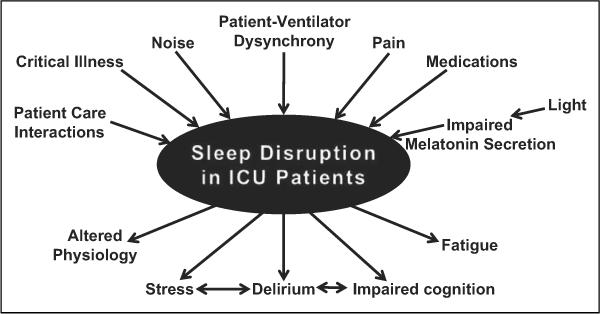
Critically ill patients frequently experience poor sleep, characterized by frequent disruptions, loss of circadian rhythms, and a paucity of time spent in restorative sleep stages. Factors that are associated with sleep disruption in the intensive care unit (ICU) include patient-ventilator dysynchrony, medications, patient care interactions, and environmental noise and light. As the field of critical care increasingly focuses on patients' physical and psychological outcomes following critical illness, understanding the potential contribution of ICU-related sleep disruption on patient recovery is an important area of investigation. This review article summarizes the literature regarding sleep architecture and measurement in the critically ill, causes of ICU sleep fragmentation, and potential implications of ICU-related sleep disruption on patients' recovery from critical illness. With this background information, strategies to optimize sleep in the ICU are also discussed.
Figures
References
-
- Figueroa-Ramos MI, Arroyo-Novoa CM, Lee KA, Padilla G, Puntillo KA. Sleep and delirium in ICU patients: a review of mechanisms and manifestations. Intensive Care Med. 2009;35(5):781–795. - PubMed
-
- Hardin KA. Sleep in the ICU: potential mechanisms and clinical implications. Chest. 2009;136(1):284–294. - PubMed
-
- Carskadon MA, Dement WC. Normal human sleep: an overview. In: Kryger M, Roth T, Dement WC, editors. Principles and practice of sleep medicine. Elsevier/Saunders; Philadelphia, PA: 2005.
-
- Collop NA, Salas RE, Delayo M, Gamaldo C. Normal sleep and circadian processes. Crit Care Clin. 2008;24(3):449–60. v. - PubMed
Publication types
MeSH terms
Grants and funding
LinkOut - more resources
Full Text Sources
Other Literature Sources
Medical
