. 2011 Jan 25;108(4):1397-402.
doi: 10.1073/pnas.1018898108. Epub 2011 Jan 10.

Inducible formation of breast cancer stem cells and their dynamic equilibrium with non-stem cancer cells via IL6 secretion

Affiliations

Inducible formation of breast cancer stem cells and their dynamic equilibrium with non-stem cancer cells via IL6 secretion

Dimitrios Iliopoulos et al. Proc Natl Acad Sci U S A. .

Abstract

Tumors are often heterogeneous, being composed of multiple cell types with different phenotypic and molecular properties. Cancer stem-like cells (CSCs) are a highly tumorigenic cell type found in developmentally diverse tumors or cancer cell lines, and they are often resistant to standard chemotherapeutic drugs. The origins of CSCs and their relationships to nonstem cancer cells (NSCCs) are poorly understood. In an inducible breast oncogenesis model, CSCs are generated from nontransformed cells at a specific time during the transformation process, but CSC formation is not required for transformation. MicroRNA profiles indicate that CSCs and NSCCs are related, but different cell types arising from a common nontransformed population. Interestingly, medium from the transformed population stimulates NSCCs to become CSCs, and conversion of NSCCs to CSCs occurs in mouse xenografts. Furthermore, IL6 is sufficient to convert NSCCs to CSCs in genetically different breast cell lines, human breast tumors, and a prostate cell line. Thus, breast and prostate CSCs and NSCCs do not represent distinct epigenetic states, and these CSCs do not behave as or arise from classic stem cells. Instead, tumor heterogeneity involves a dynamic equilibrium between CSCs and NSCCs mediated by IL6 and activation of the inflammatory feedback loop required for oncogenesis. This dynamic equilibrium provides an additional rationale for combining conventional chemotherapy with metformin, which selectively inhibits CSCs.


Conflict of interest statement

The authors declare no conflict of interest.

Figures
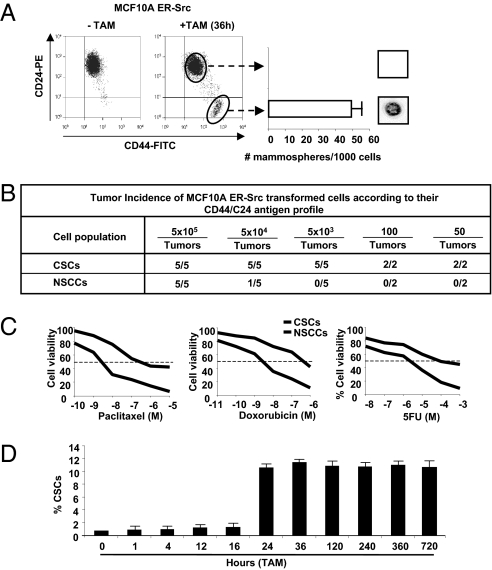
Fig. 1.
Fig. 1.
Breast CSCs are induced at a specific time during transformation. (A) CD44/CD24 profiles of ER-Src cells that were or were not treated with TAM for 36 h. Number of mammospheres per 1,000 cells (representative mammosphere shown) generated by sorted CSCs (CD44high/CD24low) and NSCCs (CD44low/CD24high). (B) Tumor incidence in mouse xenografts injected with the indicated number of CSCs or NSCCs isolated by sorting. (C) Percent viable CSCs and NSCCs after treatment with indicated concentrations of paclitaxel, doxorubicin, and 5-fluorouracil. (D) Proportion (percent) of CSCs at the indicated times after treatment of ER-Src cells with TAM.
Fig. 2.
Fig. 2.
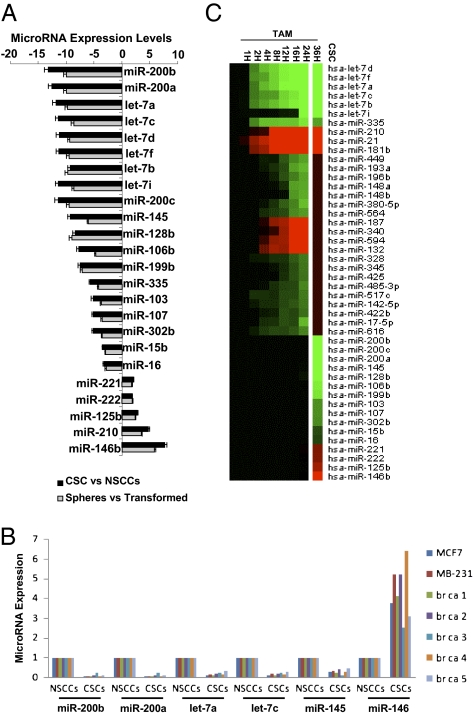
MicroRNAs differentially regulated in CSCs vs. NSCCs. (A) Relative expression levels (fold-effect) of microRNAs down-regulated (- numbers) or up-regulated (+ numbers) in isolated CSCs vs. NSCCs (black bars) or mammospheres vs. nonsorted transformed cells (gray bars). (B) Relative expression levels of the indicated microRNAs in NSCCs (defined as 1.0) and CSCs from MCF7, MDA-MB-231, and five human beast tumors. (C) Heat map representations of up-regulated (red) and down-regulated (green) microRNAs in CSCs (compared with NSCCs) or at different time points during ER-Src transformation (24), with the three different classes of microRNAs indicated.
Fig. 3.
Fig. 3.
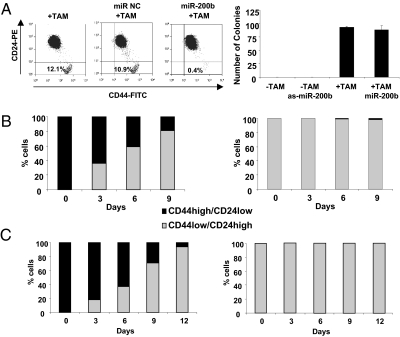
Relationship of CSC and NSCC formation and stability of the isolated cell types. (A) Transformation assays (morphology or colony formation in soft agar) of ER-Src cells that were or were not treated with TAM in the presence or absence of miR-200b or anti-sense miR-200b. (B) Number of CSCs (black) or NSCCs (gray) after growth of isolated CSCs (Left) or isolated NSCCs (Right) from ER-Src transformed cells for the indicated number of days. (C) Same as B except that sorted CSCs and NSCCs were derived from a breast tumor.
Fig. 4.
Fig. 4.
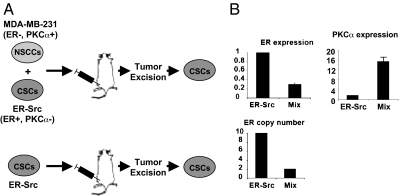
Conversion of NSCCs to CSCs in tumors in mouse xenografts. (A) Scheme of mixed xenograft experiment. The 104 ER-Src CSCs were combined (or not) with 104 NSCCs from MDA-MB-231, injected into nude mice. CSCs were obtained by sorting cells from excised tumors 15 d after injection, and the resulting material examined for ER and PKCα RNA levels or ER copy number (B).
Fig. 5.
Fig. 5.
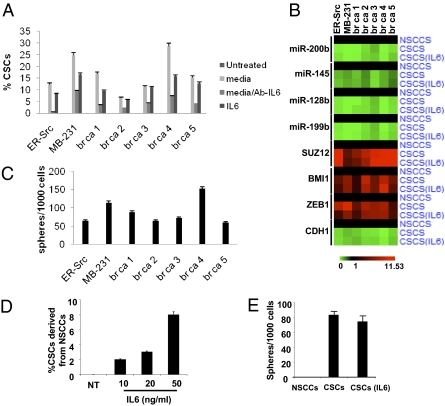
Dynamic equilibrium between CSCs and NSCCs mediated by IL6 secretion. (A) Number of CSCs formed from NSCCs from the indicated cell lines and five human breast tumors (br ca) that were treated with medium from ER–Src-transformed cells in the presence or absence of antibody against IL6 or with IL6. (B) mRNA and microRNA profiles of CSC expression markers in NSCCs, CSCs, and IL6-treated NSCCs from the indicated cell lines and human breast tumors. (C) Number of mammospheres formed from untreated and IL6-treated NSCCs from the indicated cell lines and human breast tumors. (D) Number of prostate CSCs (CD44+/CD133+) formed from NSCCs (CD44/CD133) obtained by sorting PC3 prostate cancer cells upon treatment with the indicated concentration of IL6. (E) Number of prostate spheres formed from PC3 NSCCs, CSCs, and IL6-treated NSCCs.
Fig. 6.
Fig. 6.
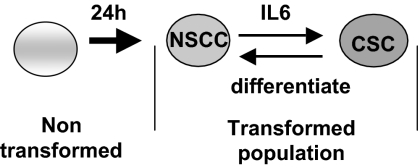
Model for formation of NSCCs and CSCs and the dynamic equilibrium between these cell types mediated by IL6. Transformation and generation of NSCCs is required for CSC formation. CSCs rapidly differentiate back into NSCCs, but they also secrete IL6 to allow conversion of NSCCs to CSCs, thereby maintaining the dynamic equilibrium.

References

    1. Ailles LE, Weissman IL. Cancer stem cells in solid tumors. Curr Opin Biotechnol. 2007;18:460–466. - PubMed
    1. Polyak K, Weinberg RA. Transitions between epithelial and mesenchymal states: Acquisition of malignant and stem cell traits. Nat Rev Cancer. 2009;9:265–273. - PubMed
    1. Grimshaw MJ, et al. Mammosphere culture of metastatic breast cancer cells enriches for tumorigenic breast cancer cells. Breast Cancer Res. 2008;10:R52. - PMC - PubMed
    1. Marotta LL, Polyak K. Cancer stem cells: A model in the making. Curr Opin Genet Dev. 2009;19:44–50. - PubMed
    1. Rosen JM, Jordan CT. The increasing complexity of the cancer stem cell paradigm. Science. 2009;324:1670–1673. - PMC - PubMed

Publication types

MeSH terms