


Implication of the purinergic system in alcohol use disorders
- PMID: 21223299
- PMCID: PMC3076125
- DOI: 10.1111/j.1530-0277.2010.01379.x
Implication of the purinergic system in alcohol use disorders
Abstract
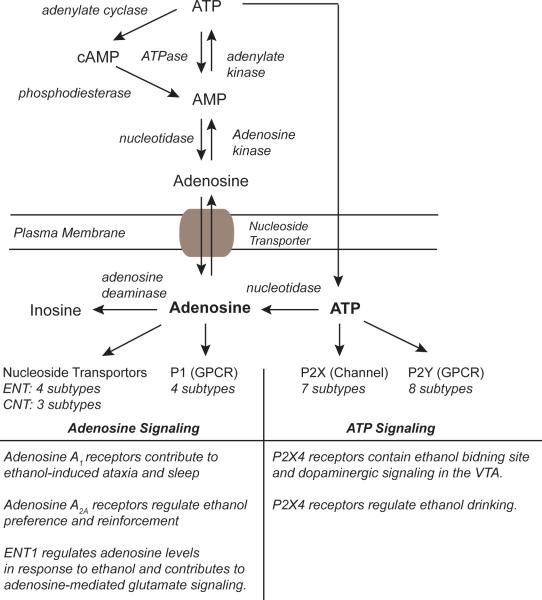
In the central nervous system, adenosine and adenosine 5'-triphosphate (ATP) play an important role in regulating neuronal activity as well as controlling other neurotransmitter systems, such as, GABA, glutamate, and dopamine. Ethanol increases extracellular adenosine levels that regulate the ataxic and hypnotic/sedative effects of ethanol. Interestingly, ethanol is known to increase adenosine levels by inhibiting an ethanol-sensitive adenosine transporter, equilibrative nucleoside transporter type 1 (ENT1). Ethanol is also known to inhibit ATP-specific P2X receptors, which might result in such similar effects as those caused by an increase in adenosine. Adenosine and ATP exert their functions through P1 (metabotropic) and P2 (P2X-ionotropic and P2Y-metabotropic) receptors, respectively. Purinergic signaling in cortex-striatum-ventral tegmental area (VTA) has been implicated in regulating cortical glutamate signaling as well as VTA dopaminergic signaling, which regulates the motivational effect of ethanol. Moreover, several nucleoside transporters and receptors have been identified in astrocytes, which regulate not only adenosine-ATP neurotransmission, but also homeostasis of major inhibitory-excitatory neurotransmission (i.e., GABA or glutamate) through neuron-glial interactions. This review will present novel findings on the implications of adenosine and ATP neurotransmission in alcohol use disorders.
Copyright © 2011 by the Research Society on Alcoholism.
Figures
References
-
- Adams CL, Cowen MS, Short JL, Lawrence AJ. Combined antagonism of glutamate mGlu5 and adenosine A2A receptors interact to regulate alcohol-seeking in rats. Int J Neuropsychopharmacol. 2008;11:229–241. - PubMed
-
- Al-Rejaie S, Dar MS. Behavioral interaction between nicotine and ethanol: possible modulation by mouse cerebellar glutamate. Alcohol Clin Exp Res. 2006a;30:1223–1233. - PubMed
-
- Al-Rejaie S, Dar MS. Possible role of mouse cerebellar nitric oxide in the behavioral interaction between chronic intracerebellar nicotine and acute ethanol administration: observation of cross-tolerance. Neuroscience. 2006b;138:575–585. - PubMed
Publication types
MeSH terms
Substances
Grants and funding
- AA017830/AA/NIAAA NIH HHS/United States
- R03 NS059831/NS/NINDS NIH HHS/United States
- AA013922/AA/NIAAA NIH HHS/United States
- AA017472A/AA/NIAAA NIH HHS/United States
- R21 AA017472/AA/NIAAA NIH HHS/United States
- U01 AA013517/AA/NIAAA NIH HHS/United States
- AA0701/AA/NIAAA NIH HHS/United States
- AA015164/AA/NIAAA NIH HHS/United States
- K01 AA017243/AA/NIAAA NIH HHS/United States
- AA017243/AA/NIAAA NIH HHS/United States
- P20 AA017830/AA/NIAAA NIH HHS/United States
- NS059831/NS/NINDS NIH HHS/United States
- R01 AA013922/AA/NIAAA NIH HHS/United States
- AA013517/AA/NIAAA NIH HHS/United States
- AA018779/AA/NIAAA NIH HHS/United States
- R01 AA015164/AA/NIAAA NIH HHS/United States
- R01 AA018779/AA/NIAAA NIH HHS/United States
- U24 AA013517/AA/NIAAA NIH HHS/United States
LinkOut - more resources
Full Text Sources
Other Literature Sources
