


Shoulder muscle endurance: the development of a standardized and reliable protocol
- PMID: 21223588
- PMCID: PMC3025902
- DOI: 10.1186/1758-2555-3-1
Shoulder muscle endurance: the development of a standardized and reliable protocol
Abstract
Background: Shoulder muscle fatigue has been proposed as a possible link to explain the association between repetitive arm use and the development of rotator cuff disorders. To our knowledge, no standardized clinical endurance protocol has been developed to evaluate the effects of muscle fatigue on shoulder function. Such a test could improve clinical examination of individuals with shoulder disorders. Therefore, the purpose of this study was to establish a reliable protocol for objective assessment of shoulder muscle endurance.
Methods: An endurance protocol was developed on a stationary dynamometer (Biodex System 3). The endurance protocol was performed in isotonic mode with the resistance set at 50% of each subject's peak torque as measured for shoulder external (ER) and internal rotation (IR). Each subject performed 60 continuous repetitions of IR/ER rotation. The endurance protocol was performed by 36 healthy individuals on two separate occasions at least two days apart. Maximal isometric shoulder strength tests were performed before and after the fatigue protocol to evaluate the effects of the endurance protocol and its reliability. Paired t-tests were used to evaluate the reduction in shoulder strength due to the protocol, while intraclass correlation coefficients (ICC) and minimal detectable change (MDC) were used to evaluate its reliability.
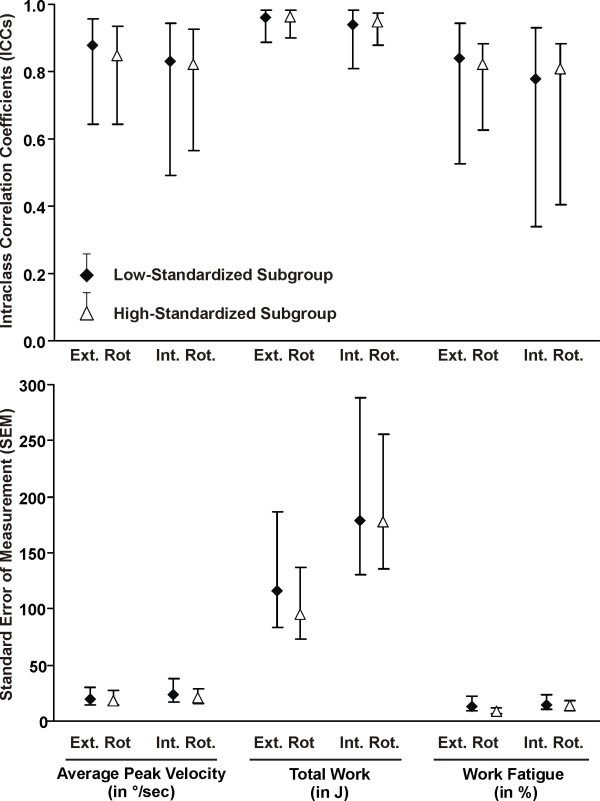
Results: Maximal isometric strength was significantly decreased after the endurance protocol (P < 0.001). The total work performed during the last third of the protocol was significantly less than the first third of the protocol (P < 0.05). The test-retest reliability of the post-fatigue strength measures was excellent (ICC >0.84).
Conclusions: Changes in muscular performance observed during and after the muscular endurance protocol suggests that the protocol did result in muscular fatigue. Furthermore, this study established that the resultant effects of fatigue of the proposed isotonic protocol were reproducible over time. The protocol was performed without difficulty by all volunteers and took less than 10 minutes to perform, suggesting that it might be feasible for clinical practice. This protocol could be used to induce local muscular fatigue in order to evaluate the effects of fatigue on shoulder kinematics or to evaluate changes in shoulder muscle endurance following rehabilitation.
Figures
References
LinkOut - more resources
Full Text Sources
