. 2011 Jan;178(1):423-33.
doi: 10.1016/j.ajpath.2010.11.009. Epub 2010 Dec 23.

Functional contributions of N- and O-glycans to L-selectin ligands in murine and human lymphoid organs

Affiliations

Functional contributions of N- and O-glycans to L-selectin ligands in murine and human lymphoid organs

Hanayo Arata-Kawai et al. Am J Pathol. 2011 Jan.

Abstract

L-selectin initiates lymphocyte interactions with high endothelial venules (HEVs) of lymphoid organs through binding to ligands with specific glycosylation modifications. 6-Sulfo sLe(x), a sulfated carbohydrate determinant for L-selectin, is carried on core 2 and extended core 1 O-glycans of HEV-expressed glycoproteins. The MECA-79 monoclonal antibody recognizes sulfated extended core 1 O-glycans and partially blocks lymphocyte-HEV interactions in lymphoid organs. Recent evidence has identified the contribution of 6-sulfo sLe(x) carried on N-glycans to lymphocyte homing in mice. Here, we characterize CL40, a novel IgG monoclonal antibody. CL40 equaled or surpassed MECA-79 as a histochemical staining reagent for HEVs and HEV-like vessels in mouse and human. Using synthetic carbohydrates, we found that CL40 bound to 6-sulfo sLe(x) structures, on both core 2 and extended core 1 structures, with an absolute dependency on 6-O-sulfation. Using transfected CHO cells and gene-targeted mice, we observed that CL40 bound its epitope on both N-glycans and O-glycans. Consistent with its broader glycan-binding, CL40 was superior to MECA-79 in blocking lymphocyte-HEV interactions in both wild-type mice and mice deficient in forming O-glycans. This superiority was more marked in human, as CL40 completely blocked lymphocyte binding to tonsillar HEVs, whereas MECA-79 inhibited only 60%. These findings extend the evidence for the importance of N-glycans in lymphocyte homing in mouse and indicate that this dependency also applies to human lymphoid organs.


Figures

Figure 1
Figure 1
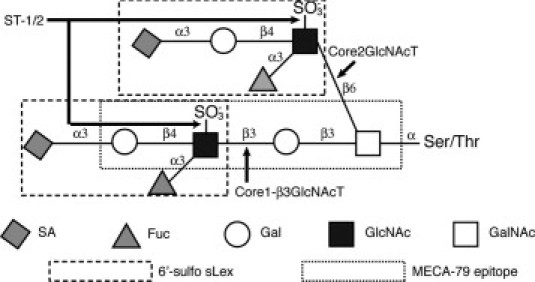
Disulfated biantennary O-glycan found in L-selectin ligands. Shown is a prototypical structure of the biantennary O-glycan, which decorates CD34 and other protein scaffolds within peripheral lymph node addressin (PNAd). Both branches are terminated by 6-sulfo sialyl Lewis x. The lower branch consists of the core 1 structure, which is extended by Core1-β3GlcNAcT with sulfation on the 6-position of GlcNAc by the sulfotransferases GlcNAc6ST-1 (ST-1) and GlcNAc6ST-2 (ST-2). The formation of the core 2 branch (upper) is initiated by the action of Core2GlcNAcT. Sulfation of this branch also occurs through the action of ST-1 and ST-2. The boxes indicate 6-sulfo sLex and the MECA-79 epitope. Chemically synthesized oligosaccharides based on the two chains were tested for antibody reactivity in Figure 2.
Figure 2
Figure 2
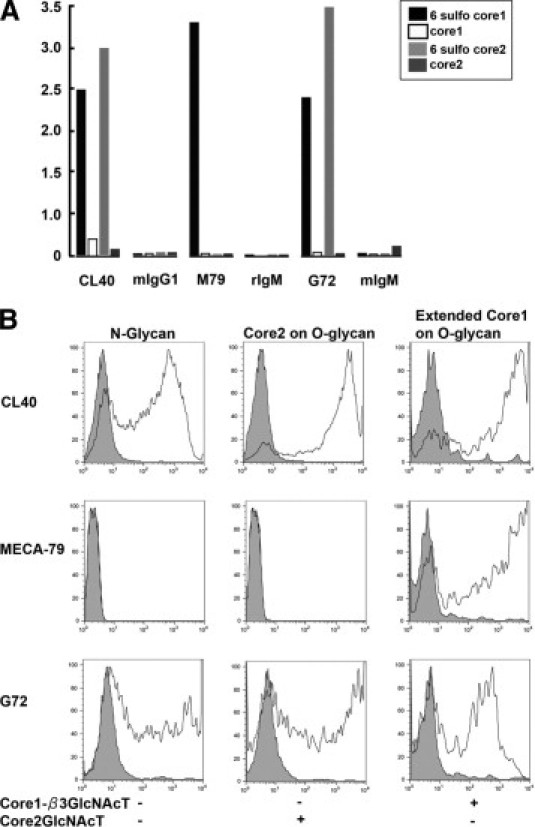
Glycan-binding specificity of CL40. A: Enzyme-linked immunosorbent assays were performed with sLex-terminating extended core 1 and core 2 O-glycans with or without sulfation (as denoted by the legend) on the C-6 position of GlcNAc (Figure 1). The binding of the indicated antibodies and class-matched control immunoglobulins is shown. Data are representative of three independent experiments. B: CHO cells were transfecting with CD34, FTVII, ST-1, and ST-2, with or without Core1βGlcNAcT and Core2GlcNAcT, as indicated in the figure) or isotype control (gray filled profiles) and analyzed by flow cytometry. The types of glycans that are formed in CHO cells transfected with the various combinations of glycosyltransferases are indicated at the tops of the three panels. Data are representative of three independent experiments.
Figure 3
Figure 3
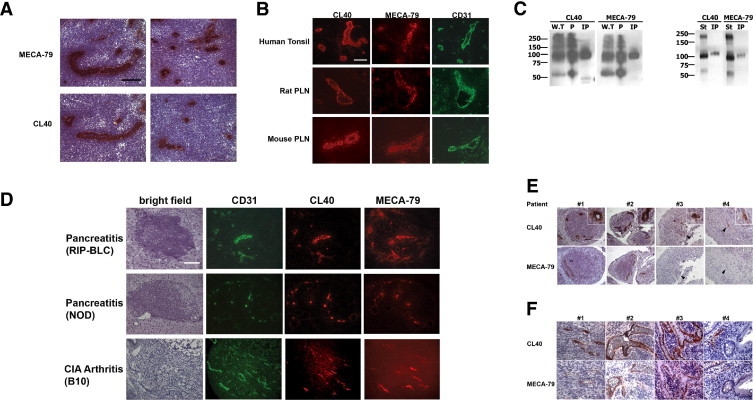
CL40 reactivity with high endothelial venules (HEVs) and HEV-like vessels and with PNAd components. A: Murine peripheral lymph node (PLN) sections were stained with MECA-79 and CL40 using horseradish peroxidase immunohistochemistry. B: Adjacent sections of human tonsil, rat PLN, and murine PLN were stained by with CL40 (red), MECA-79 (red), and a CD31 antibody (green, to reveal vessels) using fluorescence immunohistochemistry. C: Left: Human whole tonsil (W.T), peripheral lymph node addressin or PNAd (designated P) and immunoprecipitated human CD34 (IP) were electrophoresed. Right: Stroma from mouse PLN (St) and murine CD34 isolated by immunoprecipitation from a detergent lysate of stroma (IP) with anti-mouse CD34 was electrophoresed. The transferred membranes were blotted with MECA-79 or CL40 at 5 μg/ml. Data are representative of three independent experiments. D: Sections of pancreata from RIP-BLC and NOD mice, and the synovium from mice with collagen-induced arthritis (B10 mice) were sectioned. Consecutive sections were stained with hematoxylin (bright field), CL40 (red), MECA-79 (red), and a CD31 antibody (green). E: Adjacent sections of paraffin-embedded synovium from four patients with rheumatoid arthritis were stained with CL40 and MECA-79. Patient 4 exhibited CL40+ vessels that were not stained with MECA-79. In other patients, in addition to double-positive vessels, individual CL40+MECA-79 vessels are evident. Insets: Higher magnification views of CL40+ vessels. Arrowheads indicate corresponding vessels in adjacent sections of individual patients. F: Adjacent sections of paraffin-embedded colonic mucosa from patients with ulcerative colitis were stained with CL40 and MECA-79. All scale bars = 100 μm. Original magnification, 20×.
Figure 4
Figure 4
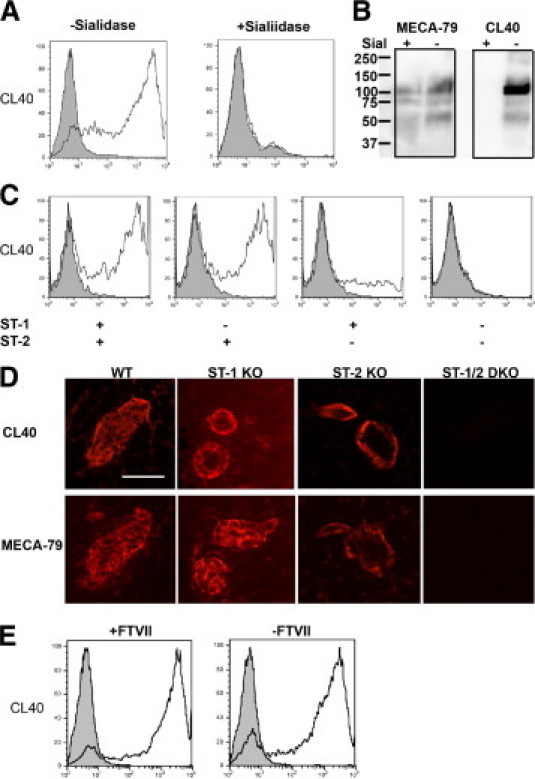
Sialylation and sulfation requirements for CL40. A: CHO cells were transfected with CD34, Core2GlcNAcT, FTVII, ST-1, and ST-2 and were treated with either 100 mU/ml neuraminidase (Sialidase) (middle) or PBS (left) at 37°C for 2 hours. The cells were stained with CL40 (open profiles) or isotype control (gray filled profiles) and were analyzed by flow cytometry. B: Murine PLN stroma were treated with 50 mU neuraminidase (Sial) or PBS for 16 hours at 37°C and were analyzed by Western blotting with CL40. The membrane was stripped and reblotted with MECA-79. C: CHO cells were transfected with CD34, Core2GlcNAcT, and FTVII, either with or without ST-1 and ST-2, as indicated. Cells were stained with CL40 (open profiles) or isotype control (gray filled profiles) and analyzed as above. D: Consecutive sections from PLNs of wild-type (WT) mice, ST-1 knockout (KO) mice, ST-2 KO mice and ST-1/2 doubly null mice (ST-DKO) were stained with CL40 or MECA-79. E: CHO cells were transfected with CD34, C2GnT, ST-1, and ST-2 with or without FTVII. Cells were stained with CL40 (open profiles) or isotype control (gray filled profiles) and analyzed as above. All data were representative of three independent experiments. Original magnification, 20×. All scale bars = 50 μm.
Figure 5
Figure 5
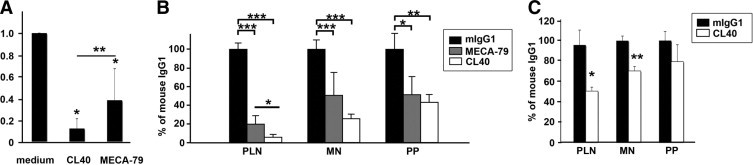
Inhibition of in vitro lymphocyte attachment to HEVs and lymphocyte homing by CL40. A: Attachment of 300.19L cells to HEVs in murine PLN cryosections was determined in the presence of 100 μg/ml of the indicated antibody or in medium. Data were obtained from 6 independent experiments with means and SEM values indicated. The results were analyzed statistically using one-way analysis of variance with P values determined by the Tukey's post hoc test. *P < 0.005 for either of the antibodies versus medium and **P < 0.01 between CL40 and MECA-79. B: Short-term homing of splenocytes to lymphoid organs was determined 1 hour after intravenous injection of labeled lymphocytes plus 200 μg of the indicated antibody or nonspecific mIgG1. Homing indices are computed as a percentage relative to that obtained with mIgG1. Means and SEM values based on 3 experiments are shown. As determined by one-way analysis of variance with Tukey's post hoc test, *P < 0.05, **P < 0.01, and ***P < 0.005. PN, MN, and PP denote peripheral lymph nodes, mesenteric lymph nodes, and Peyer's patches, respectively. C: Short-term homing was determined in Core2GlcNAcT/Core1-β3GlcNAcT double-knockout mice. The data shown are pooled from three experiments. *P < 0.05 and **P < 0.005 between CL40 and mouse IgG1 as determined by the two-way Student's t-test. The fact that CL40 produced only partial inhibition of homing in these O-glycan-deficient mice further points to the existence of determinants other than 6-sulfo sLex, as do the results shown in Supplemental Figure S4 (http://ajp.amjpathol.org).
Figure 6
Figure 6
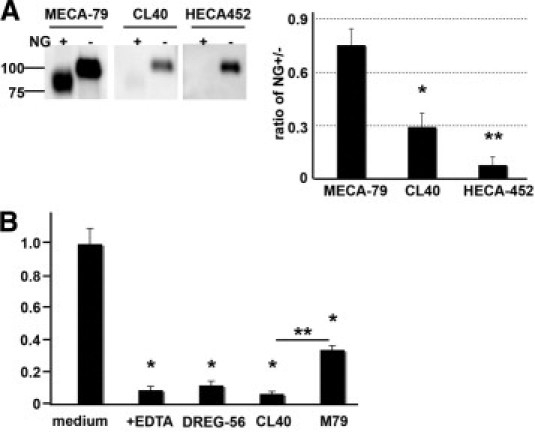
Contribution of N-glycans to CL40 reactivity. A: CD34 was immunoprecipitated from human tonsillar PNAd, treated with N-glycosidase F (NG) or PBS at 37°C for 42 hours, and then analyzed by Western blotting with the indicated antibodies. The band intensities were calculated as the ratios of NG-treated over untreated (right panel) using Multi Gauge software as described under Materials and Methods. The indicated means and SEM values were derived from three independent experiments. *P < 0.01 and **P < 0.005 against MECA-79, as determined by one-way analysis of variance and Tukey's post hoc test. B: Attachment of 300.19L cells to HEVs in cryosections of human tonsil was determined in the presence of 100 μg/ml of the indicated antibodies or medium alone. Isotype controls were also used in these experiments, although data are not shown because the results were the same as with medium only. As determined by one-way analysis of variance and Tukey's post hoc test, *P < 0.005 for the difference between the indicated treatment and medium alone and **P < 0.01 for the difference between CL40 and MECA-79. There was a significant difference between MECA-79 and EDTA at P < 0.01, and between MECA-79 and DREG-56 at P < 0.01.

References

    1. Butcher E.C., Picker L.J. Lymphocyte homing and homeostasis. Science. 1996;272:60–66. - PubMed
    1. Vestweber D., Blanks J.E. Mechanisms that regulate the function of the selectins and their ligands. Physiol Rev. 1999;79:181–213. [Erratum appears in Physiol Rev 2000, 80: follow i] - PubMed
    1. von Andrian U.H., Mempel T.R. Homing and cellular traffic in lymph nodes. Nat Rev Immunol. 2003;3:867–878. - PubMed
    1. Miyasaka M., Tanaka T. Lymphocyte trafficking across high endothelial venules: dogmas and enigmas. Nat Rev Immunol. 2004;4:360–370. - PubMed
    1. Rosen S.D. Ligands for L-selectin: homing, inflammation, and beyond. Annu Rev Immunol. 2004;22:129–156. - PubMed

Publication types

MeSH terms