Review
. 2011 Mar 1;589(Pt 5):1017-30.
doi: 10.1113/jphysiol.2010.201509. Epub 2011 Jan 4.

Ten questions about systems biology

Affiliations
Review

Ten questions about systems biology

Michael J Joyner et al. J Physiol. .

Abstract

In this paper we raise 'ten questions' broadly related to 'omics', the term systems biology, and why the new biology has failed to deliver major therapeutic advances for many common diseases, especially diabetes and cardiovascular disease. We argue that a fundamentally narrow and reductionist perspective about the contribution of genes and genetic variants to disease is a key reason 'omics' has failed to deliver the anticipated breakthroughs. We then point out the critical utility of key concepts from physiology like homeostasis, regulated systems and redundancy as major intellectual tools to understand how whole animals adapt to the real world. We argue that a lack of fluency in these concepts is a major stumbling block for what has been narrowly defined as 'systems biology' by some of its leading advocates. We also point out that it is a failure of regulation at multiple levels that causes many common diseases. Finally, we attempt to integrate our critique of reductionism into a broader social framework about so-called translational research in specific and the root causes of common diseases in general. Throughout we offer ideas and suggestions that might be incorporated into the current biomedical environment to advance the understanding of disease through the perspective of physiology in conjunction with epidemiology as opposed to bottom-up reductionism alone.


Figures
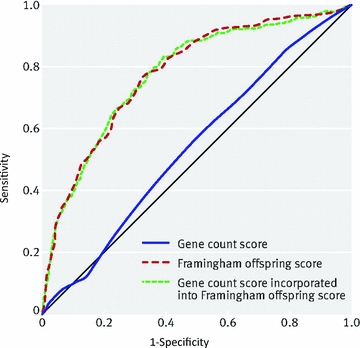
Figure 1
Figure 1. Receiver operating characteristic comparing the so-called gene count score based on 20 independently inherited diabetes risk alleles versus the Framingham Offspring score which considers several measures of blood lipids, age, sex, family history of diabetes, body mass index, blood pressure, and fasting glucose
Note that the gene count score did only slightly better than the ‘no discrimination’ line and was much worse than the simple Framingham Offspring score. This figure shows the limited predictive power of common genetic variants that have been linked to disease risk. (Reproduced from Br Med J340, b4838 (Talmud et al. 2010) with permission from BMJ Publishing Group Ltd).
Figure 2
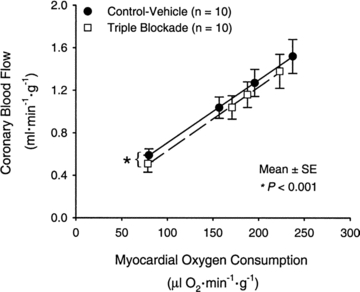
Figure 2. Coronary blood flow plotted against myocardial oxygen consumption in exercising dogs
Note the linear relationship between the rise in coronary blood flow and myocardial oxygen consumption. Blockade of nitric oxide synthase, KATP channels, and adenosine receptors had no influence on the magnitude of coronary vasodilatation during exercise. The fact that all three of these powerful vasodilating mechanisms could be blocked and yet there was a normal hyperaemic response to exercise is a classic example of redundancy in physiology. If a physiological response, such as a rise in coronary blood flow during exercise, is critical to survival, typically multiple mechanisms operate to ensure a normal or nearly normal physiological response when one or more mechanism is blocked or inhibited in some way. (Reproduced with permission from Tune et al. 2001; for further discussion see Duncker & Bache, 2008.)
Figure 3
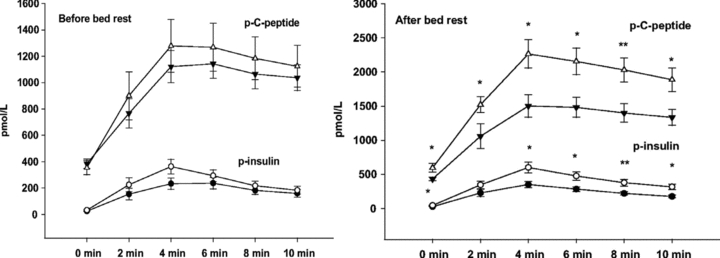
Figure 3. Plasma insulin in C peptide levels in subjects who are carriers of the higher risk T-allele (filled symbols) versus low-risk CC genotype (open symbols) of TCF7L2 rs7903146 in response to an i.v. glucose tolerance test before and after bed rest
Bed rest is associated with the relative insulin resistance in patients with the low-risk CC allele but they can increase their insulin release to compensate for peripheral insulin resistance. By contrast, this response is blunted in high risk individuals who are carriers of the T-allele. This result is an example of the potential power of small and integrative physiology studies to understand how the selected common genetic variants might contribute to the emergence of disease phenotypes in humans. More importantly, these data emphasize that physical inactivity and lifestyle can unmask genetic risks (Figure from Alibegovic et al. 2010. Copyright 2010 American Diabetes Association. From Diabetes, Vol. 59, 2010; 836–843. Reproduced by permission of The American Diabetes Association.)
Figure 4
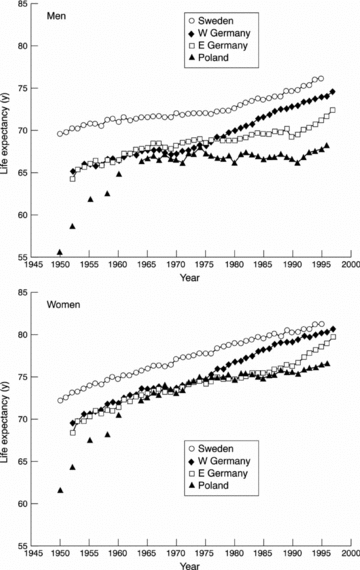
Figure 4. Life expectancy in East and West Germany, Poland and Sweden from 1950
Of note is the rise in life expectancy in East Germany after the fall of the Berlin Wall. There are complex reasons for the differences in these values and how they changed over time, but they demonstrate the power of political systems to influence health outcomes in relatively short periods of time. (Reproduced from J Epidemiol Community Health54, 890–898 (Nolte et al. 2000) with permission from BMJ Publishing Group Ltd.)
Figure 5
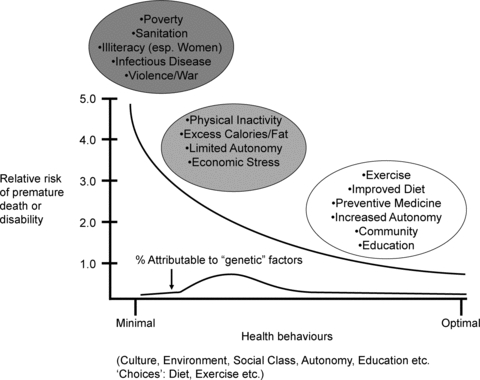
Figure 5. Conceptual model showing the contribution of optimal individual behaviour and the risk of premature death or disability from any cause and the contribution of genetics to this increased risk
Individual behaviour is influenced by complex interactions among culture, environment, social class, education, and ‘choices’ about things like diet, exercise and seat belt use. In chaotic societies with uncertain food supplies, poor sanitation, no social safety net and warfare or other forms of social displacement, premature death and disability is vastly greater than in more stable environments. Additionally, under these desperate conditions we speculate that genetic variation in individual humans contributes minimally to the pattern of death and disability. At the other end of the spectrum are educated, well-off individuals of high social status who typically engage positive health behaviours. We speculate that these individuals are largely buffered from potentially adverse genetic variants. By contrast are the inactive, obese citizens of many industrialized nations who have limited social autonomy and consistently engage in negative health behaviours. These behaviours and social factors may then interact with certain genetic variants to facilitate the emergence of many diseases such as diabetes, hypertension, cancer and vascular disease. Thus, we speculate that for a given individual a low physical activity, high calorie, high social stress lifestyle determines the extent that various ‘risk’ gene variants for metabolic, cardiovascular and other diseases become expressed or activated. This concept is also demonstrated in Fig. 3. As these interactions are likely to be complex and involve a large number of genetic variants, as shown in Fig. 1, the utility of predictive models based on genetic information is likely to be limited.

Comment in

  • What happens if you pose the wrong questions?
    Timmons JA. Timmons JA. J Physiol. 2011 Oct 1;589(Pt 19):4799-801; author reply 4803. doi: 10.1113/jphysiol.2011.213413. J Physiol. 2011. PMID: 21965633 Free PMC article. No abstract available.

References

    1. Alibegovic AC, Sonne MP, Højbjerre L, Hansen T, Pedersen O, van Hall G, et al. The T-allele of TCF7L2 rs7903146 associates with a reduced compensation of insulin secretion for insulin resistance induced by 9 days of bed rest. Diabetes. 2010;59:836–843. - PMC - PubMed
    1. Auffray C, Noble D. Origins of systems biology in William Harvey's masterpiece on the movement of the heart and the blood in animals. Int J Mol Sci. 2009;10:1658–1669. - PMC - PubMed
    1. Bassett DR, Jr, Schneider PL, Huntington GE. Physical activity in an old order Amish community. Med Sci Sports Exerc. 2004;36:79–85. - PubMed
    1. Black J. Drugs from emasculated hormones: the principle of syntopic antagonism. Science. 1989;245:486–493. - PubMed
    1. Blair SN, Morris JN. Healthy hearts – and the universal benefits of being physically active: physical activity and health. Ann Epidemiol. 2009;19:253–256. - PubMed

Publication types