. 2011 Feb 16;30(4):770-82.
doi: 10.1038/emboj.2010.349. Epub 2011 Jan 11.

The ZEB1/miR-200 feedback loop controls Notch signalling in cancer cells

Affiliations

The ZEB1/miR-200 feedback loop controls Notch signalling in cancer cells

Simone Brabletz et al. EMBO J. .

Abstract

Notch signalling is important for development and tissue homeostasis and activated in many human cancers. Nevertheless, mutations in Notch pathway components are rare in solid tumours. ZEB1 is an activator of an epithelial-mesenchymal transition (EMT) and has crucial roles in tumour progression towards metastasis. ZEB1 and miR-200 family members repress expression of each other in a reciprocal feedback loop. Since miR-200 members target stem cell factors, ZEB1 indirectly induces stemness maintenance and associated drug resistance. Here, we link ZEB1 and its cancer promoting properties to Notch activation. We show that miR-200 members target Notch pathway components, such as Jagged1 (Jag1) and the mastermind-like coactivators Maml2 and Maml3, thereby mediating enhanced Notch activation by ZEB1. We further detected a coordinated upregulation of Jag1 and ZEB1, associated with reduced miR-200 expression in two aggressive types of human cancer, pancreatic adenocarcinoma and basal type of breast cancer. These findings explain increased Notch signalling in some types of cancers, where mutations in Notch pathway genes are rare. Moreover, they indicate an additional way how ZEB1 exerts its tumour progressing functions.


Conflict of interest statement

The authors declare that they have no conflict of interest.

Figures
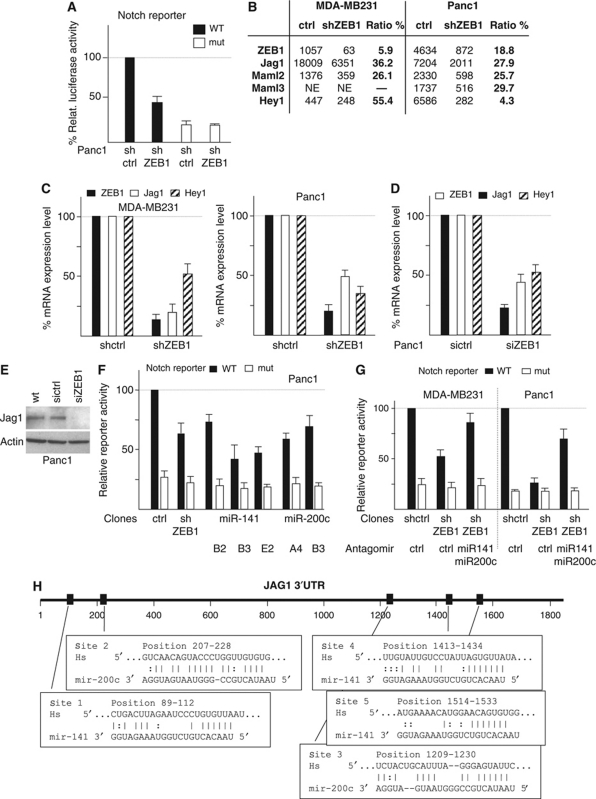
Figure 1
Figure 1
ZEB1 and miR-200 family members affect Notch signalling. (A) Stable knockdown of ZEB1 results in reduced Notch reporter activity (WT). There was no significant effect on a mutated (mut) reporter construct. Shown are mean values of each two independent clones. Control clones were set to 100%. (B) Expression values of ZEB1 and the indicated Notch pathway components deduced from a whole-genome expression screen comparing ZEB1 knockdown and control knockdown clones (NE= not expressed). (C, D) Quantitative RT–PCR after stable (C) and transient (D) knockdown of ZEB1. (E) Immunoblot showing reduced expression of Jag1 after transient knockdown of ZEB1. (F) Notch-luciferase reporter assay showing reduced activity in different clones after stable knockdown of ZEB1 or stable overexpression of miR-141 and miR-200c. (G) Antagomirs against miR-141 and miR-200c partially rescue Notch reporter inhibition by shZEB1. (H) Scheme showing five predicted target sites of miR-200 family members in the 3′UTR of Jag1.
Figure 2
Figure 2
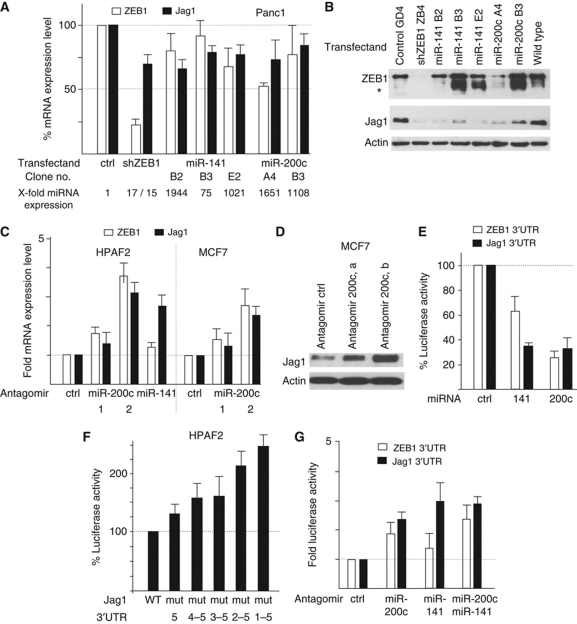
Jag1 is a target of miR-200 family members. (A, B) Quantitative RT–PCR (A) and immunoblot (B) for ZEB1 and Jag1 after stable knockdown of ZEB1 or overexpression of miR-141 and 200c in Panc1 cells (* is a degradation product of ZEB1). Also shown is the relative expression of the indicated microRNAs in the different clones. (C, D) Inhibition of endogenous miRs by the indicated specific antagomirs increase the mRNA levels of ZEB1 and Jag1 (C) and the protein level of Jag1 (D) in differentiated cancer cell lines. (E) Transient overexpression of miR-141 or miR-200c reduced the activity of Jag1 3′UTR reporter and a ZEB1 3′UTR control reporter in Panc1 cells. (F) Subsequent mutations of predicted miR-200 binding sites in the Jag1 3′UTR-luciferase construct increased reporter activity in HPAFII cells, endogenously expressing miR-200 family members. (G) Inhibition of endogenous miRs in HPAFII cells by the indicated specific antagomirs (antagomir miR-200c (b) was used) increased the activity of the Jag1 3′UTR reporter and a ZEB1 3′UTR control reporter.
Figure 3
Figure 3
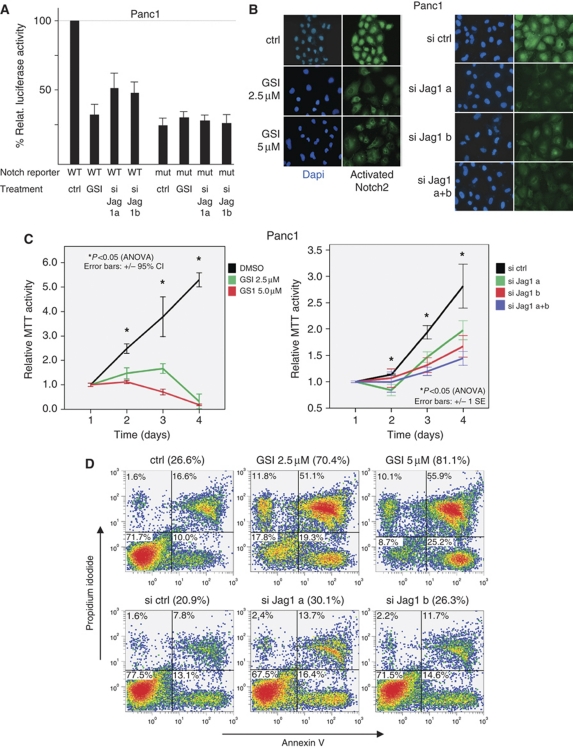
Notch signalling and Jag1 expression are important for cancer cell properties. (A) Treatment with 5 μM GSI or transient knockdown of Jag1 inhibits Notch reporter activity. (B) Immunofluorescence showing reduced nuclear expression of activated Notch2 after GSI treatment or transient Jag1 knockdown. (C) GSI treatment or transient knockdown of Jag1 inhibits proliferation measured in an MTT assay. X axis indicates days after cell seeding. Asterisks indicate significance of control versus treated cells. (D) GSI treatment or transient knockdown of Jag1 increases apoptosis of Panc1 cells irradiated with 5 Gy. The percentage of apoptotic cells is indicated, resulting from the addition of the two right, annexin V positive quadrants.
Figure 4
Figure 4
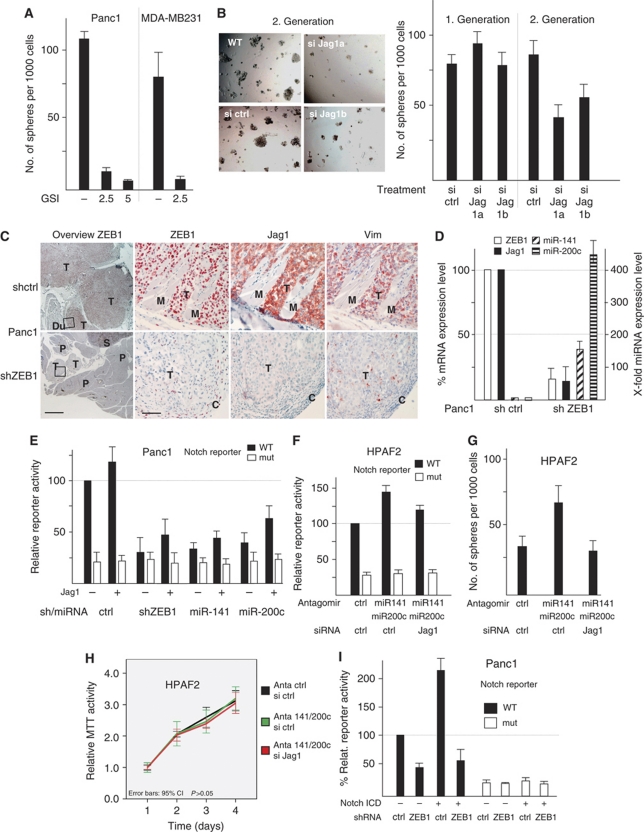
Jag1 alone is not sufficient for the effects of ZEB1 and miR-200 on Notch signalling. (A) GSI treatment inhibits the sphere-forming capacity. (B) Transient knockdown of Jag1 inhibits the sphere-forming capacity in the second, but not in the first generation of spheres in Panc1 cells. A representative picture of spheres from the second generation is shown. (C) Representative immunohistochemistry showing a huge control tumour (T) invading the duodenal wall (Du) and small, encapsulated, non-invasive tumour nodules of shZEB1 cells surrounded by pancreas (P) and spleen (S) tissue (overview). Squares indicate magnified areas showing a coordinated reduction of ZEB1, Jag1 and vimentin expression in tumours derived from ZEB1 knockdown cells, encapsulated by ZEB1 expressing fibroblasts (c) and high expression in control tumour cells invading the duodenal muscle layers (M). Size bar is 200 and 20 μm. (D) Quantitative RT–PCR after microdissection of orthotopic xenograft tumours showing decrease of Jag1 and increase of miR-141 and miR-200c after knockdown of ZEB1. Shown are the mean values of all grown tumours (six mice for control and four mice for ZEB1 knockdown Panc1 cell clones), control knockdown was set to 100% or 1. (E) Coexpression of Jag1 lacking the 3′UTR can only partially rescue Notch reporter inhibition by shZEB1 or miR-141 and miR-200c. (F) Inhibition of endogenous miR-141 and miR-200c in differentiated HPAF2 cells increases Notch reporter activity, which is only partially reversed by siRNA-mediated knockdown of Jag1. (G) Inhibition of endogenous miR-141 and miR-200c increases the second-generation sphere-forming capacity, which is reversed by siRNA-mediated knockdown of Jag1. (H) Proliferation of differentiated HPAF2 cells is not affected by antagomirs and Jag1 knockdown. (I) Cotransfection of the Notch ICD increases the Notch reporter activity in control clones, but not in stable ZEB1 knockdown clones. There was no significant effect on a mutated (mut) reporter construct. Shown are mean values of each two independent clones. Control clones were set to 100%.
Figure 5
Figure 5
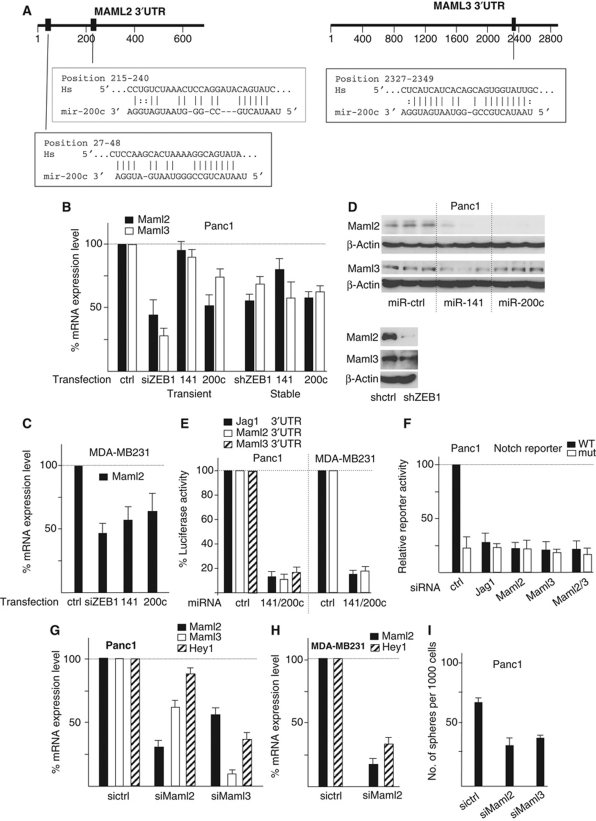
The Notch coactivators Maml2 and Maml3 are targets of miR-200. (A) Scheme showing predicted target sites of miR-200 family members in the 3′UTR of Maml2 and Maml3. (BD) Knockdown of ZEB1 or overexpression of miR-141 and miR-200c decrease the expression of Maml2 and Maml3 on mRNA (B, C) and protein (D) level. Overexpression of miR-200 in Panc1 was done by lentiviral transduction, shown in (D) are each three independent lines. (E) Overexpression of miR-141 and miR-200c decreases activity of the indicated 3′UTR reporter constructs. (F) Knockdown of Jag1, Maml2 or Maml3 decreases Notch reporter activity. (G, H) Knockdown of Maml2 or Maml3 decreases expression of the Notch target gene Hey1 in Panc1 (G) and MDA-MB231 (H). Maml3 is not expressed in MDA-MB231 (see Figure 1B). (I) Knockdown of Maml2 or Maml3 decreases the sphere-forming capacity of Panc1 in the second-sphere generation.
Figure 6
Figure 6
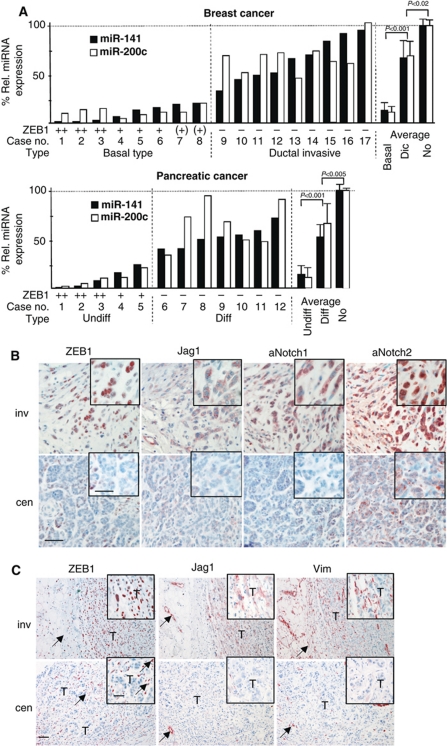
Correlation of ZEB1 and Notch activity in human cancers. (A) qPCR for miR-141 and miR-200c after microdissection of tumour areas from the indicated types of human primary tumours, showing a significant reduction in basal versus ductal invasive type (dic) of breast cancers, as well as in undifferentiated versus differentiated pancreatic adenocarcinomas. The statistical significance for the mean values of all included cases is shown. miRNA expression in normal (no) breast or pancreatic epithelial tissue was set to 100%. Shown are also the ZEB1 expression levels in tumour cells scored by immunohistochemistry. (B) Immunohistochemistry of a typical basal type of breast cancer showing correlated expression of ZEB1, Jag1, activated Notch1 and activated Notch2 in cancer cells of invasive (inv) tumour areas. In central tumour areas (cen), a correlated reduction was often detectable. (Inserts show magnifications, specific staining in red, nuclear counter staining in blue). Size bar is 20 and 12 μm for inserts. (C) Immunohistochemistry of an undifferentiated pancreatic adenocarcinoma showing correlated expression of ZEB1, Jag1 and the mesenchymal marker Vimentin in cancer cells of invasive (inv) tumour areas. In central tumour areas (cen) often a correlated reduction was detectable (squares show magnifications). Arrows show positive staining of fibroblasts for ZEB1 and Vimentin, and blood vessels for Jag1. T=tumour cells. Size bar is 20 and 12 μm for inserts.
Figure 7
Figure 7
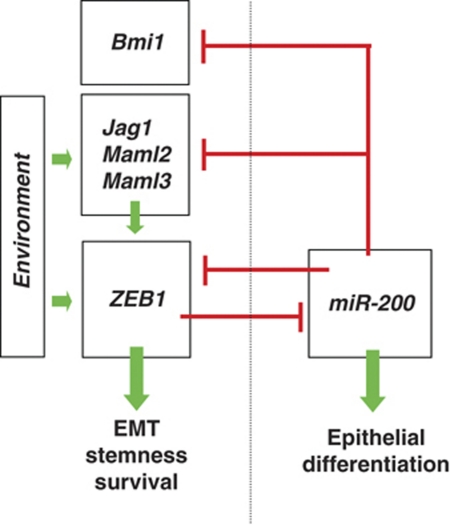
Proposed model for a molecular link between ZEB1, miR-200 and Notch signalling (explanation see Discussion section).

References

    1. Brabletz S, Brabletz T (2010) The ZEB/miR-200 feedback loop[mdash]a motor of cellular plasticity in development and cancer? EMBO Rep 11: 670–677 - PMC - PubMed
    1. Brabletz T, Spaderna S, Kolb J, Hlubek F, Faller G, Bruns CJ, Jung A, Nentwich J, Duluc I, Domon-Dell C, Kirchner T, Freund JN (2004) Down-regulation of the homeodomain factor Cdx2 in colorectal cancer by collagen type I: an active role for the tumor environment in malignant tumor progression. Cancer Res 64: 6973–6977 - PubMed
    1. Brummelkamp TR, Bernards R, Agami R (2002) Stable suppression of tumorigenicity by virus-mediated RNA interference. Cancer Cell 2: 243–247 - PubMed
    1. Burk U, Schubert J, Wellner U, Schmalhofer O, Vincan E, Spaderna S, Brabletz T (2008) A reciprocal repression between ZEB1 and members of the miR-200 family promotes EMT and invasion in cancer cells. EMBO Rep 9: 582–589 - PMC - PubMed
    1. Gou S, Liu T, Wang C, Yin T, Li K, Yang M, Zhou J (2007) Establishment of clonal colony-forming assay for propagation of pancreatic cancer cells with stem cell properties. Pancreas 34: 429–435 - PubMed

Publication types

MeSH terms

LinkOut - more resources