


Employment-based abstinence reinforcement as a maintenance intervention for the treatment of cocaine dependence: post-intervention outcomes
- PMID: 21226886
- PMCID: PMC3074032
- DOI: 10.1111/j.1360-0443.2011.03364.x
Employment-based abstinence reinforcement as a maintenance intervention for the treatment of cocaine dependence: post-intervention outcomes
Abstract
Aims: Due to the chronicity of cocaine dependence, practical and effective maintenance interventions are needed to sustain long-term abstinence. We sought to assess the effects of long-term employment-based reinforcement of cocaine abstinence after discontinuation of the intervention.
Design: Participants who initiated sustained opiate and cocaine abstinence during a 6-month abstinence reinforcement and training program worked as data entry operators and were randomly assigned to a group that could work independently of drug use (control, n = 24), or an abstinence-contingent employment (n = 27) group that was required to provide cocaine- and opiate-negative urine samples to work and maintain maximum rate of pay.
Setting: A non-profit data entry business.
Participants: Unemployed welfare recipients who persistently used cocaine while in methadone treatment.
Measurements: Urine samples and self-reports were collected every 6 months for 30 months.
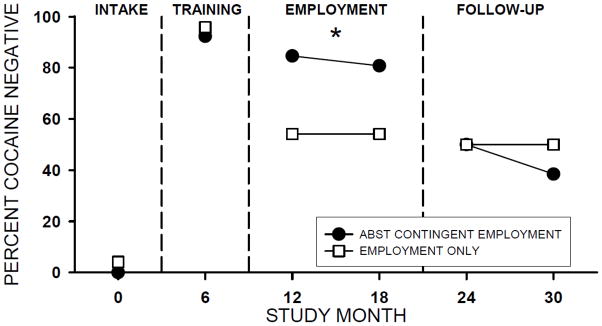
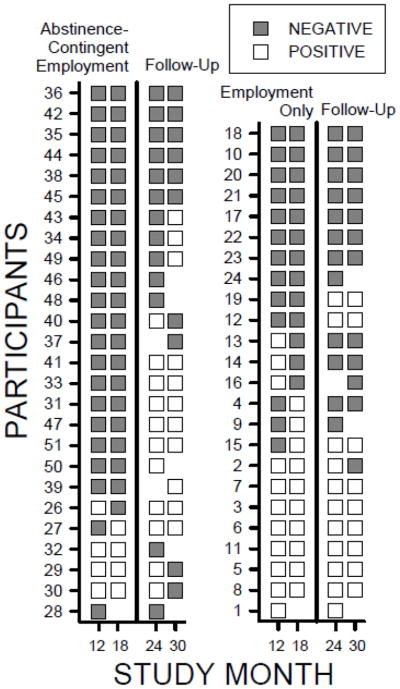
Findings: During the employment year, abstinence-contingent employment participants provided significantly more cocaine-negative samples than controls (82.7% and 54.2%; P = 0.01, OR = 4.61). During the follow-up year, the groups had similar rates of cocaine-negative samples (44.2% and 50.0%; P = 0.93) and human immunodeficiency virus risk behaviors. Participants' social, employment, economic and legal conditions were similar in the two groups across all phases of the study.
Conclusions: Employment-based reinforcement effectively maintains long-term cocaine abstinence, but many patients relapse to use when the abstinence contingency is discontinued, even after a year of abstinence-contingent employment. Relapse could be prevented in many patients by leaving employment-based abstinence reinforcement in place indefinitely, which could be facilitated by integrating it into typical workplaces.
Trial registration: ClinicalTrials.gov NCT00249496.
© 2011 The Authors, Addiction © 2011 Society for the Study of Addiction.
Conflict of interest statement
DECLARATION: The authors declare no conflict of interest.
Figures
Comment in
-
Commentary on DeFulio & Silverman (2011): Employment-based abstinence reinforcement: is there a next step?Addiction. 2011 May;106(5):968-9. doi: 10.1111/j.1360-0443.2011.03415.x. Addiction. 2011. PMID: 21477250 No abstract available.
References
-
- Galai N, Safaeian M, Vlahov D, Bolotin A, Celentano DD ALIVE Study. Longitudinal patterns of drug injection behavior in the ALIVE study cohort, 1988–2000: Description and determinants. Am J Epidemiol. 2003;158(7):695–704. - PubMed
-
- Hser YI, Hoffman V, Grella CE, Anglin MD. A 33-year follow-up of narcotics addicts. Arch Gen Psychiatry. 2001;58(5):503–508. - PubMed
-
- Hser YI, Huang D, Chou CP, Anglin MD. Trajectories of heroin addiction: growth mixture modeling results based on a 33-year outcome study. Eval Rev. 2007;31(6):548–563. - PubMed
Publication types
MeSH terms
Substances
Associated data
Grants and funding
LinkOut - more resources
Full Text Sources
Medical
