Human and swine hosts share vancomycin-resistant Enterococcus faecium CC17 and CC5 and Enterococcus faecalis CC2 clonal clusters harboring Tn1546 on indistinguishable plasmids
- PMID: 21227995
- PMCID: PMC3067689
- DOI: 10.1128/JCM.01750-10
Human and swine hosts share vancomycin-resistant Enterococcus faecium CC17 and CC5 and Enterococcus faecalis CC2 clonal clusters harboring Tn1546 on indistinguishable plasmids
Abstract
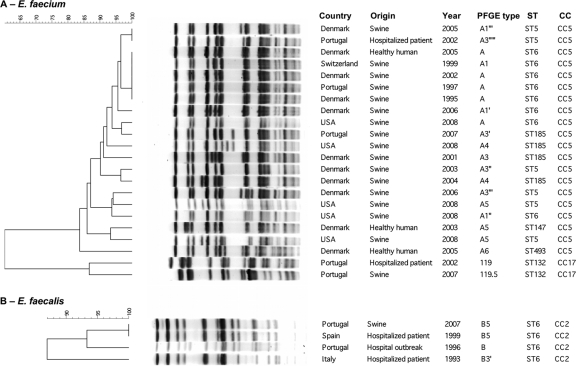
VRE isolates from pigs (n = 29) and healthy persons (n = 12) recovered during wide surveillance studies performed in Portugal, Denmark, Spain, Switzerland, and the United States (1995 to 2008) were compared with outbreak/prevalent VRE clinical strains (n = 190; 23 countries; 1986 to 2009). Thirty clonally related Enterococcus faecium clonal complex 5 (CC5) isolates (17 sequence type 6 [ST6], 6 ST5, 5 ST185, 1 ST147, and 1 ST493) were obtained from feces of swine and healthy humans. This collection included isolates widespread among pigs of European Union (EU) countries since the mid-1990s. Each ST comprised isolates showing similar pulsed-field gel electrophoresis (PFGE) patterns (≤6 bands difference; >82% similarity). Some CC5 PFGE subtype strains from swine were indistinguishable from hospital vancomycin-resistant enterococci (VRE) causing infections. A truncated variant of Tn1546 (encoding resistance to vancomycin) and tcrB (coding for resistance to copper) were consistently located on 150- to 190-kb plasmids (rep(pLG1)). E. faecium CC17 (ST132) isolates from pig manure and two clinical samples showed identical PFGE profiles and contained a 60-kb mosaic plasmid (rep(Inc18) plus rep(pRUM)) carrying diverse Tn1546-IS1216 variants. The only Enterococcus faecalis isolate obtained from pigs (CC2-ST6) corresponded to a multidrug-resistant clone widely disseminated in hospitals in Italy, Portugal, and Spain, and both animal and human isolates harbored an indistinguishable 100-kb mosaic plasmid (rep(pRE25) plus rep(pCF10)) containing the whole Tn1546 backbone. The results indicate a current intra- and international spread of E. faecium and E. faecalis clones and their plasmids among swine and humans.
Figures
References
-
- Agersø Y., et al. 2008. Vancomycin-resistant Enterococcus faecalis isolates from a Danish patient and two healthy human volunteers are possibly related to isolates from imported turkey meat. J. Antimicrob. Chemother. 62:844–845 - PubMed
-
- Bates J., Jordens J. Z., Griffiths D. T. 1994. Farm animals as a putative reservoir for vancomycin-resistant enterococcal infection in man. J. Antimicrob. Chemother. 34:507–514 - PubMed
Publication types
MeSH terms
Substances
LinkOut - more resources
Full Text Sources