Comparative Study
. 2011 Jul;5(7):1152-61.
doi: 10.1038/ismej.2010.200. Epub 2011 Jan 13.

Quantitative proteomic analyses of the response of acidophilic microbial communities to different pH conditions

Affiliations
Comparative Study

Quantitative proteomic analyses of the response of acidophilic microbial communities to different pH conditions

Christopher P Belnap et al. ISME J. 2011 Jul.

Abstract

Extensive genomic characterization of multi-species acid mine drainage microbial consortia combined with laboratory cultivation has enabled the application of quantitative proteomic analyses at the community level. In this study, quantitative proteomic comparisons were used to functionally characterize laboratory-cultivated acidophilic communities sustained in pH 1.45 or 0.85 conditions. The distributions of all proteins identified for individual organisms indicated biases for either high or low pH, and suggests pH-specific niche partitioning for low abundance bacteria and archaea. Although the proteome of the dominant bacterium, Leptospirillum group II, was largely unaffected by pH treatments, analysis of functional categories indicated proteins involved in amino acid and nucleotide metabolism, as well as cell membrane/envelope biogenesis were overrepresented at high pH. Comparison of specific protein abundances indicates higher pH conditions favor Leptospirillum group III, whereas low pH conditions promote the growth of certain archaea. Thus, quantitative proteomic comparisons revealed distinct differences in community composition and metabolic function of individual organisms during different pH treatments. Proteomic analysis revealed other aspects of community function. Different numbers of phage proteins were identified across biological replicates, indicating stochastic spatial heterogeneity of phage outbreaks. Additionally, proteomic data were used to identify a previously unknown genotypic variant of Leptospirillum group II, an indication of selection for a specific Leptospirillum group II population in laboratory communities. Our results confirm the importance of pH and related geochemical factors in fine-tuning acidophilic microbial community structure and function at the species and strain level, and demonstrate the broad utility of proteomics in laboratory community studies.


Figures
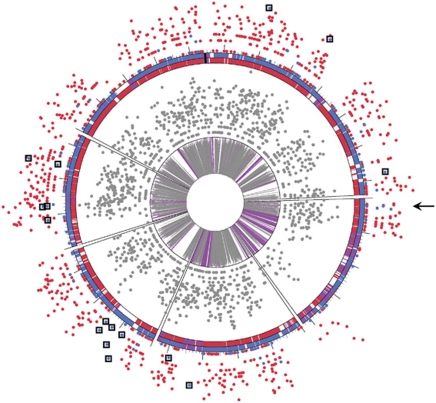
Figure 1
Figure 1
PIGT analysis of Leptospirillum group II in laboratory proteomic datasets. Unique peptides from all three proteomic replicates were plotted onto aligned genomic representations of Leptospirillum group II 5-way CG (red ring) and UBA (blue ring) genomic variants. Purple loci represent regions of 100% amino acid identity, black represents the CRISPR repeat region, and loci for which a homolog does not exist are white. Large tick marks are spaced 100 genes apart. The inner gray ring represents percent amino acid identity between orthologs (indicated by height of tick marks, purple regions equivalent to 100% identical). Gray spots surrounding the inner ring are the total number of peptides detected at each loci. Spots on the outside of the diagram represent the number of unique peptides detected at each loci (red=Type I, blue=Type VI). Unique peptides are plotted on a log2 scale, with higher placement indicating higher detection. The arrow indicates a region of unique Type VI peptides consistently detected in the otherwise Type I dominated laboratory genotype. This region likely represents a small recombinant block. Boxes surround other abundant Type VI peptides that lack a Type I orthologue in the 5-way CG genomic dataset (and thus probably represent Type I peptides). The color reproduction of this figure is available on the html full text version of the manuscript.
Figure 2
Figure 2
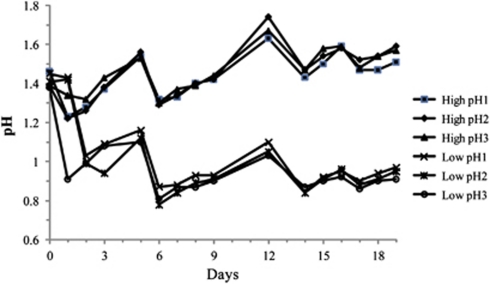
Solution pH of replicate laboratory reactors. After biofilm establishment at ∼pH 1.4, three 15N-labeled reactors were lowered to an average pH of 0.85 (day 0). pH treatments were maintained over a 19-day period, after which communities were sampled for proteomic analyses. Fresh medium was re-supplied on days 5, 9, 13 and 16.
Figure 3
Figure 3
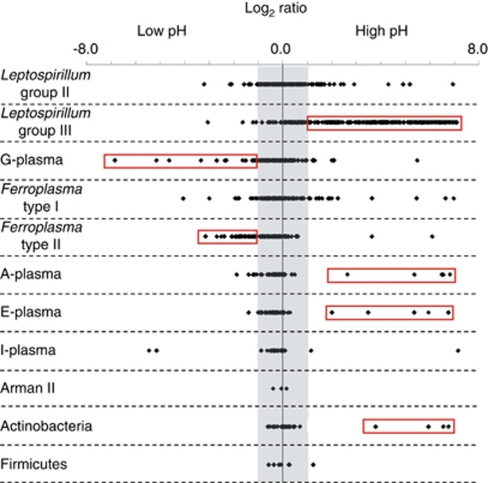
Distribution of average protein abundances for quantitative proteomic comparison of communities maintained at high and low pH. Log2 ratios for all proteins are plotted according to taxa. Positive log2 ratio values indicate proteins more abundant in high pH communities; negative values indicate proteins more abundant in low pH communities. The shaded area denotes values between 1 and −1 (within 2 × ), in which proteins are not considered significantly different between high and low pH comparisons. Red boxes highlight proteins from organisms that exhibited a strong response to either high or low pH. The color reproduction of this figure is available on the html full text version of the manuscript.
Figure 4
Figure 4
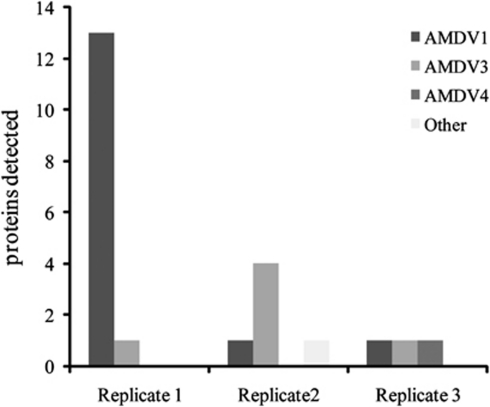
Viral proteins detected in replicate proteomic analyses used to compare communities in high and low pH solutions. The number of proteins detected for putative virus types AMDV1, AMDV3, AMDV4 and unclassified viral proteins (other) are shown for each replicate.

References

    1. Amann RI. Fluorescently labelled, rRNA-targeted oligonucleotide probes in the study of microbial ecology. Mol Ecol. 1995;4:543–554.
    1. Andersson AF, Banfield JF. Virus population dynamics and acquired virus resistance in natural microbial communities. Science. 2008;320:1047–1050. - PubMed
    1. Belnap CP, Pan C, VerBerkmoes NC, Power ME, Samatova NF, Carver RL, et al. Cultivation and quantitative proteomic analyses of acidophilic microbial communities. ISME J. 2010;4:520–530. - PubMed
    1. Bond PL, Banfield JF. Design and performance of rRNA targeted oligonucleotide probes for in situ detection and phylogenetic identification of microorganisms inhabiting acid mine drainage environments. Microb Ecol. 2001;2:149–161. - PubMed

    1. Bond PL, Druschel GK, Banfield JF. Comparison of acid mine drainage microbial communities in physically and geochemically distinct ecosystems. Appl Environ Microbiol. 2000a;66:4962–4971. - PMC - PubMed

Publication types