


18F-FDG PET or PET-CT to evaluate prognosis for head and neck cancer: a meta-analysis
- PMID: 21229262
- PMCID: PMC11828190
- DOI: 10.1007/s00432-010-0972-y
18F-FDG PET or PET-CT to evaluate prognosis for head and neck cancer: a meta-analysis
Abstract
Purpose: The purpose of this meta-analysis was to evaluate the prognostic value of standard uptake value (SUV) from serial Fluorine-18-fluorodeoxyglucose positron emission tomography/computed tomography ((18)F-FDG PET/CT) in patients with head and neck cancer.
Methods: We searched for articles limited to head and neck cancer, dealt with the impact of SUV on survival and published in English. The endpoints were disease-free survival (DFS), overall survival (OS), and local control (LC). Two reviewers extracted data independently.
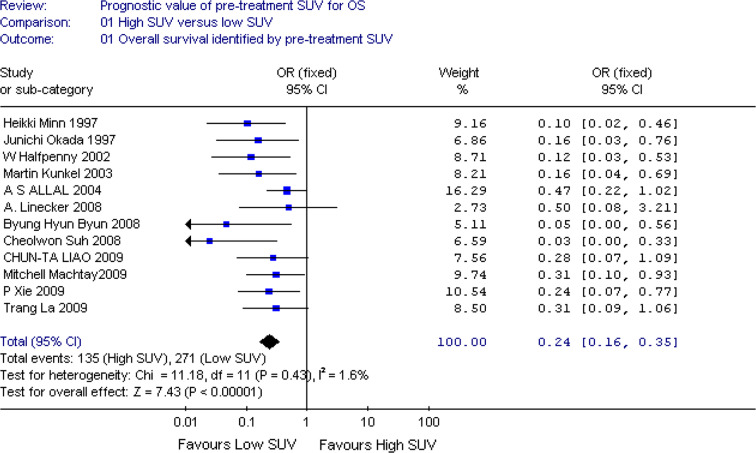
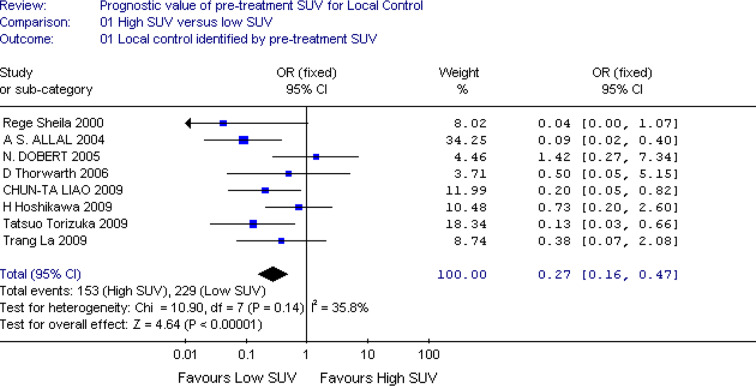
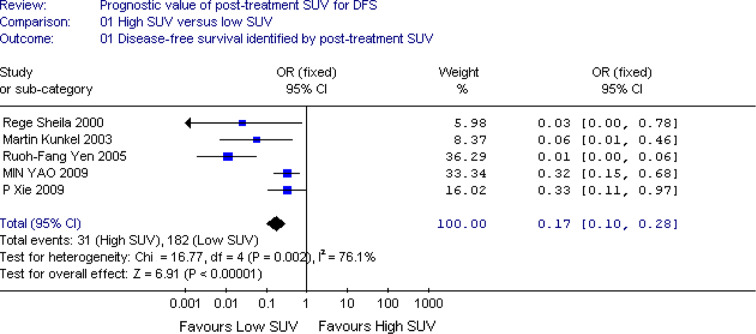
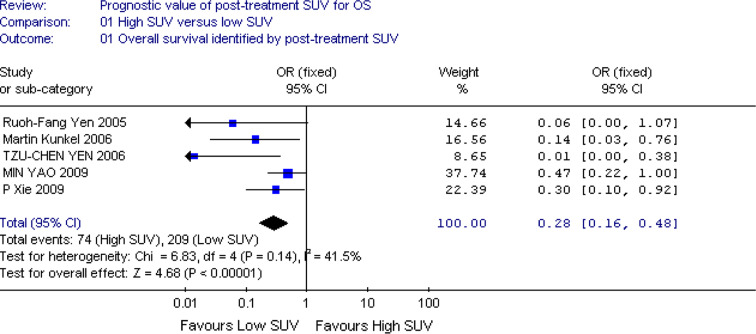
Results: Thirty-five studies were identified; of which, 26 studies involving 1,415 patients met the inclusion criteria. Pooled survival data suggested better DFS, OS, and LC in patients with low SUV of pre-treatment, and the odds ratio (OR) was 0.23, 0.24, and 0.27, respectively. Patients having tumors with low SUV of post-treatment also had significantly better DFS (OR = 0.17) and OS (OR = 0.28) than those with high SUV.
Conclusions: The present meta-analysis showed that (18)F-FDG uptake, as measured by the SUV before treatment and metabolic response after treatment, are valuable for predicting long-term survival in head and neck cancer. High (18)F-FDG uptake may be useful for identifying patients requiring more aggressive treatment.
Conflict of interest statement
There is no conflict of interest among authors.
Figures


References
-
- Allal AS, Dulguerov P, Allaoua M et al (2002) Standardized uptake value of 2-[18F] fluoro-2-deoxy-d-glucose in predicting outcome in head and neck carcinomas treated by radiotherapy with or without chemotherapy. J Clin Oncol 20(5):1398–1404 - PubMed
-
- Allal AS, Slosman DO, Kebdani T et al (2004) Prediction of outcome in head-and-neck cancer patients using the standardized uptake value of 2-[18F]fluoro-2-deoxy-d-glucose. Int J Radiat Oncol Biol Phys 59(5):1295–1300 - PubMed
-
- Bernier J, Domenge C, Ozsahin M et al (2004) Postoperative irradiation with or without concomitant chemotherapy for locally advanced head and neck cancer. N Engl J Med 350(19):1945–1952 - PubMed
-
- Bonner JA, Harari PM, Giralt J et al (2006) Radiotherapy plus cetuximab for squamous-cell carcinoma of the head and neck. N Engl J Med 354(6):567–578 - PubMed
-
- Brun E, Kjellén E, Tennvall J et al (2002) FDG PET studies during treatment: prediction of therapy outcome in head and neck squamous cell carcinoma. Head Neck 24(2):127–135 - PubMed
Publication types
MeSH terms
Substances
LinkOut - more resources
Full Text Sources
Medical
Miscellaneous
