Induction chemotherapy with cisplatin and fluorouracil alone or in combination with docetaxel in locally advanced squamous-cell cancer of the head and neck: long-term results of the TAX 324 randomised phase 3 trial
- PMID: 21233014
- PMCID: PMC4356902
- DOI: 10.1016/S1470-2045(10)70279-5
Induction chemotherapy with cisplatin and fluorouracil alone or in combination with docetaxel in locally advanced squamous-cell cancer of the head and neck: long-term results of the TAX 324 randomised phase 3 trial
Abstract
Background: At a minimum follow-up of 2 years, the TAX 324 study showed a significant survival benefit of induction chemotherapy with docetaxel, cisplatin, and fluorouracil (TPF) versus cisplatin and fluorouracil (PF) in locally advanced head and neck cancer. We report the long-term results at 5 years' minimum follow-up.
Methods: TAX 324 was a randomised, open-label phase 3 trial comparing three cycles of TPF induction chemotherapy (docetaxel 75 mg/m(2), followed by intravenous cisplatin 100 mg/m(2) and fluorouracil 1000 mg/m(2) per day, administered as a continuous 24-h infusion for 4 days) with three cycles of PF (intravenous cisplatin 100 mg/m(2), followed by fluorouracil 1000 mg/m(2) per day as a continuous 24-h infusion for 5 days) in patients with stage III or IV squamous-cell carcinoma of the head or neck. Both regimens were followed by 7 weeks of chemoradiotherapy with concomitant weekly carboplatin. Randomisation was done centrally with the use of a biased-coin minimisation technique. At study entry, patients were stratified according to the site of the primary tumour, nodal status (N0 or N1 vs N2 or N3), and institution. For this long-term analysis, data as of Dec 1, 2008, were gathered retrospectively from patients' medical records. Overall and progression-free survival were the primary endpoints. Tracheostomy and dependence on a gastric feeding tube were used as surrogate measures for treatment-related long-term toxicity. The intention-to-treat analysis included data from all 501 patients (255 TPF, 246 PF); data from the initial analysis in 2005 were used for 61 patients who were lost to follow-up. TAX 324 was registered at ClinicalTrials.gov, NCT00273546.
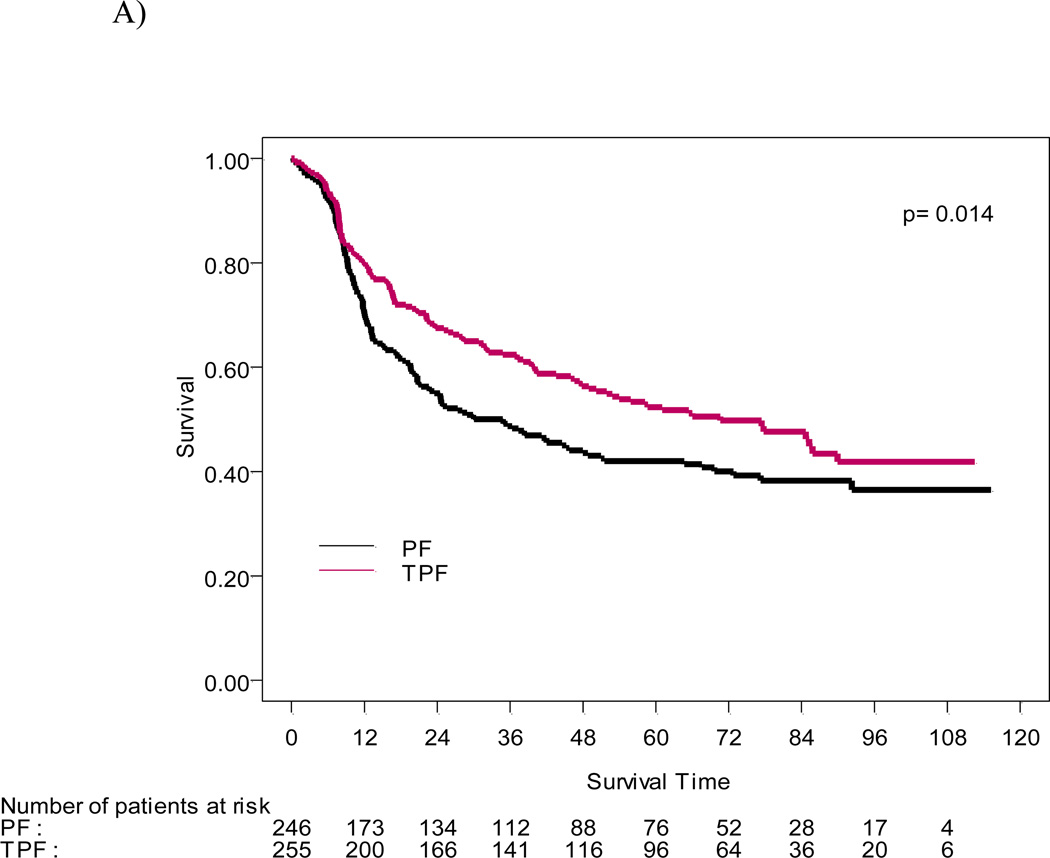
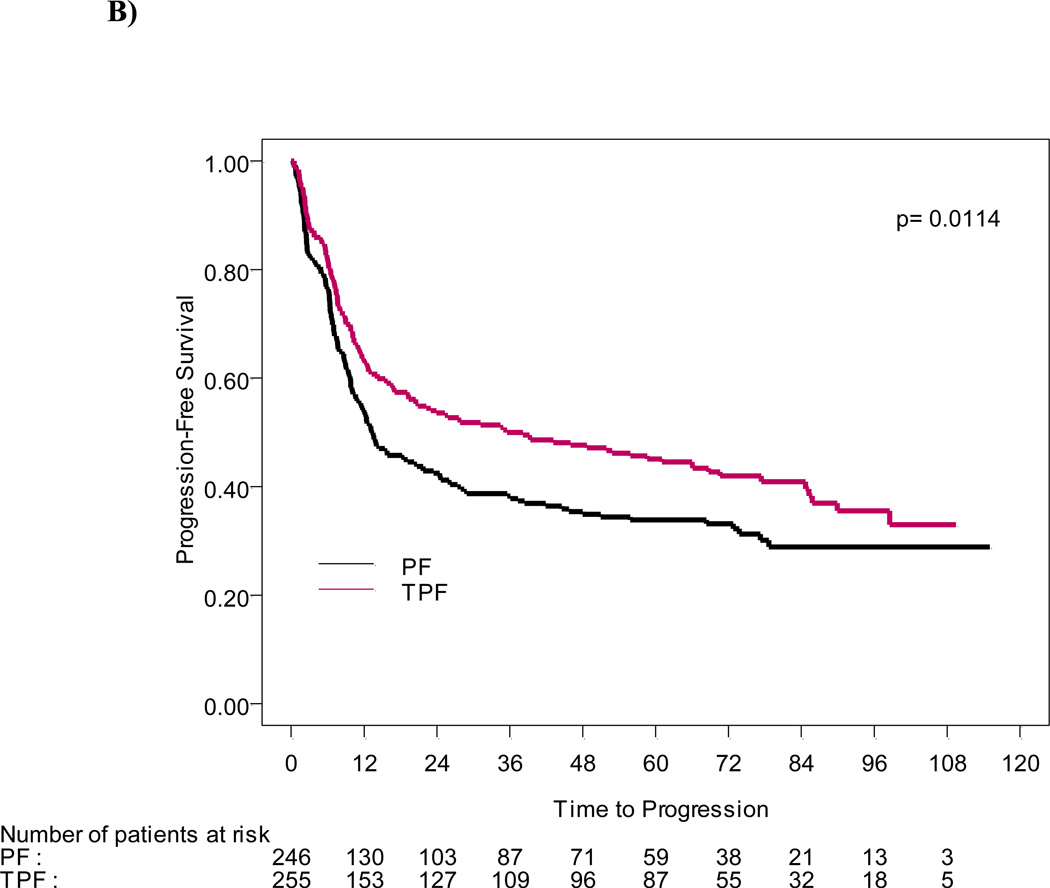
Findings: Median follow-up was 72·2 months (95% CI 68·8-75·5). Overall survival was significantly better after treatment with TPF versus PF (hazard ratio [HR] 0·74, 95% CI 0·58-0·94), with an estimated 5-year survival of 52% in patients treated with TPF and 42% in those receiving PF. Median survival was 70·6 months (95% CI 49·0-89·0) in the TPF group versus 34·8 months (22·6-48·0) in the PF group (p=0·014). Progression-free survival was also significantly better in patients treated with TPF (median 38·1 months, 95% CI 19·3-66·1, vs 13·2 months, 10·6-20·7; HR 0·75, 95% CI 0·60-0·94). We detected no significant difference in dependence on gastric feeding tubes and tracheostomies between treatment groups. In the TPF group, three (3%) of 91 patients remained feeding-tube dependent, compared with eight (11%) of 71 patients in the PF group. Six (7%) of 92 patients had tracheostomies in the TPF group, versus eight (11%) of 71 in the PF group.
Interpretation: Induction chemotherapy with TPF provides long-term survival benefit compared with PF in locally advanced head and neck cancer. Patients who are candidates for induction chemotherapy should be treated with TPF.
Funding: Sanofi-Aventis.
Copyright © 2011 Elsevier Ltd. All rights reserved.
Conflict of interest statement
JL, OG, JF and DS report no conflict of interest.
MT’s academic institution has received research support from Sanofi Aventis.
KC has received travel support from Sanofi-Aventis and his academic institution has received research support from Sanofi Aventis.
RT has received consultancy honoraria and speaker’s fees from Sanofi-Aventis.
RH has received consultant’s fees from Sanofi-Aventis and Bristol-Meyer-Squibb.
NS has been an employee of Sanofi-Aventis until September, 2010 and holds stock of Sanofi-Aventis.
MP has received consultancy fees for participating in Data Safety and Monitoring Boards (DSMB) for Glaxo-Smith-Kline, Amgen, Merck-EMD, Novartis. He has participated in advisory boards for Pfitzer and has received consultancy fees from Biovex. He is holding patents with Allopexx and has received royalties. His academic institution has received research funding from Sanofi-Aventis. He has received honoraria for lectures at ASCO.
Figures


Comment in
-
Induction chemotherapy in head and neck cancer: closer to an answer?Lancet Oncol. 2011 Feb;12(2):113-4. doi: 10.1016/S1470-2045(10)70293-X. Epub 2011 Jan 11. Lancet Oncol. 2011. PMID: 21233015 No abstract available.
-
How does TPF improve survival over PF?Lancet Oncol. 2011 May;12(5):419-20; author reply 421-2. doi: 10.1016/S1470-2045(11)70108-5. Lancet Oncol. 2011. PMID: 21536218 No abstract available.
-
How does TPF improve survival over PF?Lancet Oncol. 2011 May;12(5):420-1; author reply 421-2. doi: 10.1016/S1470-2045(11)70109-7. Lancet Oncol. 2011. PMID: 21536219 No abstract available.
References
-
- Parkin DM, Bray F, Ferlay J, Pisani P. Global cancer statistics, 2002. CA Cancer J Clin. 2005 Mar-Apr;55(2):74–108. - PubMed
-
- Horner M, Ries L, Krapcho M, Neyman N, Aminou R, Howlader N, et al. SEER Cancer Statistics Review, 1975–2006. National Cancer Institute; Bethesda, MD: 2009. http://seer.cancer.gov/csr/1975_2006/, based on November 2008 SEER data submission.
-
- Adelstein DJ, Li Y, Adams GL, Wagner H, Jr, Kish JA, Ensley JF, et al. An intergroup phase III comparison of standard radiation therapy and two schedules of concurrent chemoradiotherapy in patients with unresectable squamous cell head and neck cancer. J Clin Oncol. 2003 Jan 1;21(1):92–98. - PubMed
-
- Denis F, Garaud P, Bardet E, Alfonsi M, Sire C, Germain T, et al. Final results of the 94-01 French Head and Neck Oncology and Radiotherapy Group randomized trial comparing radiotherapy alone with concomitant radiochemotherapy in advanced-stage oropharynx carcinoma. J Clin Oncol. 2004 Jan 1;22(1):69–76. - PubMed
-
- Haddad RI, Shin DM. Recent advances in head and neck cancer. N Engl J Med. 2008 Sep 11;359(11):1143–1154. - PubMed
Publication types
MeSH terms
Substances
Associated data
Grants and funding
LinkOut - more resources
Full Text Sources
Medical
Research Materials