


The effect of various breathing exercises (pranayama) in patients with bronchial asthma of mild to moderate severity
- PMID: 21234211
- PMCID: PMC3017963
- DOI: 10.4103/0973-6131.53838
The effect of various breathing exercises (pranayama) in patients with bronchial asthma of mild to moderate severity
Abstract
Background/aim: The incidence of bronchial asthma is on increase. Chemotherapy is helpful during early course of the disease, but later on morbidity and mortality increases. The efficacy of yoga therapy though appreciated is yet to be defined and modified.
Aim: To study the effect of breathing exercises (pranayama) in patients with bronchial asthma of mild to moderate severity.
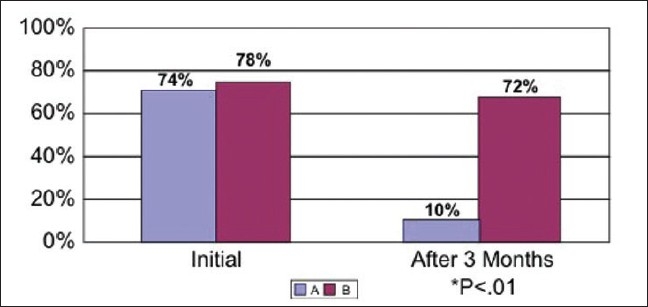
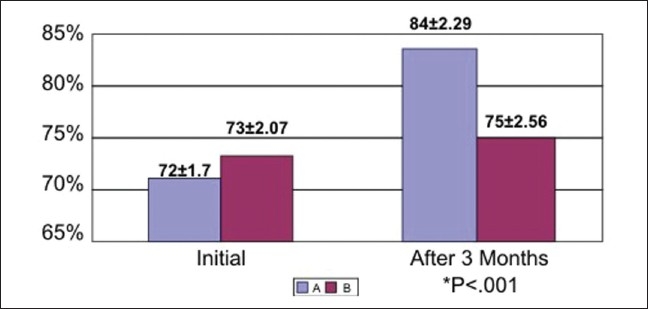
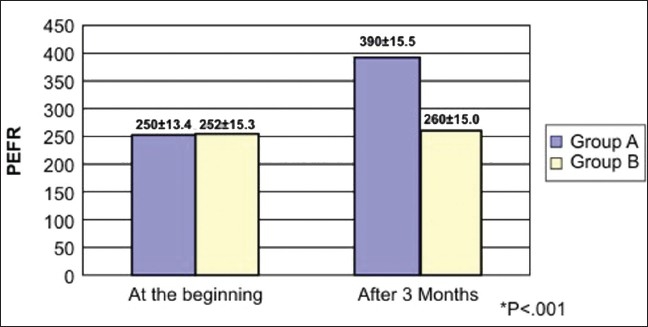
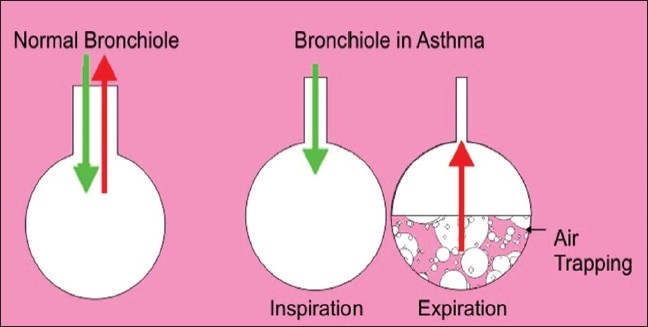
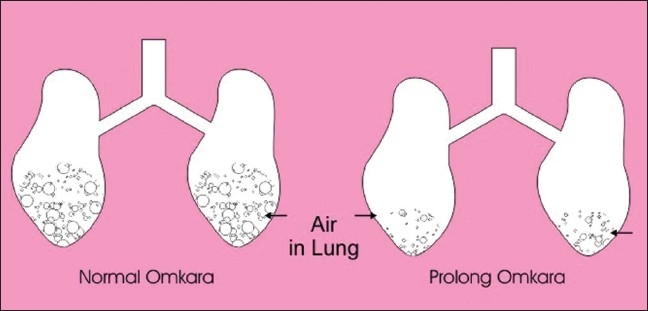
Materials and methods: Fifty cases of bronchial asthma (Forced Expiratory Volume in one second (FEV1) > 70%) were studied for 12 weeks. Patients were allocated to two groups: group A and group B (control group). Patients in group A were treated with breathing exercises (deep breathing,Brahmari, and Omkara, etc.) for 20 minutes twice daily for a period of 12 weeks. Patients were trained to perform Omkara at high pitch (forceful) with prolonged exhalation as compared to normal Omkara. Group B was treated with meditation for 20 minutes twice daily for a period of 12 weeks. Subjective assessment, FEV1%, and Peak Expiratory Flow Rate (PEFR) were done in each case initially and after 12 weeks.
Results: After 12 weeks, group A subjects had significant improvement in symptoms, FEV1, and PEFR as compared to group B subjects.
Conclusion: Breathing exercises (pranayama), mainly expiratory exercises, improved lung function subjectively and objectively and should be regular part of therapy.
Keywords: Bronchial asthma; FEV1; PEFR; expiratory breathing exercises.
Figures
References
-
- McFadden ER., Jr . Harrison’s principles of Internal medicine. In: Fauci SA, Braunwald E, Kasper DL, Hauser SL, longo DL, Jameson, editors. USA: McGraw Hill; 2005. p. 1511.
-
- Goyeche JR, Ikeniy A. The Yoga Perspective part II: Yoga therapy in treatment of asthma. J Asthma. 1982;19:189–201. - PubMed
-
- Vedanathan PK, Kesavalu LN, Murthy K, Durall K, Hall MJ, et al. Nagarathna, Clinical study of Yoga Techniques in university students with asthma: A control study. Allergy Asthma Proc. 1998;19:3–9. - PubMed
-
- Benson H, Rosener BA, Marzetta B, Klemechu KM. Decreased blood pressure in pharmacologically treated. Hypertensive patients who regularly elicited the relaxation response. Lancet. 1974;1:289–92. - PubMed
LinkOut - more resources
Full Text Sources